Best Deferred MBA Programs in 2026: Harvard 2+2, Yale, Stanford and More
- 1. Why Undergraduates Are Applying to MBA Programs Before Graduating
- 2. What Is a Deferred MBA Program?
- 3. The Best Deferred MBA Programs in 2026
- 4. Comparison Table: Deferred MBA Programs 2026
- 5. Who Should Apply to Deferred MBA Programs?
- 6. The Application Strategy: How to Stand Out as an Undergrad
- 7. Deferred MBA vs Waiting to Apply Normally: Which Is Better?
- 8. Common Mistakes Deferred MBA Applicants Make
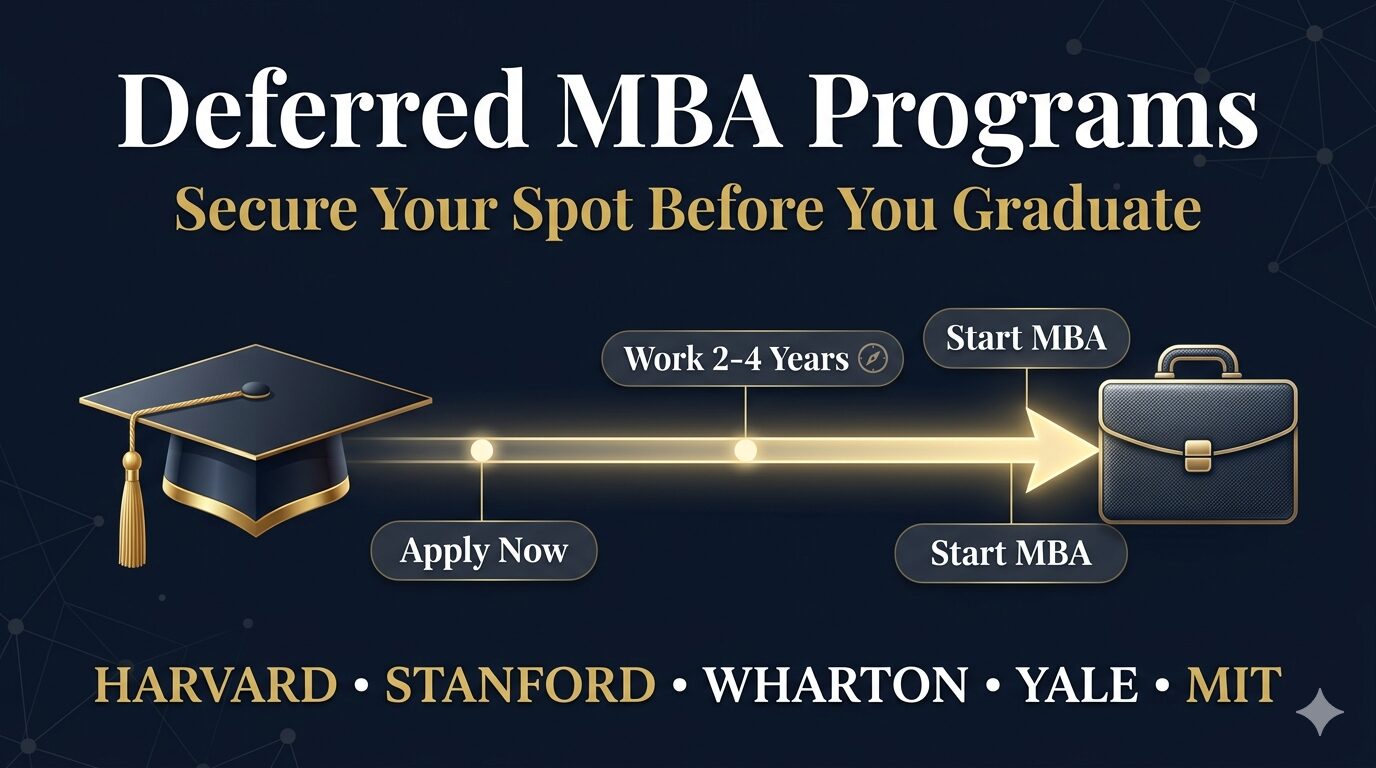
One of the biggest shifts in MBA admissions over the last few years has been the rise of deferred MBA programs. In 2026, more undergraduate students than ever are applying to elite business schools before they even start their full-time careers. The logic is simple: the traditional MBA admissions process has become brutally competitive. Deferred enrollment programs allow top undergraduates to secure admission now, work for a few years, and then return to campus later — giving students something increasingly rare in modern career planning: certainty.
Deferred MBA programs are not an easier path to elite business schools — they are often more competitive. Schools are making long-term bets on future potential, which raises the bar for every applicant.
1. Why Undergraduates Are Applying to MBA Programs Before Graduating
One of the biggest shifts in MBA admissions over the last few years has been the rise of deferred MBA programs. In 2026, more undergraduate students than ever are applying to elite business schools before they even start their full-time careers. The logic is simple: the traditional MBA admissions process has become brutally competitive. At schools like Harvard Business School and Stanford Graduate School of Business, acceptance rates remain painfully low even for applicants with strong resumes, elite employers, and top GMAT scores. For ambitious college students, locking in a future MBA seat early removes a huge layer of uncertainty.
Deferred enrollment programs allow top undergraduates to secure admission now, work for a few years, and then return to campus later. In practice, it gives students something increasingly rare in modern career planning: certainty. That certainty matters more in 2026 than it did a decade ago. The job market for graduates has become more volatile, especially in consulting, tech, and finance. Students are watching layoffs happen at major firms while AI reshapes entire industries. Many high-performing undergrads now want a long-term safety net before entering the workforce.
There is also a prestige factor. Deferred MBA programs have become a signal that you were identified early as a high-potential candidate. Being admitted into programs like Harvard 2+2 or Stanford Deferred Enrollment immediately separates you from most of your peer group. The result is that deferred MBA admissions are now attracting some of the most competitive college students in the world — especially candidates interested in consulting, Wall Street, startups, entrepreneurship, and technology leadership.
2. What Is a Deferred MBA Program?
A deferred MBA program allows undergraduate students or recent graduates to apply to business school before gaining traditional full-time work experience. Instead of starting the MBA immediately, admitted students defer enrollment for a required period — usually between two and five years — while they work professionally. After completing that work requirement, they return to campus and begin the MBA program.
Here is how the process usually works: you apply during your senior year of college or shortly after graduation; if admitted, your spot is reserved conditionally; you work full-time for several years; and then you return later to complete the MBA. Importantly, you do not pay tuition during the deferral period. You only begin paying once you officially start the MBA program.
The biggest advantage is obvious: you eliminate the uncertainty of future MBA admissions. Normally, professionals apply to MBA programs after several years of work experience, competing against thousands of applicants with impressive resumes from firms like Goldman Sachs, McKinsey & Company, or Google. Admissions outcomes can become unpredictable even for strong candidates. That said, these programs are not easier than traditional MBA admissions. In many cases, they are even more selective because schools are making long-term bets on your future potential rather than evaluating years of professional achievement.
3. The Best Deferred MBA Programs in 2026
Harvard Business School — 2+2 Program. Harvard Business School operates the most famous deferred MBA program in the world. Students apply during college or within one year of graduation, work for two to four years, and then return to Harvard for the MBA. The program remains extraordinarily competitive — estimated acceptance rates are around 6%, which is often lower than the already difficult standard HBS admissions rate. Harvard looks for more than academic excellence, focusing heavily on leadership, initiative, intellectual curiosity, and long-term impact potential. Harvard explicitly encourages applications from STEM and technical students, not just business majors.
Stanford GSB — Deferred Enrollment. Stanford Graduate School of Business may operate the single hardest deferred MBA program to enter. Stanford's deferred enrollment pathway is exceptionally selective because the school already has one of the lowest MBA acceptance rates in the world — estimates hover around 5% or even lower in some cycles. Unlike some programs that prioritize structured career progression, Stanford often favors applicants with unusual stories, entrepreneurial potential, or evidence of extraordinary impact. Stanford's strong connection to entrepreneurship and Silicon Valley makes it especially appealing for students interested in startups, AI, and venture capital.
Yale SOM — Silver Scholars Program. Yale School of Management offers one of the most unusual deferred MBA structures. Unlike traditional deferred programs, Silver Scholars allows students to begin the MBA immediately after undergrad. The structure works like this: Year 1 MBA coursework, Year 2 full-time internship or work experience, Year 3 final MBA coursework. The acceptance rate is estimated around 8%, making it highly competitive but slightly more accessible than Harvard or Stanford.
Wharton — Moelis Advance Access Program (M2A). The Wharton School launched the M2A program to compete directly with other elite deferred MBA offerings. Wharton remains especially dominant for students interested in investment banking, private equity, hedge funds, venture capital, and corporate finance. Many successful applicants have internship experience at firms like JPMorgan Chase, Morgan Stanley, or elite consulting firms. Estimated acceptance rates remain around 7%.
MIT Sloan — Deferred Enrollment. MIT Sloan School of Management operates one of the strongest deferred MBA programs for technical and analytical candidates, attracting a large percentage of applicants from engineering, computer science, mathematics, data science, artificial intelligence, and biotechnology. Candidates interested in AI, fintech, robotics, product management, and technical entrepreneurship often view Sloan as one of the best long-term MBA investments available. Estimated acceptance rates are near 8%.
Columbia Business School — Early Decision Program. Columbia's biggest advantage is obvious: New York City. For students targeting investment banking, private equity, asset management, or hedge funds, Columbia provides unmatched proximity to Wall Street recruiting and networking opportunities. Columbia's deferred-style admissions opportunities are generally slightly less selective than Harvard or Stanford, with estimated acceptance rates around 10%, though competition remains extremely intense.
4. Comparison Table: Deferred MBA Programs 2026
| Program | School | Work Exp Required | Deferral Period | Acceptance Rate |
|---|---|---|---|---|
| HBS 2+2 | Harvard | 2-4 years | 2-4 years | ~6% |
| GSB Deferred | Stanford | 1-5 years | 1-5 years | ~5% |
| Silver Scholars | Yale SOM | None (internship) | Immediate | ~8% |
| M2A Program | Wharton | 2-5 years | 2-5 years | ~7% |
| Deferred Enrollment | MIT Sloan | 2-5 years | 2-5 years | ~8% |
| Early Decision | Columbia | 2-4 years | 2-4 years | ~10% |
5. Who Should Apply to Deferred MBA Programs?
Deferred MBA programs are not designed for average applicants. Schools are making long-term bets on future leadership potential, which means expectations are extremely high even before you begin your career. The strongest candidates usually have a GPA above 3.7, strong quantitative coursework, elite internships, demonstrated leadership, and clear long-term ambition.
Leadership matters enormously. Admissions committees want evidence that you already influence people around you. That could mean founding a startup, leading a student organization, captaining a sports team, managing a nonprofit initiative, or conducting meaningful research. Students from Ivy League schools and other target universities naturally dominate the applicant pool, but elite schools absolutely admit exceptional candidates from non-target universities as well. Deferred MBA programs also work best for students who already know they want high-level business leadership exposure in the future — candidates interested in consulting, finance, entrepreneurship, product leadership, or executive management tend to benefit the most.
6. The Application Strategy: How to Stand Out as an Undergrad
The biggest challenge for deferred MBA applicants is simple: you have limited work experience. That means every other part of your profile becomes more important. First, timing matters — many strong applicants prepare during junior year rather than waiting until senior year. That gives you more time for GMAT or GRE preparation, leadership development, and internship recruiting.
Second, your "why MBA" must feel believable despite your age. Weak applicants write generic statements about "wanting leadership skills." Strong applicants connect their MBA goals directly to specific career ambitions and industry interests. Third, leadership is critical — schools care far more about initiative than titles alone. Starting something meaningful often matters more than joining prestigious organizations passively. Fourth, standardized test scores carry enormous weight for deferred applicants. Without years of work performance, admissions committees rely more heavily on quantitative indicators like GMAT and GRE scores.
Fifth, your essays need clarity. Schools want confidence that you understand where your career is heading, even if your plans evolve later. Finally, recommendations matter more than many students realize. Strong professors, research advisors, internship managers, or mentors can significantly strengthen your application if they can speak credibly about your leadership and intellectual potential.
7. Deferred MBA vs Waiting to Apply Normally: Which Is Better?
There is no universally correct answer here. For some students, deferred MBA programs are incredible opportunities. For others, traditional MBA timing remains the better choice.
| Factor | Apply Deferred (Now) | Apply Normally (3-5 Years) |
|---|---|---|
| Certainty | High — secured seat | None — reapply later |
| Acceptance Rate | Lower (~6%) | Slightly higher (~12%) |
| Work Experience | Limited | Stronger professional profile |
| Application Prep | Less time | More preparation time |
| Best For | High-achieving students with clear goals | Most professionals |
Deferred admission works best if you are already an unusually strong candidate with clear long-term ambition. Traditional MBA admissions may be smarter if you need more time to build leadership experience, improve your profile, or clarify your career direction. There is also a psychological factor — having a guaranteed MBA seat allows some students to take bigger career risks early because they know they already secured elite graduate school admission.
8. Common Mistakes Deferred MBA Applicants Make
The most common mistake applicants make is treating deferred MBA programs like "easier" MBA admissions. They are not. These programs attract some of the strongest undergraduates globally, including future consultants, bankers, engineers, founders, and researchers.
Another major mistake is weak career storytelling. Admissions committees do not expect perfect certainty, but they do expect direction. Generic goals like "becoming a business leader" usually fail. Applicants also underestimate interview preparation — schools like Harvard Business School and Stanford Graduate School of Business expect candidates to understand their programs deeply before interviews begin. Leadership gaps are another common weakness. Many applicants have excellent grades but very little evidence of initiative or influence outside academics. Finally, vague post-MBA plans hurt applicants significantly. Deferred MBA admissions are fundamentally about future potential. If your goals sound generic, schools struggle to envision your long-term trajectory.
- Deferred MBA programs allow undergraduates to secure elite MBA admission before full-time work experience
- Programs like Harvard 2+2 and Stanford Deferred are even more competitive than regular MBA admissions
- Strongest applicants combine elite academics with leadership, initiative, and clear career goals
- Especially valuable for students targeting consulting, finance, entrepreneurship, and tech leadership
- Applying deferred makes sense if you have strong direction and want to eliminate future admissions uncertainty