Harvard MBA Curriculum in 2026: Courses, Finance Training, and What Students Really Learn at HBS
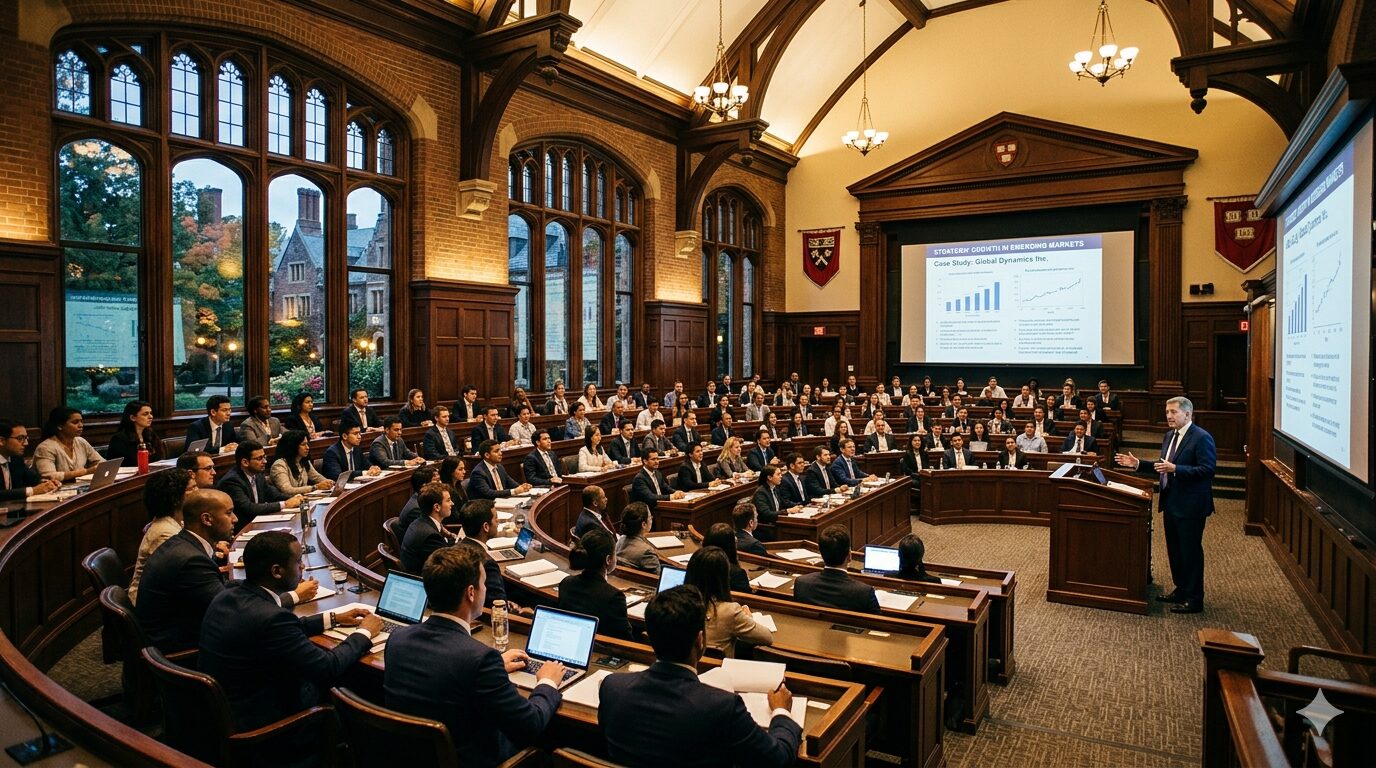
For decades, the MBA program at Harvard Business School has been considered one of the most prestigious business education experiences in the world. But many prospective students still ask the same question: what do students actually study inside the Harvard MBA program? The answer is far more interesting than most people expect. Unlike programs focused heavily on lectures and exams, HBS builds its MBA experience around real business decisions, leadership development, strategic thinking, and practical management training — and in 2026, the curriculum is evolving faster than at any point in its history.
Harvard does not just teach business — it trains executives to make high-stakes decisions under uncertainty. That distinction is why the HBS network remains the most powerful in the world 75 years after the program was founded.
1. How the Harvard MBA Is Structured
The Harvard MBA is a two-year, full-time, general management program divided into two distinct phases. The first year is a required, shared curriculum — every student in the class takes the same core courses together. The second year is almost entirely elective, allowing students to specialize deeply in finance, entrepreneurship, technology, or any other domain. This structure is intentional: Harvard believes that effective general managers need breadth before they earn the right to specialize. A first-year finance student sits next to a former military officer, a doctor, and a startup founder — and the diversity of perspectives in case discussions is itself part of the curriculum.
Students move through the first year in assigned groups called sections of approximately 90 students. The section becomes your primary community for the first year — you take every class together, study together, and develop the kind of intense professional relationships that define the HBS alumni network for decades afterward. The section model also means that participation and communication skills are developed under real social pressure, not in anonymous online forums.
2. First-Year Core Courses
The first-year required curriculum covers the full breadth of general management. For finance-focused students, the Finance I and Finance II courses are the most directly relevant, but the curriculum is designed so that every course contributes to a student's ability to evaluate and lead complex organizations.
| Course | Core Focus | Finance Relevance |
|---|---|---|
| Finance I & II | Corporate finance, valuation, capital allocation | Very High — direct IB/PE preparation |
| Financial Reporting & Control | Accounting, financial statements, GAAP | Very High — essential for all finance roles |
| Strategy | Competitive dynamics, market positioning | High — M&A and corporate strategy |
| Leadership & Org. Behavior | Team dynamics, executive decision-making | Medium — client and team management |
| Technology & Operations | Digital transformation, supply chains | Medium — fintech and operational finance |
| Marketing | Customer behavior, pricing, branding | Low-Medium — useful for corporate roles |
| Data Science & AI for Leaders | Machine learning, business analytics | High — quant finance and fintech |
| FIELD Immersion | Real-world project with global company | Medium — client interaction skills |
Finance I and Finance II together form the analytical backbone of the HBS experience for students targeting investment banking, private equity, or hedge funds. The courses cover corporate finance fundamentals, discounted cash flow valuation, capital structure decisions, and investment analysis. What distinguishes these courses from standard finance education is the case method delivery — students do not just learn to apply the DCF formula, they debate whether a specific CEO made the right capital allocation decision in a real transaction, with classmates who may have been the banker or consultant on the deal.
3. Harvard's AI and Data Science Push
One of the most significant curriculum shifts in recent years is the expansion of AI and data science education. The course Data Science and AI for Leaders, now a required first-year component, helps students understand machine learning applications, business analytics, AI-driven decision-making, and the strategic impact of artificial intelligence across industries. This is not a programming course — HBS does not train software engineers. It trains executives to ask the right questions of technical teams, evaluate AI-driven business models, and understand where machine learning creates genuine competitive advantage versus where it is organizational noise.
For finance students specifically, this matters enormously. Quantitative hedge funds, systematic trading firms, and the data science teams at major banks are hiring MBA graduates who can bridge the gap between finance domain expertise and algorithmic thinking. An HBS graduate who combines Finance I/II knowledge with a genuine understanding of machine learning applications is more valuable to these employers in 2026 than a pure quant or a pure finance MBA graduate.
4. The Case Method: How It Actually Works
The Harvard case method is one of the most discussed and least understood features of the HBS experience. Rather than traditional lectures, students analyze real business situations and discuss executive decisions, strategic mistakes, leadership challenges, and financial outcomes. During the MBA, students analyze approximately 400 to 500 business cases — real companies, real decisions, real consequences. Each case is typically 15-25 pages of primary source material: financial statements, board memos, market data, and management interviews.
Class participation is not optional — it is graded and typically represents 50% of the course grade. The professor cold-calls students to open a case discussion, and that student must analyze the situation and make a clear recommendation in front of 90 peers. This creates an environment where communication, intellectual confidence, and the ability to synthesize complex information quickly become survival skills rather than optional soft skills. For students targeting client-facing finance careers — investment banking, PE, consulting — this is arguably the most valuable preparation the MBA provides that cannot be replicated through technical training alone.
5. Second-Year Electives and Specializations
During the second year, students choose from more than 100 elective courses and independent projects. The flexibility is significant — a student focused on private equity can spend their entire second year on PE-specific courses, deal analysis projects, and independent research with a faculty member. Popular finance-related electives include courses in leveraged buyouts, venture capital and private equity, real estate investment, securities analysis, and financial crises. The Entrepreneurial Finance course is consistently one of the most popular in the school, reflecting the overlap between HBS's finance strength and its entrepreneurial culture.
Harvard also offers joint degree programs combining the MBA with law (JD/MBA), public policy (MPP/MBA), and engineering (MS/MBA). The MS/MBA program run jointly with the Harvard John A. Paulson School of Engineering is particularly relevant for students targeting fintech, quantitative finance, or technology-focused investment roles where deep technical credentials complement the business training.
6. Is the Harvard MBA Worth It in 2026?
The Harvard MBA remains one of the most powerful business credentials in the world — but its value is not uniform across career paths. For students targeting investment banking, consulting, or entrepreneurship, the HBS brand and alumni network provide advantages that are difficult to quantify but consistently visible in recruiting outcomes. Major investment banks, strategy consulting firms, and venture capital funds actively recruit at HBS and treat HBS graduates as a pre-screened, high-quality talent pool. That institutional relationship — built over decades — is not easily replicated by any other program.
The honest caveat: at $76,000 per year in tuition plus living expenses, the Harvard MBA costs over $230,000 in direct expenses, plus two years of foregone income. The NPV calculation is positive for most HBS graduates — median post-MBA compensation exceeds $175,000 in base salary alone — but it requires a career trajectory that actually captures the premium the degree commands. Students who use Harvard to pivot into high-compensation finance roles recover the investment within 3-5 years. Students who use it to enter non-profit or government roles may find the ROI considerably more modest.