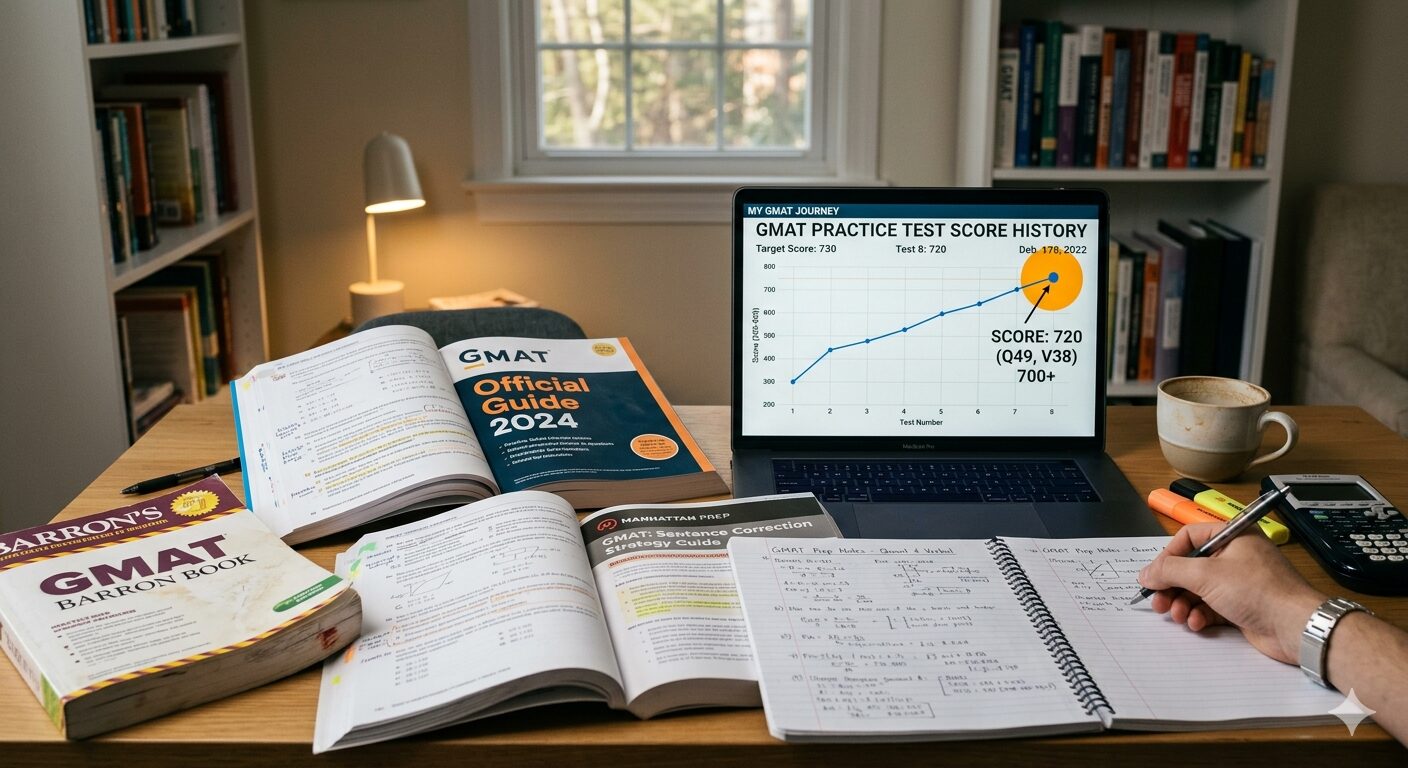
GMAT Study Plan: How to Score 700+ in 3 Months
A 700+ GMAT score is the threshold that puts you in serious contention at every M7 program. The median at Wharton is 733. At Chicago Booth it is 730. At Harvard Business School it is 740. Getting above 700 does not guarantee admission — but scoring below it at a top finance program almost always requires an extraordinary compensating factor. The good news: 700 is achievable in 3 months for most working professionals, with the right structure and the right resources.
The GMAT rewards consistent, structured practice over cramming. Students who study 10 hours per week for 12 weeks consistently outperform students who study 30 hours per week for 3 weeks.
1. What the GMAT Actually Tests
The GMAT Focus Edition (current since 2023) has three sections: Quantitative Reasoning, Verbal Reasoning, and Data Insights. Total score ranges from 205 to 805. Understanding what each section actually measures is the first step to studying efficiently — many candidates waste weeks on things the GMAT does not heavily weight.
Quantitative Reasoning tests problem-solving with algebra, arithmetic, and geometry at roughly a high-school level. The questions reward efficient reasoning, not computation speed. Students who try to brute-force every problem run out of time. Data Insights combines data sufficiency questions (a format unique to the GMAT) with multi-source reasoning and table analysis — it rewards logical thinking more than mathematical ability. Verbal Reasoning tests critical reasoning, reading comprehension, and sentence correction.
2. Score Targets by School
| School | Median GMAT (2025) | 80% Range | Finance Strength |
|---|---|---|---|
| Harvard Business School | 740 | 700–770 | Very strong |
| Wharton (UPenn) | 733 | 700–760 | Top finance MBA |
| Chicago Booth | 730 | 700–760 | Top quant/finance |
| MIT Sloan | 730 | 700–760 | Strong (fintech) |
| Columbia Business School | 729 | 700–760 | Top (NYC finance) |
| Stanford GSB | 738 | 700–770 | Strong (VC + PE) |
| Kellogg (Northwestern) | 727 | 690–760 | Strong |
| London Business School | 708 | 660–740 | Strong (Europe) |
| INSEAD | 703 | 650–740 | International |
Target a score at or above the median of your target schools. For M7 programs, 720+ is a strong score; 700–719 is competitive with other strong application elements. Every unnecessary retake slightly dilutes the result — admissions committees see your full score history. Plan to take the test once.
3. The 3-Month Study Plan
This plan assumes 8–12 hours of study per week — realistic for most working professionals. If you have more time, compress to 8 weeks. If less, extend to 16 weeks without changing the structure.
| Week | Focus | Key Activities | Hrs/Week |
|---|---|---|---|
| Week 1 | Diagnostic | Full official practice test. Identify weak sections. | 10 |
| Week 2–3 | Quant Foundations | Algebra, arithmetic, number properties. 50 OG problems/day. | 10 |
| Week 4–5 | Data Insights | Data sufficiency logic. Multi-source reasoning. Table analysis. | 10 |
| Week 6–7 | Verbal Foundations | CR argument structure. RC strategy. SC grammar rules. | 10 |
| Week 8–9 | Mixed Practice | Timed section drills. Error log review. Find persistent gaps. | 10 |
| Week 10–11 | Full Simulations | 2 full official practice tests. Review every wrong answer. | 12 |
| Week 12 | Final Prep | Light review, rest, logistics. Test day. | 6 |
The error log is non-negotiable. Every incorrect answer gets logged with: question type, why you got it wrong (concept gap, careless error, or time pressure), and the correct approach. Reviewing it weekly is how you stop repeating mistakes. Candidates who skip the error log plateau around 650 and cannot understand why their score does not improve.
4. Quant Strategy: Stop Losing Points
The Quant section is where most candidates lose the most recoverable points. The content is high-school level; the difficulty is in time pressure and problem construction. The two most common failure patterns are: trying to calculate what should be estimated, and missing what a data sufficiency question is actually asking.
Data sufficiency questions always use the same five answer choices about whether Statement 1, Statement 2, or both are sufficient. This format is unique to the GMAT and requires a specific mental framework. Practice data sufficiency exclusively for at least 5 days before mixing it with other types — the reasoning pattern is different enough that mixing them early creates confusion.
Number properties — divisibility, primes, factors, and remainders — appear in 20–25% of Quant questions. One focused week on number properties typically yields a larger score improvement than any other single Quant topic. Start there if you are below 650 in Quant.
5. Verbal Strategy: CR, RC, and SC
Critical Reasoning questions test argument analysis: identifying assumptions, strengthening or weakening conclusions, and spotting logical flaws. The most common mistake is choosing answers based on what sounds reasonable in the real world rather than what the argument strictly supports. The GMAT is a closed world — external knowledge is irrelevant and sometimes actively misleading. Evaluate only the evidence presented in the stimulus.
Reading Comprehension rewards active reading. Before answering questions, identify the main point of each paragraph and the passage's overall purpose in one sentence. RC errors almost always come from misremembering what the passage said versus what you assumed. The correct RC answer is always supported by specific language in the passage — if you cannot point to the supporting sentence, the answer is wrong regardless of how reasonable it seems.
Sentence Correction tests a finite set of grammar rules: subject-verb agreement, pronoun reference, parallel construction, modifier placement, and verb tense. Learning these 6 rule categories and recognizing them on sight eliminates 70–80% of SC errors. Answering SC by "ear" — choosing what sounds right — is unreliable. Identify the error, eliminate choices that do not fix it, and check for secondary errors among what remains.
6. Resources and Final Week
Official GMAT materials from GMAC are the only resources that exactly replicate the real test. Always prioritize official materials for timed practice.
- Official GMAT Focus Practice Exams 1–6 (mba.com) — take at least 3 in full test conditions
- GMAT Official Guide 2024–2025 — primary question bank for content practice
- Manhattan Prep GMAT Focus — best third-party resource for Quant strategy
- Magoosh GMAT — good for on-the-go video explanations and mobile practice
- GMAT Club forums — free community explanations for virtually every released question
In the final week: stop new practice problems after day 3. Rest, review your error log one final time, and confirm test day logistics. Arriving tired costs more points than any last-minute studying can recover. The GMAT rewards a clear, rested mind more than a well-prepared exhausted one.