MBA
MBA ProgramsBest MBA Programs for Investment Banking in 2026
Which business schools actually get you into Goldman Sachs, JPMorgan, and Evercore — ranked by real recruiting outcomes.
Every article is researched and written with academic rigor and industry experience to sharpen your decision-making.
Real-time performance of key indices, commodities, and asset classes relevant to finance professionals.
📥 Free: Wall Street Recruiting Checklist
20 steps to break into investment banking — download instantly
Our aggregator pulls headlines from leading financial media with full copyright respect: we only show public RSS feed excerpts with a direct link to the original source.
See Financial NewsIn-depth analysis of curricula, costs, alumni networks, and return on investment for each program.
Which business schools actually get you into Goldman Sachs, JPMorgan, and Evercore — ranked by real recruiting outcomes.
An honest head-to-head comparison of the two most prestigious finance MBA programs — curriculum, network, and placement.
A frank ROI analysis: tuition costs, salary uplifts, payback periods, and when the MBA makes no financial sense.
Cost, time, career outcomes, and which one actually opens the doors you need — a practical framework for your decision.
Essays, recommendations, leadership stories, and the application mistakes that eliminate strong candidates every cycle.
The complete guide for serious candidates: which programs open doors to Goldman Sachs, PE firms, and top hedge funds.
First-year core courses, the case method, AI integration, second-year electives, and whether HBS is worth the investment.
Core curriculum, finance specialization, Wall Street recruiting dominance, and whether Wharton is worth it in 2026.
Whether an MBA is worth $200k+ in 2026 when AI is automating finance tasks — honest analysis with ROI data for top programs.
A direct comparison of MBA vs Master in Finance in 2026 — cost, duration, recruiting access, ROI, and which degree fits your goals.
An honest breakdown of MBA admissions consulting in 2026 — who benefits, real costs, and whether you need it for Harvard or Wharton.
A complete guide to deferred MBA programs in 2026 — Harvard 2+2, Stanford GSB, Yale Silver Scholars, Wharton M2A, MIT Sloan, and Columbia.
Career paths, updated salaries, and strategies to maximize your professional trajectory in finance.
The timeline, the networking playbook, the superday format, and what banks actually evaluate beyond your GPA.
How PE firms actually recruit, what the work looks like day-to-day, and the compensation structure most candidates misunderstand.
Strategies, hiring paths, what analysts do all day, and why compensation is both higher and more volatile than banking.
Day-to-day differences, salary comparison, work-life balance, and which exit opportunities each career actually creates.
Where to intern, how to get selected, and why your summer analyst program is the most important recruiting step of your career.
What VC firms do, how they recruit, what they pay, and the path into the industry for MBA graduates and operators.
Banking, PE, VC, consulting, corporate finance — what each career actually involves and which fits your personality.
What M&A bankers do, how deals work, the skills that matter most, and where bankers go after 3 years in the industry.
An honest analysis of consulting layoffs, what McKinsey, BCG and Bain are actually hiring, and whether consulting is still worth pursuing after your MBA.
Educational technical content on valuation, financial modeling, and portfolio management to establish content authority.
The three-statement model, DCF, LBO, and comparable companies — what you must master before your first finance interview.
Real compensation data for IB analysts, PE associates, hedge fund PMs, and consultants — base, bonus, and total comp.
The formatting rules, bullet-point structure, and technical skills section that get resumes past finance recruiter screens.
Research analyst to PM — how long it takes, what firms value, compensation at each level, and the skills that advance careers.
What M&A bankers do, how deals work, the skills that matter most, and where bankers go after 3 years in the industry.
Strategies, hiring paths, what analysts do all day, and why compensation is both higher and more volatile than banking.
From GMAT to statement of purpose: everything you need to build a competitive MBA application.
Essays, recommendations, leadership stories, and the application mistakes that eliminate strong candidates every cycle.
The formatting rules, bullet-point structure, and technical skills section that get resumes past finance recruiter screens.
A frank ROI analysis: tuition costs, salary uplifts, payback periods, and when the MBA makes no financial sense.
Where to intern, how to get selected, and why your summer analyst program is the most important recruiting step of your career.
An honest head-to-head comparison of the two most prestigious finance MBA programs — curriculum, network, and placement.
Which business schools actually get you into Goldman Sachs, JPMorgan, and Evercore — ranked by real recruiting outcomes.
Week-by-week plan, score targets by school, Quant and Verbal strategy, and the best resources for working professionals.
Curated headlines from the world's leading financial sources
Click "Refresh Feeds" to load the latest financial headlines
Real-time charts and market data — equities, fixed income, forex, and commodities. Powered by TradingView.
An editorial project created by finance professionals with real experience in investment banking and executive education.
MBA Finance Guide was born from a real need: finance professionals aspiring to an MBA face a serious information barrier. The most comprehensive resources are often scattered, generic, or fail to bridge academic theory with the realities of the job market — especially for candidates targeting Wall Street and global financial hubs.
Our team has spent over a decade in the trenches of investment banking, private equity, and high-level financial consulting. We have gone through the MBA admissions process ourselves, worked at funds in New York and London, and now dedicate part of our time to passing on that knowledge with rigor and honesty.
We typically respond within 48 business hours. For personalized consulting inquiries, please mention it in your message.
Your information will never be shared with third parties.
We offer 1:1 consulting sessions of 60 minutes to review your profile, define your program shortlist, and design your application strategy.
Request a Session →MBA Finance Guide operates the website accessible at mbafinanceguide.com. For privacy-related inquiries, please contact us at: mbafinanceguide@outlook.com.
Data processing is based on: (a) the user's consent when completing the contact form; (b) legitimate interest for anonymous statistical traffic analysis. For California residents, we comply with the California Consumer Privacy Act (CCPA).
You have the right to access, correct, delete, object to processing, and request portability or restriction of your personal data. To exercise these rights, please email mbafinanceguide@outlook.com.
This site uses Google AdSense to display advertising. Google may use cookies to show ads based on your prior visits to this or other websites. Users can opt out of personalized advertising by visiting Google Ad Settings.
Contact form data is retained for a maximum of 2 years from the last contact. Anonymized analytics data is retained for 26 months.
This website, accessible at mbafinanceguide.com, is owned and operated by the editorial team of MBA Finance Guide. Contact email: mbafinanceguide@outlook.com.
MBA Finance Guide is an editorial information and education portal covering Finance MBA programs, finance careers, and related topics. All content is strictly informational and educational in nature and does not constitute personalized financial, investment, legal, or academic advice.
All original texts, graphics, logos, images, and other content published on this site are the property of MBA Finance Guide or its authors and contributors, protected under applicable intellectual property law. Reproduction, distribution, or public communication without express written authorization is strictly prohibited.
MBA Finance Guide does not guarantee the accuracy, completeness, or timeliness of the information published. Salary data, rankings, and statistics are estimates based on public sources and may not reflect current market conditions. Users assume responsibility for how they use the information provided.
This site is monetized through Google AdSense. Advertisers are selected automatically by Google, and MBA Finance Guide does not endorse or take responsibility for any products or services advertised.
This legal notice is governed by the laws of the United States. Any disputes arising from the use of this website shall be resolved in the competent courts of the applicable jurisdiction.

Investment banking remains one of the most competitive industries in the world, and in 2026, elite MBA programs still play a massive role in recruiting.
While many students believe technical skills alone are enough, the reality is more complicated. Top investment banks continue to recruit heavily from a small group of business schools with strong alumni networks and direct recruiting pipelines.
For ambitious professionals targeting firms like Goldman Sachs, Morgan Stanley, JPMorgan, or Evercore, choosing the right MBA can significantly impact salary potential, networking access, and long-term career growth.
Wharton remains one of the strongest MBA brands for finance careers.
The school has deep relationships with:
Many students pursuing M&A, valuation, or private equity recruiting prioritize Wharton because of its finance-heavy culture and powerful alumni network.
Harvard Business School continues to dominate because of its global prestige and leadership reputation.
While Wharton may be viewed as more finance-focused, Harvard consistently places graduates into:
The HBS network remains one of the most influential professional communities in the world.
Stanford has become especially attractive for students interested in:
Its close connection to Silicon Valley gives students access to some of the most powerful companies and investors in modern finance.
One reason MBA programs remain attractive is compensation.
MBA associates at top investment banks often earn:
However, students should also understand the demanding nature of the industry.
Long hours, high pressure, and intense competition remain common in investment banking.
For many professionals, the answer is yes.
A top MBA can dramatically improve:
But not all MBA programs provide the same ROI.
Students should carefully evaluate:

Among finance students, few MBA debates are more popular than Harvard versus Wharton.
Both schools are considered elite.
Both place graduates into Wall Street.
Both attract ambitious professionals from around the world.
But despite their similarities, the two programs offer very different experiences.
Wharton has long been viewed as the strongest MBA program for finance.
Its curriculum and recruiting ecosystem are heavily connected to:
Students interested in valuation, financial modeling, and M&A often feel naturally drawn toward Wharton.
The school’s analytical culture also appeals to candidates who enjoy technical finance.
Harvard Business School approaches business education differently.
The famous case-method system focuses heavily on:
That broader approach helps Harvard graduates move into:
The global recognition of the Harvard brand also creates opportunities outside traditional finance.
Wharton generally has a stronger concentration of students pursuing investment banking careers.
Major Wall Street firms actively recruit there for:
Harvard also places graduates into top banks, but many students diversify into multiple industries after graduation.
Students who want a deeply finance-focused MBA experience often prefer Wharton.
Students looking for broader leadership positioning and global prestige may prefer Harvard.
Ultimately, both schools remain among the most powerful MBA brands in the world.

Investment banking recruiting feels confusing from the outside.
Some students receive interviews at elite banks surprisingly early.
Others apply online repeatedly without success.
The reason is simple:
recruiting in investment banking is heavily relationship-driven.
Understanding how the process actually works can dramatically improve a student’s chances of landing interviews.
Top investment banks offer:
That naturally attracts enormous competition.
Banks receive applications from:
Standing out requires much more than strong grades.
Networking remains one of the most important parts of investment banking recruiting.
Students who build relationships with:
often gain major advantages during recruiting cycles.
Many successful candidates spend months preparing before applications even open.
Investment banking interviews frequently test:
Students who ignore technical preparation often struggle during superday interviews.
The most successful candidates usually combine:
Summer analyst internships often function as extended interviews.
Many banks hire full-time analysts directly from their intern classes.
That makes internships one of the most important stages of investment banking recruiting.
Breaking into investment banking is difficult.
But students who understand:
immediately place themselves in a stronger position.

The MBA remains one of the most debated graduate degrees in the world.
Some professionals see it as a life-changing investment.
Others believe business school has become too expensive.
The truth depends heavily on:
Not all MBA programs deliver the same career outcomes.
Top-tier business schools often provide:
Lower-ranked programs may not generate the same opportunities.
That’s why MBA ROI can vary dramatically between schools.
Graduates entering industries like:
can see major increases in compensation.
Many MBA graduates receive:
However, career outcomes still depend heavily on individual execution.
Beyond salary, top MBA programs provide:
Many graduates later describe the alumni network as one of the most valuable parts of the MBA experience.
An MBA can absolutely transform a career.
But students should approach business school strategically rather than emotionally.
The strongest outcomes usually come from:

Technical finance skills matter more than ever in modern recruiting.
Students pursuing careers in:
are increasingly expected to understand financial modeling before graduation.
That’s why students who develop strong modeling skills early often gain a major advantage during recruiting.
Financial modeling involves building spreadsheets that represent a company’s financial performance.
Professionals use these models to:
Excel remains one of the most important tools in the finance industry.
This model connects:
It forms the foundation for advanced financial analysis.
DCF analysis estimates a company’s intrinsic value based on future cash flows.
This remains one of the most common valuation methods in investment banking.
This method compares companies using valuation multiples such as:
Comparable analysis is widely used across finance careers.
LBO models analyze acquisitions funded heavily with debt.
Students interested in private equity eventually need to understand these concepts.
Finance professionals spend huge amounts of time working inside spreadsheets.
Students who improve:
often become much more competitive during interviews.
Financial modeling remains one of the most valuable technical skills in finance.
Students who combine:
position themselves much more effectively for competitive finance careers in 2026.

Few finance careers attract as much attention as private equity.
For many students, the industry represents:
Private equity firms acquire companies, improve operations, and eventually sell those businesses for profit.
But despite the excitement surrounding the industry, many students still misunderstand how private equity recruiting actually works.
Breaking into private equity is extremely competitive.
And unlike investment banking, there is rarely a simple application process.
Private equity firms raise capital from institutional investors and wealthy clients.
They then use that capital to:
Some firms focus on:
The industry can become highly analytical and financially demanding.
Most private equity professionals begin their careers in investment banking.
That’s because banking analysts develop critical skills in:
Many elite private equity firms recruit directly from top investment banking analyst programs.
This is one reason investment banking is often viewed as a gateway into private equity.
Private equity firms typically value:
Candidates are often expected to understand:
Communication skills also matter significantly because professionals regularly interact with executives and investors.
Private equity compensation can become extremely high.
Professionals often receive:
However, compensation varies significantly depending on:
The industry also remains highly demanding and competitive.
Private equity continues to attract ambitious finance professionals because of its:
But students should understand that entering the industry usually requires years of preparation, technical development, and strong networking.

Hedge funds have always carried a certain level of mystery.
Students often hear stories about:
But very few people truly understand what hedge funds actually do.
And even fewer understand how difficult the industry can be to enter.
In reality, hedge funds operate very differently from investment banks or private equity firms.
Success depends heavily on:
Hedge funds manage capital for institutional investors and wealthy individuals.
Their goal is simple:
produce strong investment returns.
Funds may invest in:
Some hedge funds focus on long-term investing.
Others specialize in short-term trading.
Hedge funds often hire smaller teams than investment banks.
That means recruiting can become extremely selective.
Many professionals entering hedge funds come from:
Strong analytical skills are essential.
Hedge funds care heavily about:
Candidates are often expected to:
The ability to think differently from the market can become incredibly valuable.
Compensation in hedge funds can become extremely high.
Top-performing portfolio managers sometimes earn millions annually.
However, compensation is often heavily tied to performance.
That means income volatility can become much higher than in traditional corporate careers.
Hedge funds remain one of the most intellectually demanding areas of finance.
Students interested in the industry should focus on:
The industry rewards performance above almost everything else.

Among ambitious business students, one debate appears constantly:
consulting versus investment banking.
Both careers offer:
But the day-to-day experience inside each industry is very different.
Understanding those differences is critical before committing years of preparation to either path.
Investment bankers primarily work on:
The job is highly financial and analytical.
Bankers spend enormous amounts of time:
The workload can become extremely intense.
Consultants help companies solve strategic and operational problems.
Projects may involve:
Consulting generally involves:
The work tends to be broader and less financially technical than investment banking.
Both industries offer strong compensation.
Investment banking often pays slightly more at the entry level because of:
Consulting compensation remains highly competitive, especially at firms like:
Neither industry is known for perfect work-life balance.
However, investment banking generally involves:
Consulting may involve more travel but often provides slightly more predictable working conditions.
Both careers create strong exit opportunities.
Investment bankers often move into:
Consultants frequently transition into:
Neither consulting nor investment banking is universally better.
The right choice depends heavily on:
Students who enjoy financial analysis may prefer banking.
Students who enjoy broader business strategy may prefer consulting.

Finance professionals often compare two major career credentials:
Both can significantly improve career opportunities.
But they serve very different purposes.
Understanding the difference between these paths is critical for students and professionals planning long-term finance careers.
The Chartered Financial Analyst (CFA) program focuses heavily on:
The curriculum is highly technical.
Many professionals pursue the CFA while working full-time.
The exams are also known for being extremely difficult.
MBA programs provide broader business education.
Students typically study:
Top MBA programs also provide:
For investment banking recruiting, top MBA programs generally provide stronger recruiting access.
Banks recruit heavily from elite MBA programs.
The CFA is respected in banking but is usually more associated with:
The CFA often carries stronger relevance in:
Many hedge funds and asset managers highly respect the designation.
Both credentials can improve compensation.
However, salary growth depends heavily on:
No credential automatically guarantees high income.
The CFA and MBA are not direct substitutes.
They solve different career problems.
Students focused on:
may prefer the CFA.
Professionals seeking:
may benefit more from an MBA.

Finance internships have become one of the most important factors in recruiting.
For students pursuing careers in:
internships can dramatically improve long-term career opportunities.
In many cases, internships function as direct pipelines into full-time jobs.
Employers increasingly expect students to graduate with relevant experience.
Internships help students:
Strong internships also help students perform better during interviews.
Investment banking internships remain some of the most competitive opportunities available to students.
Interns often work on:
Many banks hire full-time analysts directly from their summer intern classes.
Private equity and venture capital internships expose students to:
These internships are often smaller and more difficult to secure than banking roles.
Corporate finance internships can also provide valuable experience.
Students may work on:
These roles help students develop strong financial fundamentals.
Students should focus on:
LinkedIn outreach and alumni conversations can become extremely valuable during recruiting.
Strong internships can completely change a student’s career trajectory.
Students who combine:
often place themselves in a much stronger position for competitive finance careers.

Venture capital has become one of the most attractive careers in modern finance.
The industry sits at the center of:
Many students are drawn to venture capital because of the excitement surrounding startup investing.
But the reality of the industry is often very different from what people imagine online.
Venture capital is highly relationship-driven, extremely competitive, and deeply connected to networking.
Understanding how the industry actually works is essential for anyone hoping to enter the field.
Venture capital firms invest in early-stage and high-growth companies.
Their goal is to identify startups with strong long-term growth potential before those businesses become massive.
VC firms typically provide:
In exchange, they receive ownership stakes in those companies.
If the startup grows successfully, the investment can generate enormous returns.
One major reason venture capital is difficult to enter is the limited number of roles available.
Compared to investment banks or consulting firms, VC firms often operate with very small teams.
Recruiting is also less structured.
Many opportunities come through:
Venture capital firms typically look for candidates who understand:
Strong communication skills matter enormously because venture capital professionals spend significant time:
Analytical ability also remains important, especially when evaluating business models and growth potential.
Compensation in venture capital varies significantly.
Junior professionals may earn less than investment bankers initially.
However, long-term upside can become substantial if investments perform well.
Senior venture capital professionals may benefit from:
Venture capital remains one of the most exciting areas of finance in 2026.
But students should understand that entering the industry requires:
The people who succeed in venture capital often combine analytical thinking with genuine curiosity about innovation.

Few industries generate as much salary curiosity as Wall Street.
Students constantly search for information about:
And while finance compensation can become extremely high, the reality is more complex than many people expect.
Compensation depends heavily on:
Investment banking remains one of the highest-paying entry-level career paths.
Analysts at major banks often receive:
As professionals move into associate and vice president roles, compensation can rise significantly.
However, investment banking also involves:
Private equity professionals frequently earn higher long-term compensation than investment bankers.
In addition to salaries and bonuses, many professionals eventually receive:
At senior levels, compensation can become extremely large.
Hedge fund compensation is heavily performance-driven.
Top-performing portfolio managers can earn enormous amounts during strong market years.
However, compensation volatility also tends to be much higher compared to traditional corporate careers.
Top consulting firms like:
continue offering highly competitive salaries.
MBA graduates entering consulting frequently receive:
Finance compensation often reflects:
The industry rewards professionals who can consistently create financial value.
Finance careers can provide extraordinary earning potential.
But students should evaluate careers based on more than salary alone.
Long-term success also depends on:

In competitive industries like:
small resume mistakes can immediately hurt recruiting chances.
That’s because recruiters often review resumes incredibly quickly.
Students usually have only a few seconds to create a strong first impression.
A well-structured finance resume can dramatically improve interview opportunities.
Finance recruiting follows very specific formatting expectations.
Recruiters generally prefer resumes that are:
Messy formatting can signal poor attention to detail.
That becomes especially problematic in finance careers where precision matters.
Students should clearly list:
Strong GPAs remain valuable in competitive recruiting.
This section carries enormous weight.
Students should focus on:
Strong action verbs improve readability and professionalism.
Finance recruiters often look for skills related to:
Students with technical finance experience often stand out more quickly.
Students frequently damage their resumes by:
Recruiters prefer resumes that communicate impact clearly and efficiently.
Even strong resumes rarely succeed without networking.
Building relationships with:
can dramatically improve recruiting outcomes.
A strong finance resume combines:
Students who invest time improving resume quality often improve their interview opportunities significantly.

Finance offers some of the highest-paying and most competitive careers available to college graduates.
But many students struggle to understand the differences between major finance paths.
Some careers focus heavily on:
Others focus more on:
Understanding these differences early can help students make smarter long-term career decisions.
Investment banking remains one of the most prestigious finance careers.
Bankers work on:
The compensation can become extremely high, but the workload is also notoriously demanding.
Private equity professionals acquire companies and work to improve business performance.
The industry attracts many former investment bankers because of:
Hedge funds focus heavily on investing and market performance.
Professionals analyze:
Strong analytical ability is critical in this industry.
Venture capital focuses on startup investing and innovation.
Professionals work closely with founders and emerging companies.
The industry appeals strongly to people interested in:
Corporate finance roles exist inside major companies.
Professionals may work on:
These careers often provide more predictable lifestyles than Wall Street roles.
The best finance career depends heavily on:
Students should spend time learning how each industry actually operates before committing to a career path.

Applying to top MBA programs has become increasingly competitive.
Elite business schools receive applications from:
Strong applicants usually offer much more than impressive test scores.
Admissions teams look for:
Most elite MBA programs prefer candidates with meaningful professional experience.
Admissions teams want students who can contribute real-world insights inside the classroom.
Strong work experience often demonstrates:
Top MBA applicants usually explain:
Clear career direction makes applications significantly more compelling.
MBA admissions teams value leadership heavily.
Leadership can appear through:
Schools want students who can positively influence classmates and future organizations.
MBA essays often determine whether applicants feel memorable.
Strong essays usually sound:
Admissions officers read thousands of applications every year.
Generic essays rarely stand out.
Applicants should spend time researching:
Speaking with current students and alumni can provide valuable insight.
Successful MBA applications combine:
In highly competitive admissions environments, authenticity and preparation often matter more than applicants realize.

Few finance careers combine:
quite like mergers and acquisitions.
M&A banking sits at the center of some of the largest financial transactions in the world.
Professionals in this field advise companies on:
For MBA graduates and finance professionals, M&A remains one of the most prestigious and financially rewarding career paths on Wall Street.
But despite the compensation and prestige, the industry is also known for:
M&A bankers advise corporate executives and boards during major transactions.
Their responsibilities often include:
Bankers may work on:
The work combines both technical finance and high-level business strategy.
M&A recruiting is heavily concentrated among:
Bulge bracket firms typically offer:
Elite boutiques often focus more purely on advisory work and may provide:
Many finance professionals strongly prefer boutique M&A because of the intense advisory exposure.
Technical finance skills remain essential in mergers and acquisitions.
Professionals are expected to understand:
However, technical ability alone is rarely enough.
Top M&A professionals also develop:
The best bankers understand not only whether a deal works financially, but whether it makes strategic sense.
M&A compensation remains among the highest in finance.
Associates and vice presidents at top firms often receive:
However, compensation reflects the demanding nature of the work.
Long hours and unpredictable schedules remain extremely common.
M&A experience creates strong long-term career flexibility.
Professionals often transition into:
The transaction experience gained in M&A banking remains highly respected across finance.
Mergers and acquisitions continues to attract ambitious professionals because of its:
Students interested in M&A should focus heavily on:

Asset management remains one of the most intellectually demanding careers in finance.
Unlike investment banking, which focuses heavily on transactions, asset management revolves around:
Professionals in this industry manage money on behalf of:
For MBA graduates interested in investing rather than deal execution, asset management can become an incredibly rewarding long-term career path.
Asset managers analyze investment opportunities and allocate capital across:
Their primary objective is to generate strong long-term returns while managing risk.
Professionals may work in:
The industry rewards patience, discipline, and analytical thinking.
One of the biggest shifts in modern asset management is the growth of passive investing.
Passive investing focuses on:
Active management involves professionals attempting to outperform market benchmarks through:
Career experiences can differ significantly between these two models.
Strong investment professionals usually develop expertise in:
Communication skills also matter because investment ideas must often be defended clearly to:
Many successful professionals spend years refining their investment philosophy.
Compensation varies significantly depending on:
Portfolio managers at successful firms may eventually earn:
However, career progression in asset management is usually slower than many MBA graduates initially expect.
The path toward portfolio management often takes years.
Many professionals begin as:
Over time, they build:
Consistent analytical quality becomes far more important than short-term market luck.
Asset management remains one of the most respected long-term careers in finance.
Professionals who succeed in the industry often combine:
For MBA graduates interested in investing, the field can provide both intellectual satisfaction and substantial long-term upside.
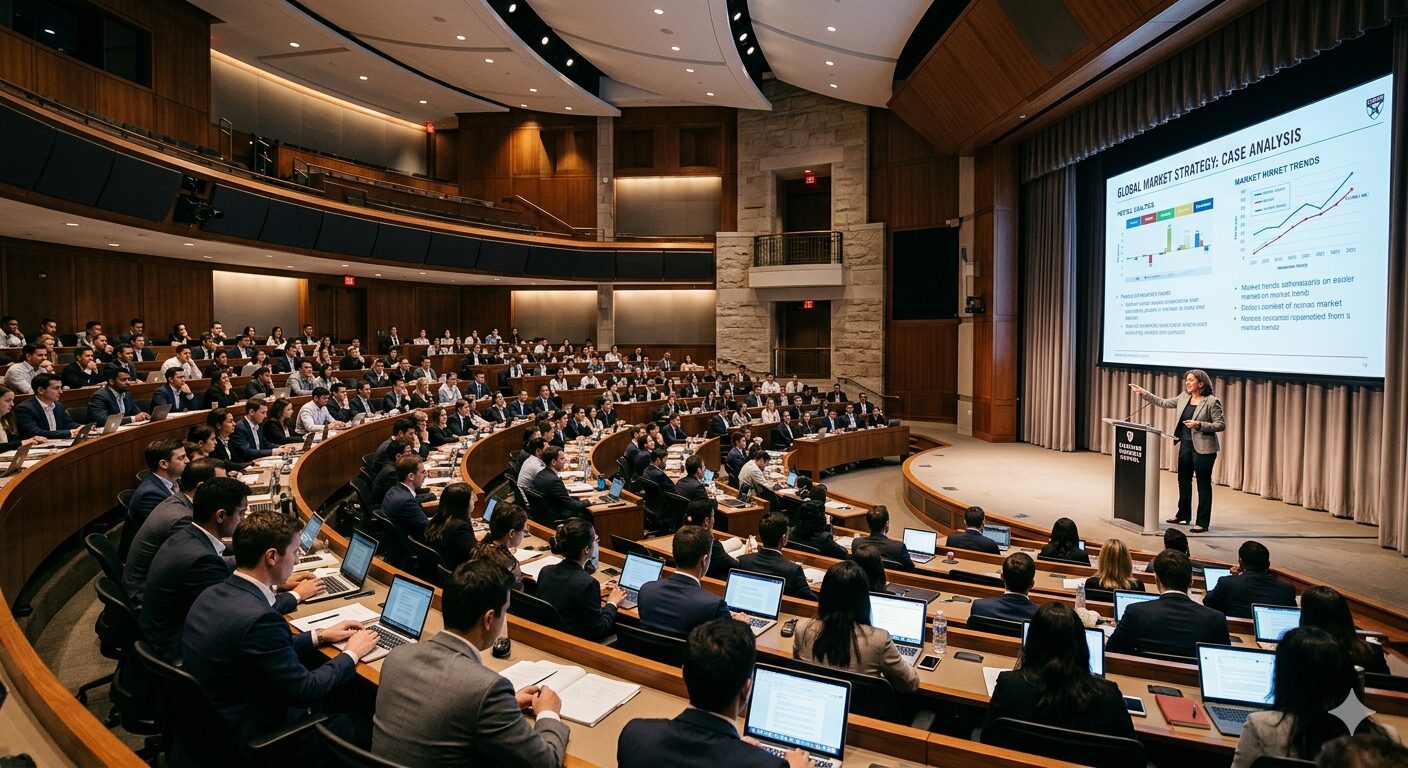
If you spend enough time researching finance careers, eventually the same terms start appearing everywhere:
That’s not a coincidence.
For decades, top MBA programs have served as major recruiting pipelines into elite finance firms.
But here’s something many students discover too late:
not all MBA programs create the same career opportunities.
Some schools maintain deep recruiting relationships with:
Others offer strong academics but limited Wall Street access.
Understanding that difference can completely change a student’s career trajectory.
In industries like investment banking, recruiting remains heavily relationship-driven.
Top business schools provide:
Large banks continue recruiting aggressively from specific “target schools.”
That’s one reason elite MBA programs remain so influential in finance.
Wharton continues to dominate conversations around MBA finance recruiting.
The school maintains exceptionally strong relationships with:
Many professionals consider Wharton one of the strongest MBA brands in global finance.
Harvard Business School remains one of the most prestigious institutions in the world.
Its influence extends far beyond finance into:
Many students use Harvard to pivot into investment banking from:
Stanford offers extraordinary access to:
Its location creates strong opportunities for students interested in tech-focused finance careers.
MIT Sloan has become increasingly attractive for finance professionals interested in:
The combination of finance and technology continues becoming more valuable every year.
For students targeting international finance careers, both London Business School and INSEAD remain extremely powerful options.
These programs provide:
Compensation remains one of the biggest reasons professionals pursue investment banking careers.
MBA associates at top banks frequently earn:
However, the workload can become extremely demanding.
Many bankers continue working:
High compensation often comes with equally high pressure.
Top banks evaluate far more than intelligence alone.
Recruiters usually look for:
Technical interviews may include:
Behavioral interviews matter just as much.
Students interested in investment banking should become comfortable with:
Important concepts often include:
Strong technical preparation significantly improves recruiting performance.
Breaking into investment banking remains incredibly competitive.
But students who combine:
still create real opportunities for themselves.
The right MBA can dramatically accelerate that process.
And in 2026, elite business schools continue playing a major role in shaping the next generation of Wall Street professionals.

A 700+ GMAT score is the threshold that puts you in serious contention at every M7 program. The median at Wharton is 733. At Chicago Booth it is 730. At Harvard Business School it is 740. Getting above 700 does not guarantee admission — but scoring below it at a top finance program almost always requires an extraordinary compensating factor. The good news: 700 is achievable in 3 months for most working professionals, with the right structure and the right resources.
The GMAT rewards consistent, structured practice over cramming. Students who study 10 hours per week for 12 weeks consistently outperform students who study 30 hours per week for 3 weeks.
The GMAT Focus Edition (current since 2023) has three sections: Quantitative Reasoning, Verbal Reasoning, and Data Insights. Total score ranges from 205 to 805. Understanding what each section actually measures is the first step to studying efficiently — many candidates waste weeks on things the GMAT does not heavily weight.
Quantitative Reasoning tests problem-solving with algebra, arithmetic, and geometry at roughly a high-school level. The questions reward efficient reasoning, not computation speed. Students who try to brute-force every problem run out of time. Data Insights combines data sufficiency questions (a format unique to the GMAT) with multi-source reasoning and table analysis — it rewards logical thinking more than mathematical ability. Verbal Reasoning tests critical reasoning, reading comprehension, and sentence correction.
| School | Median GMAT (2025) | 80% Range | Finance Strength |
|---|---|---|---|
| Harvard Business School | 740 | 700–770 | Very strong |
| Wharton (UPenn) | 733 | 700–760 | Top finance MBA |
| Chicago Booth | 730 | 700–760 | Top quant/finance |
| MIT Sloan | 730 | 700–760 | Strong (fintech) |
| Columbia Business School | 729 | 700–760 | Top (NYC finance) |
| Stanford GSB | 738 | 700–770 | Strong (VC + PE) |
| Kellogg (Northwestern) | 727 | 690–760 | Strong |
| London Business School | 708 | 660–740 | Strong (Europe) |
| INSEAD | 703 | 650–740 | International |
Target a score at or above the median of your target schools. For M7 programs, 720+ is a strong score; 700–719 is competitive with other strong application elements. Every unnecessary retake slightly dilutes the result — admissions committees see your full score history. Plan to take the test once.
This plan assumes 8–12 hours of study per week — realistic for most working professionals. If you have more time, compress to 8 weeks. If less, extend to 16 weeks without changing the structure.
| Week | Focus | Key Activities | Hrs/Week |
|---|---|---|---|
| Week 1 | Diagnostic | Full official practice test. Identify weak sections. | 10 |
| Week 2–3 | Quant Foundations | Algebra, arithmetic, number properties. 50 OG problems/day. | 10 |
| Week 4–5 | Data Insights | Data sufficiency logic. Multi-source reasoning. Table analysis. | 10 |
| Week 6–7 | Verbal Foundations | CR argument structure. RC strategy. SC grammar rules. | 10 |
| Week 8–9 | Mixed Practice | Timed section drills. Error log review. Find persistent gaps. | 10 |
| Week 10–11 | Full Simulations | 2 full official practice tests. Review every wrong answer. | 12 |
| Week 12 | Final Prep | Light review, rest, logistics. Test day. | 6 |
The error log is non-negotiable. Every incorrect answer gets logged with: question type, why you got it wrong (concept gap, careless error, or time pressure), and the correct approach. Reviewing it weekly is how you stop repeating mistakes. Candidates who skip the error log plateau around 650 and cannot understand why their score does not improve.
The Quant section is where most candidates lose the most recoverable points. The content is high-school level; the difficulty is in time pressure and problem construction. The two most common failure patterns are: trying to calculate what should be estimated, and missing what a data sufficiency question is actually asking.
Data sufficiency questions always use the same five answer choices about whether Statement 1, Statement 2, or both are sufficient. This format is unique to the GMAT and requires a specific mental framework. Practice data sufficiency exclusively for at least 5 days before mixing it with other types — the reasoning pattern is different enough that mixing them early creates confusion.
Number properties — divisibility, primes, factors, and remainders — appear in 20–25% of Quant questions. One focused week on number properties typically yields a larger score improvement than any other single Quant topic. Start there if you are below 650 in Quant.
Critical Reasoning questions test argument analysis: identifying assumptions, strengthening or weakening conclusions, and spotting logical flaws. The most common mistake is choosing answers based on what sounds reasonable in the real world rather than what the argument strictly supports. The GMAT is a closed world — external knowledge is irrelevant and sometimes actively misleading. Evaluate only the evidence presented in the stimulus.
Reading Comprehension rewards active reading. Before answering questions, identify the main point of each paragraph and the passage's overall purpose in one sentence. RC errors almost always come from misremembering what the passage said versus what you assumed. The correct RC answer is always supported by specific language in the passage — if you cannot point to the supporting sentence, the answer is wrong regardless of how reasonable it seems.
Sentence Correction tests a finite set of grammar rules: subject-verb agreement, pronoun reference, parallel construction, modifier placement, and verb tense. Learning these 6 rule categories and recognizing them on sight eliminates 70–80% of SC errors. Answering SC by "ear" — choosing what sounds right — is unreliable. Identify the error, eliminate choices that do not fix it, and check for secondary errors among what remains.
Official GMAT materials from GMAC are the only resources that exactly replicate the real test. Always prioritize official materials for timed practice.
In the final week: stop new practice problems after day 3. Rest, review your error log one final time, and confirm test day logistics. Arriving tired costs more points than any last-minute studying can recover. The GMAT rewards a clear, rested mind more than a well-prepared exhausted one.

For decades, the MBA program at Harvard Business School has been considered one of the most prestigious business education experiences in the world. But many prospective students still ask the same question: what do students actually study inside the Harvard MBA program? The answer is far more interesting than most people expect. Unlike programs focused heavily on lectures and exams, HBS builds its MBA experience around real business decisions, leadership development, strategic thinking, and practical management training — and in 2026, the curriculum is evolving faster than at any point in its history.
Harvard does not just teach business — it trains executives to make high-stakes decisions under uncertainty. That distinction is why the HBS network remains the most powerful in the world 75 years after the program was founded.
The Harvard MBA is a two-year, full-time, general management program divided into two distinct phases. The first year is a required, shared curriculum — every student in the class takes the same core courses together. The second year is almost entirely elective, allowing students to specialize deeply in finance, entrepreneurship, technology, or any other domain. This structure is intentional: Harvard believes that effective general managers need breadth before they earn the right to specialize. A first-year finance student sits next to a former military officer, a doctor, and a startup founder — and the diversity of perspectives in case discussions is itself part of the curriculum.
Students move through the first year in assigned groups called sections of approximately 90 students. The section becomes your primary community for the first year — you take every class together, study together, and develop the kind of intense professional relationships that define the HBS alumni network for decades afterward. The section model also means that participation and communication skills are developed under real social pressure, not in anonymous online forums.
The first-year required curriculum covers the full breadth of general management. For finance-focused students, the Finance I and Finance II courses are the most directly relevant, but the curriculum is designed so that every course contributes to a student's ability to evaluate and lead complex organizations.
| Course | Core Focus | Finance Relevance |
|---|---|---|
| Finance I & II | Corporate finance, valuation, capital allocation | Very High — direct IB/PE preparation |
| Financial Reporting & Control | Accounting, financial statements, GAAP | Very High — essential for all finance roles |
| Strategy | Competitive dynamics, market positioning | High — M&A and corporate strategy |
| Leadership & Org. Behavior | Team dynamics, executive decision-making | Medium — client and team management |
| Technology & Operations | Digital transformation, supply chains | Medium — fintech and operational finance |
| Marketing | Customer behavior, pricing, branding | Low-Medium — useful for corporate roles |
| Data Science & AI for Leaders | Machine learning, business analytics | High — quant finance and fintech |
| FIELD Immersion | Real-world project with global company | Medium — client interaction skills |
Finance I and Finance II together form the analytical backbone of the HBS experience for students targeting investment banking, private equity, or hedge funds. The courses cover corporate finance fundamentals, discounted cash flow valuation, capital structure decisions, and investment analysis. What distinguishes these courses from standard finance education is the case method delivery — students do not just learn to apply the DCF formula, they debate whether a specific CEO made the right capital allocation decision in a real transaction, with classmates who may have been the banker or consultant on the deal.
One of the most significant curriculum shifts in recent years is the expansion of AI and data science education. The course Data Science and AI for Leaders, now a required first-year component, helps students understand machine learning applications, business analytics, AI-driven decision-making, and the strategic impact of artificial intelligence across industries. This is not a programming course — HBS does not train software engineers. It trains executives to ask the right questions of technical teams, evaluate AI-driven business models, and understand where machine learning creates genuine competitive advantage versus where it is organizational noise.
For finance students specifically, this matters enormously. Quantitative hedge funds, systematic trading firms, and the data science teams at major banks are hiring MBA graduates who can bridge the gap between finance domain expertise and algorithmic thinking. An HBS graduate who combines Finance I/II knowledge with a genuine understanding of machine learning applications is more valuable to these employers in 2026 than a pure quant or a pure finance MBA graduate.
The Harvard case method is one of the most discussed and least understood features of the HBS experience. Rather than traditional lectures, students analyze real business situations and discuss executive decisions, strategic mistakes, leadership challenges, and financial outcomes. During the MBA, students analyze approximately 400 to 500 business cases — real companies, real decisions, real consequences. Each case is typically 15-25 pages of primary source material: financial statements, board memos, market data, and management interviews.
Class participation is not optional — it is graded and typically represents 50% of the course grade. The professor cold-calls students to open a case discussion, and that student must analyze the situation and make a clear recommendation in front of 90 peers. This creates an environment where communication, intellectual confidence, and the ability to synthesize complex information quickly become survival skills rather than optional soft skills. For students targeting client-facing finance careers — investment banking, PE, consulting — this is arguably the most valuable preparation the MBA provides that cannot be replicated through technical training alone.
During the second year, students choose from more than 100 elective courses and independent projects. The flexibility is significant — a student focused on private equity can spend their entire second year on PE-specific courses, deal analysis projects, and independent research with a faculty member. Popular finance-related electives include courses in leveraged buyouts, venture capital and private equity, real estate investment, securities analysis, and financial crises. The Entrepreneurial Finance course is consistently one of the most popular in the school, reflecting the overlap between HBS's finance strength and its entrepreneurial culture.
Harvard also offers joint degree programs combining the MBA with law (JD/MBA), public policy (MPP/MBA), and engineering (MS/MBA). The MS/MBA program run jointly with the Harvard John A. Paulson School of Engineering is particularly relevant for students targeting fintech, quantitative finance, or technology-focused investment roles where deep technical credentials complement the business training.
The Harvard MBA remains one of the most powerful business credentials in the world — but its value is not uniform across career paths. For students targeting investment banking, consulting, or entrepreneurship, the HBS brand and alumni network provide advantages that are difficult to quantify but consistently visible in recruiting outcomes. Major investment banks, strategy consulting firms, and venture capital funds actively recruit at HBS and treat HBS graduates as a pre-screened, high-quality talent pool. That institutional relationship — built over decades — is not easily replicated by any other program.
The honest caveat: at $76,000 per year in tuition plus living expenses, the Harvard MBA costs over $230,000 in direct expenses, plus two years of foregone income. The NPV calculation is positive for most HBS graduates — median post-MBA compensation exceeds $175,000 in base salary alone — but it requires a career trajectory that actually captures the premium the degree commands. Students who use Harvard to pivot into high-compensation finance roles recover the investment within 3-5 years. Students who use it to enter non-profit or government roles may find the ROI considerably more modest.

When people talk about the best MBA programs for finance careers, one name appears almost every time: Wharton. The Wharton School at the University of Pennsylvania has built one of the strongest reputations in the world for finance education, analytical business training, leadership development, and Wall Street recruiting. But many prospective students still wonder — what do Wharton MBA students actually study? The answer goes far beyond spreadsheets and corporate finance. The Wharton MBA curriculum is designed to combine analytical rigor, leadership development, communication skills, and deep career specialization — and in 2026, the program continues evolving around artificial intelligence, business analytics, global markets, and technology-driven finance.
Wharton does not just teach finance — it trains professionals to apply analytical frameworks to every business problem they encounter. That combination of depth and breadth is why Wharton graduates consistently appear at the top of Wall Street, consulting, and PE recruiting pipelines.
The Wharton MBA is a two-year, full-time, highly customizable graduate business program. Students must complete 19 course units (CUs) during the MBA. Unlike Harvard's section-based, case-method model, Wharton gives students significantly more flexibility in structuring their curriculum from the beginning. The program is divided into three major sections: the Core Curriculum, Majors and Specializations, and Elective Courses. This structure allows students to build strong business fundamentals while customizing the MBA tightly around specific career goals — which is one reason Wharton consistently attracts a high concentration of finance-focused students who want both analytical depth and recruiting access.
The first major component is the Wharton Core Curriculum, which builds foundational knowledge across leadership, economics, finance, marketing, communication, and analytics. The core is divided into the Fixed Core (first semester) and the Flexible Core (where students choose within defined disciplines).
| Course | Type | Core Focus | Finance Relevance |
|---|---|---|---|
| Foundations of Teamwork & Leadership | Fixed | Collaboration, executive communication | Medium — client and team management |
| Marketing Management | Fixed | Customer behavior, pricing, branding | Low-Medium |
| Microeconomics for Managers | Fixed | Pricing dynamics, competitive markets | High — macro/micro for finance |
| Regression Analysis for Managers | Fixed | Statistics, data-driven decisions | High — quant finance foundation |
| Management Communication | Fixed | Presentations, business writing | High — IB and PE client work |
| Corporate Finance | Flexible | Valuation, capital structure, M&A | Very High — IB/PE core skill |
| Accounting | Flexible | Financial statements, GAAP | Very High — essential for all finance |
| Macroeconomics | Flexible | Interest rates, global markets | High — markets and macro investing |
| Business Analytics | Flexible | AI, machine learning, data strategy | High — quant and fintech roles |
The Regression Analysis for Managers course deserves specific mention for finance students. Unlike programs where statistics is treated as an optional or supplementary skill, Wharton makes quantitative data analysis a fixed core requirement. This reflects Wharton's broader philosophy that rigorous analytical thinking — not just financial modeling — is the foundation of effective business leadership. Students who enter Wharton with stronger quantitative backgrounds can opt into advanced versions of core courses, allowing them to move faster toward specialized finance electives.
One of Wharton's biggest competitive advantages is the depth of its specialization system. Students must complete at least one MBA Major, chosen from approximately 18 to 20 concentration areas. The Finance Major is by far the most popular, attracting a large share of the class each year. Within the Finance Major, students take a series of courses covering corporate finance, investment management, financial derivatives, real estate finance, and advanced valuation. The breadth within the single major is comparable to what other schools offer across their entire elective catalog.
Other popular majors with strong finance overlap include Business Analytics (increasingly valuable for quant roles and fintech), Real Estate (for students targeting real estate PE and REITs), and Entrepreneurship & Innovation (for VC-focused students). Students can also combine majors — a Finance + Business Analytics double major is increasingly common among students targeting quantitative hedge funds, systematic trading firms, or fintech leadership roles where analytical credibility is as important as finance domain knowledge.
Wharton's recruiting outcomes in finance are consistently at the top of the M7. Goldman Sachs, JPMorgan, Morgan Stanley, Evercore, Lazard, and virtually every major PE and hedge fund actively recruit at Wharton and treat it as a primary target school. The reasons are structural: Wharton has the largest Finance alumni network in elite finance, a finance faculty that includes active practitioners and Nobel laureates, and a student culture where finance career preparation is deeply embedded in the first-year experience.
The Wharton Finance Club is one of the most active professional organizations in any MBA program — it runs technical training workshops, PE recruiting prep sessions, and direct alumni networking events that begin in the first weeks of the first year. Students who arrive at Wharton planning to enter investment banking or PE typically start building their recruiting relationships before the first semester is over, which is the correct timeline given that formal recruiting begins in January of the first year.
Wharton offers more than 200 elective courses, allowing students to build highly specific academic pathways. Students may also take courses across other University of Pennsylvania graduate schools — the Law School, the Engineering School, and the School of Arts and Sciences — creating genuinely interdisciplinary options that no other M7 program can match at scale. Global learning is integrated throughout the MBA through international business projects, global immersions, and cross-border case studies. As finance and consulting become increasingly global, the ability to navigate cross-cultural business environments is a genuine differentiator in senior leadership roles.
Summer internships between the first and second year are treated as the primary recruiting pipeline by most employers. Students who secure internships at Goldman Sachs, Blackstone, or McKinsey in the summer after first year receive full-time offers at the end of the internship in the vast majority of cases — making that summer the most career-critical period of the MBA. Wharton's placement rate in competitive summer internships consistently ranks among the highest in the country, a reflection of both the school's recruiting relationships and the preparation quality of its students.
For students targeting finance careers, Wharton is arguably the single most powerful MBA credential available. The combination of the Finance Major, the Wall Street recruiting network, the Wharton alumni base in PE and hedge funds, and the quantitative analytical training creates an educational product that is genuinely differentiated from even other M7 programs. Tuition runs approximately $84,000 per year, making the two-year cost over $240,000 before living expenses — but post-MBA compensation for finance-track Wharton graduates consistently exceeds $300,000 in the first year, making the investment financially justifiable for most students on that career path.
The honest caveat is admission: Wharton's acceptance rate is below 15%, and the median GMAT is 733. Successful applicants typically combine 3-7 years of strong professional experience, demonstrated leadership, and a clear career narrative that explains why Wharton specifically — not just "an elite MBA" — is the right next step. Candidates who can articulate the specific Wharton resources, courses, and alumni relationships they plan to leverage are consistently more competitive than equally credentialed candidates who treat Wharton as one application among many.
Find out if an MBA is worth it — and exactly when you will break even on your investment.
Fill in your details and click Calculate My ROI to see your personalized breakdown.
From LBO to WACC — every term you need to know for MBA interviews, finance careers and Wall Street.
Compare two top MBA programs side by side — cost, salary, finance placement and more.
Select two schools above to start comparing
Cost, salary, GMAT scores, finance placement and more — all side by side.
Test your knowledge across 30 questions — 15 Investment Banking technical and 15 GMAT quantitative.
Select a category or take the full 30-question challenge.
20 proven steps to break into investment banking — used by candidates at Harvard, Wharton and Columbia.

Enter your email and download the checklist immediately — no spam, ever.
Trusted by finance candidates at
Harvard • Wharton • Columbia • Booth • NYU Stern

The rise of AI has triggered a genuine crisis of confidence among prospective MBA students. If ChatGPT can write a memo, build a financial model, and summarize an earnings call in seconds, what exactly are $200,000 and two years of your life buying you? It is a legitimate question — and one that deserves a direct, data-grounded answer rather than reassuring platitudes from business school admissions offices. The honest 2026 answer is nuanced: AI is meaningfully changing what finance professionals do, but the career credentials, network access, and leadership development that a top MBA provides have become more valuable, not less, in an AI-accelerated world.
AI is reshaping finance workflows — but the humans directing those workflows still need judgment, relationships, and institutional credibility. That is exactly what a top MBA is designed to build.
In 2026, every prospective MBA student is confronting the same uncomfortable question: does a $200,000+ degree still make sense when AI tools can perform many of the analytical tasks that used to require years of expensive education? The anxiety is real, but it is also somewhat misdirected. AI is automating tasks — specific, repeatable, data-processing tasks. It is not automating careers, judgment, relationships, or organizational credibility. Understanding the difference is critical to making a rational decision about graduate business education.
The MBA's value proposition has always rested on three pillars: skills, network, and credential. AI is affecting the first pillar at the margins — certain technical tasks are becoming easier. But the credential and network pillars are completely unaffected by AI adoption, and if anything, they are becoming more valuable as the supply of AI-proficient workers grows and employers increasingly differentiate based on leadership capacity and institutional trust rather than technical execution alone.
The right question is not whether AI replaces the MBA. The right question is whether an MBA still provides a sufficient return on a $200k+ investment for your specific career goals. For investment banking, private equity, consulting, and corporate leadership tracks, the answer in 2026 remains yes — with important caveats about program selection and career fit.
AI is genuinely automating a meaningful portion of the work that junior finance professionals once performed manually. Document review, data extraction from financial statements, first-draft financial model construction, earnings call transcription and summarization, covenant compliance checking in credit agreements — these tasks are being partially or fully automated across investment banks, PE firms, and asset managers. Junior analysts at bulge-bracket banks are reporting that AI tools now handle work that previously consumed 30-40% of their working hours.
This is real and consequential. But it is important to recognize what this automation actually means for MBA value: it means that the lower-level analytical grunt work that used to justify hiring large analyst classes is shrinking. Firms need fewer people doing data entry and first-pass modeling. They need more people who can interpret, contextualize, advise, and lead — which is precisely the skill set that MBA programs are designed to develop. The automation of junior-level tasks does not make the MBA irrelevant; it makes the judgment and leadership development that MBAs provide more valuable at the margin.
There are entire categories of high-value finance work that AI cannot perform in 2026 and is unlikely to perform well for many years. Client relationship management requires trust, emotional intelligence, and institutional credibility that no language model can credibly replicate. Deal negotiation involves real-time reading of human psychology, power dynamics, and organizational politics. Investment thesis development at the highest level requires the synthesis of qualitative judgment with quantitative analysis in ways that remain fundamentally human. Managing teams through uncertainty, communicating complex ideas to boards, structuring novel deal terms — these are all deeply human activities.
Leadership, in particular, is an area where AI has essentially no footprint. PE portfolio company CEOs, investment committee chairs, and managing directors at major banks are not being replaced by AI — they are using AI to make their existing teams more productive. The people in those senior roles came through MBA programs, not because the MBA taught them Python, but because it taught them how to operate credibly in high-stakes institutional environments. That skill is completely orthogonal to what AI does.
The MBA alumni network argument has always been made by business schools, and it has always been somewhat overstated in marketing materials. But in 2026, the network component of a top MBA is genuinely undervalued by prospective students. As AI compresses the technical skill differentials between candidates — if everyone can build a DCF in minutes using AI tools, the technical moat shrinks — what differentiates candidates increasingly comes down to relationships, referrals, and institutional trust.
Harvard, Wharton, and Booth graduates are not getting hired at Goldman Sachs and Blackstone because they learned financial modeling in business school. They are getting hired because alumni already inside those firms vouch for them, because recruiters have 30-year relationships with those schools, and because the credential signals a specific level of institutional selectivity that firms use as a proxy for candidate quality. AI does nothing to undermine this dynamic — if anything, it intensifies it, because the credential becomes a more important signal when technical skills are increasingly commoditized.
The practical implication is that the MBA network compounds over a career in ways that are difficult to quantify at the time of enrollment but become unmistakably clear by year ten. Board seats, LP relationships, senior hiring decisions, and strategic partnership introductions disproportionately flow through MBA alumni networks. That advantage is completely unaffected by the rise of AI language models.
| Program | Total Cost | Avg Post-MBA Salary | Break-Even |
|---|---|---|---|
| Harvard HBS | $230,000 | $175,000 | 3–4 years |
| Wharton | $225,000 | $172,000 | 3–4 years |
| Chicago Booth | $215,000 | $165,000 | 3–4 years |
| Kellogg | $210,000 | $158,000 | 4–5 years |
| Yale SOM | $200,000 | $150,000 | 4–5 years |
These numbers tell a clear story for candidates targeting finance, consulting, and leadership tracks: the break-even is 3-5 years, and the 10-year net present value of the investment is substantially positive for most M7 graduates who pursue the right career paths. The salary premium from a top MBA over a non-MBA career trajectory at the same starting point typically runs $50,000-$100,000 per year in finance — a premium that compounds significantly over a 20-year career. For a full program-by-program comparison, see our guide on Harvard MBA vs. Wharton MBA for Finance careers. The ROI math has not fundamentally changed in 2026.
An MBA is clearly worth it in 2026 for several specific profiles. Career switchers moving into investment banking, private equity, or management consulting from unrelated fields almost always need an MBA from a target school — there is no other credible pathway into these careers at the post-analyst level without the institutional credential. Candidates targeting senior leadership roles in corporate finance, strategy, or general management benefit enormously from the MBA's combination of credential signaling and network development. International candidates looking to break into the US finance market use M7 MBAs as the primary mechanism for obtaining recruiting access that would otherwise be completely unavailable to them.
The strongest 2026 candidates are those who combine MBA credentials with genuine AI competency — not the ability to use ChatGPT, but the ability to integrate AI tools into financial workflows, evaluate AI-generated analysis critically, and build processes that leverage AI while retaining human judgment at decision points. Programs like Wharton, Booth, and MIT Sloan are actively incorporating AI education into their curricula, which increases the value of attending specifically those programs for candidates who want both credentials.
The MBA is not worth it for everyone. Candidates who already have strong recruiting access to their target role — software engineers at top tech companies, for example, or finance professionals already in PE or hedge funds — often find that the opportunity cost of two years out of the workforce, plus $200k in tuition and foregone income, does not justify the credential. The MBA is a tool for gaining access and making career transitions; if you do not need either, the financial case weakens considerably.
Candidates targeting roles where the MBA credential is not a meaningful differentiator should also think carefully. Technical roles in quantitative finance, systematic trading, and data science increasingly value advanced degrees in mathematics, statistics, or computer science over business education. And entrepreneurs who are already building companies rarely benefit from the two-year interruption that a full-time MBA requires, particularly when alternative credentials and accelerator networks are available without the full program cost.
The honest 2026 verdict is this: a top MBA remains one of the highest-ROI educational investments available for candidates targeting finance, consulting, and leadership careers — but only from programs with genuine recruiting power and alumni network depth. AI has not changed this calculation in any fundamental way. What it has changed is the adjacent skill set that the strongest candidates bring alongside their MBA credential. The MBA graduate who also understands how to deploy AI tools in financial workflows, evaluate AI-generated analysis, and lead AI-augmented teams is meaningfully more valuable than the MBA graduate who treats AI as a threat rather than a tool.
The MBA application cycle for 2027 entry will be competitive regardless of what AI does to individual tasks. If you are targeting Goldman Sachs, Blackstone, McKinsey, or a top corporate leadership role, the credential from a top-8 program is still the most reliable path to that outcome. The question is not whether to get an MBA in the age of AI — it is whether your target program has the recruiting relationships, alumni network, and curriculum quality to justify the investment. For Harvard, Wharton, Booth, Kellogg, and their M7 peers, the answer remains yes.
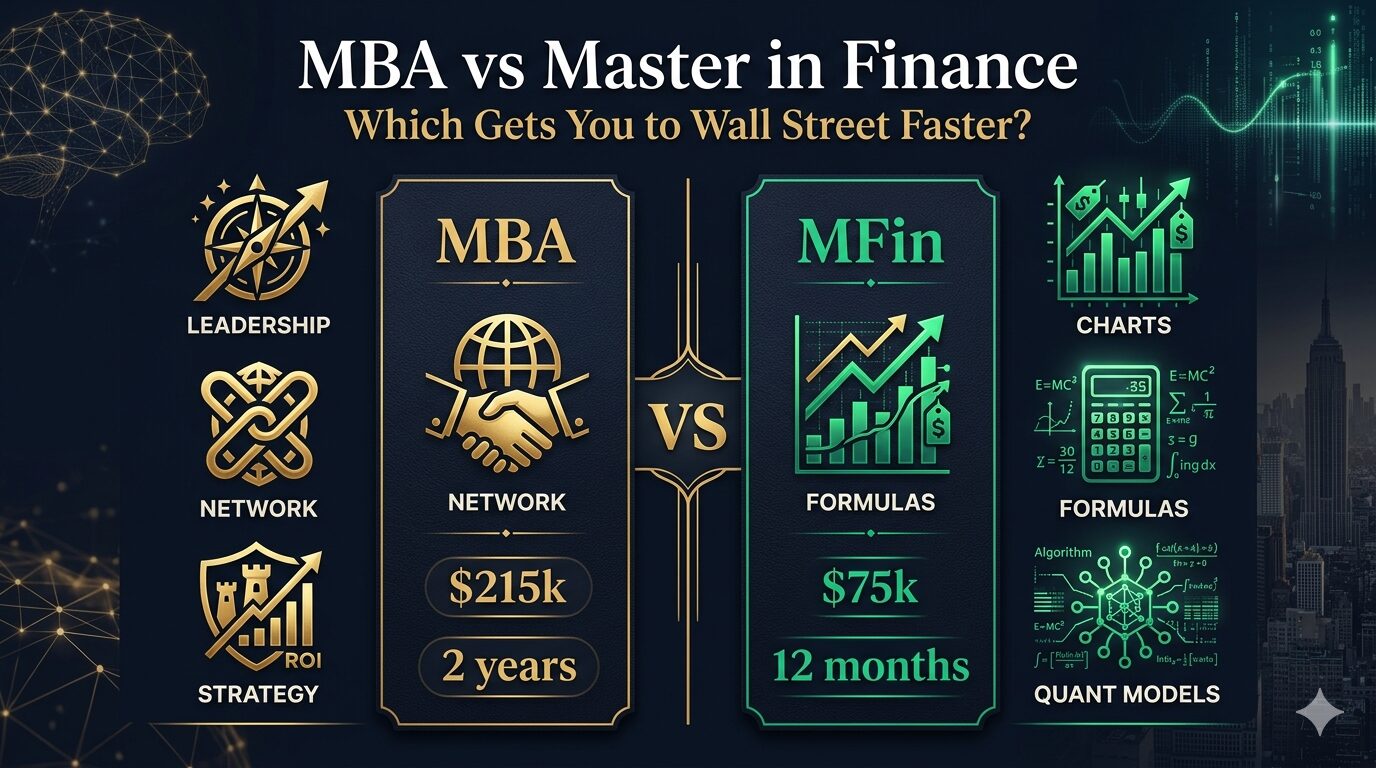
Two graduate degrees dominate the conversation for candidates targeting Wall Street: the MBA and the Master in Finance. They serve overlapping but distinct audiences, and choosing the wrong one for your profile and career goals can cost you years of time and six figures in avoidable tuition. The decision is more nuanced in 2026 than it has ever been — because the MBA is evolving to compete more directly with specialized finance degrees, while top MFin programs are expanding their recruiting relationships to reach employers that once recruited exclusively from MBA programs.
The MBA and the MFin are not interchangeable. One is designed for career changers and future leaders. The other is designed for technically minded recent graduates who want deep finance specialization fast. Your choice should start with honest self-assessment about where you are, not where you want to end up.
Both the MBA and the Master in Finance can lead to careers at investment banks, PE firms, asset managers, and hedge funds. But they get there via completely different mechanisms, serve different candidate profiles, and create different types of institutional capital. The MBA is a generalist leadership credential that happens to open specific finance doors through its recruiting network. The MFin is a specialized technical degree that provides deep quantitative finance training and increasingly strong placement at specific finance employers — particularly in technical and quantitative roles.
The most common mistake candidates make is treating this as a prestige comparison — asking which degree is "better" — rather than a fit question: which degree is right for my specific experience level, financial situation, and target career path? A recent college graduate targeting a quant trading role at Jane Street is almost certainly better served by a Princeton MFin than a Harvard MBA. A career-changer with five years in consulting who wants to move into PE is almost certainly better served by a Wharton MBA. The degree that matches your situation produces a dramatically better return than the nominally more prestigious degree that does not.
The Master in Finance is a specialized graduate degree focused on advanced financial theory, quantitative methods, and technical finance skills. Top programs include Princeton's Bendheim Center MFin, MIT Sloan's Master of Finance, London Business School's Master in Finance, and HEC Paris's Master in Finance. These programs typically run 10-16 months and admit students with limited professional experience — often directly from undergraduate programs or with one to three years of work experience. The curriculum is heavily quantitative: derivatives pricing, fixed income analysis, portfolio theory, financial econometrics, and risk management are core components.
The MFin is not a watered-down MBA. At programs like Princeton and MIT, it is a rigorous, mathematically demanding degree that prepares students for roles that require genuine quantitative depth. Graduates enter investment banking sales and trading, quantitative research, risk management, and increasingly asset management roles where analytical sophistication is the primary differentiator. The credential is well understood by sophisticated financial employers and is treated with significant respect in quantitative and trading-oriented hiring contexts.
The MBA is a two-year general management degree with broad applicability across industries and functions. Unlike the MFin, it is explicitly designed for candidates with meaningful professional experience — typically 3-7 years — who want to either change careers or dramatically accelerate their trajectory in their existing field. The MBA curriculum covers finance, marketing, operations, leadership, strategy, and organizational behavior. At M7 programs, the finance elective catalog is genuinely deep, but the foundation is breadth and leadership development rather than technical finance specialization.
The MBA's primary mechanism for creating career outcomes is its recruiting ecosystem, not its curriculum. The on-campus recruiting relationships that Harvard, Wharton, Booth, and Kellogg maintain with Goldman Sachs, McKinsey, Blackstone, and their peers are the core product being purchased. A Wharton MBA graduate entering investment banking is not competing on technical superiority over MFin graduates — they are entering through a recruiting channel that is specifically reserved for MBA students from target programs, with different interview formats, offer timelines, and expectations.
| Factor | MBA | Master in Finance |
|---|---|---|
| Duration | 2 years | 10–12 months |
| Total Cost | $200k–$230k | $60k–$90k |
| Work Exp Required | 3–7 years | 0–3 years |
| Curriculum Focus | Broad / Leadership | Technical / Quant |
| Network Size | Very large | Smaller, specialized |
| IB Recruiting Access | Strong at M7 | Moderate |
| PE / VC Access | Strong | Limited |
| Best For | Career switchers | Recent graduates |
| ROI Timeline | 3–5 years | 1–2 years |
The cost differential is the most striking data point for most candidates: a top MFin costs roughly one-quarter to one-third of a top MBA. For candidates who do not need the MBA's career-switching mechanism, network breadth, or institutional credential, the financial case for the MFin is very strong. The ROI timeline reflects this — MFin graduates typically recover their investment in 1-2 years because the degree is shorter, cheaper, and they enter the workforce sooner. MBA graduates break even in 3-5 years despite higher post-degree salaries because the investment is so much larger.
For traditional investment banking — mergers and acquisitions, capital markets, leveraged finance — the MBA from an M7 program is the dominant pathway at the associate level. Bulge-bracket banks maintain formal on-campus recruiting programs at Harvard, Wharton, Booth, Kellogg, Columbia, and MIT Sloan that produce a substantial fraction of their associate-class hiring. MFin graduates can enter investment banking, but typically at the analyst level rather than the associate level, and with more limited access to the most prestigious banking franchises through campus recruiting alone.
The distinction matters because associate versus analyst is not just a title difference — it is a different career trajectory, different compensation level, and different set of exit opportunities. MBA associates at Goldman Sachs earn substantially more than MFin analysts in their first year, and the exit opportunity set into PE and hedge funds is stronger from the associate level. For candidates who specifically want investment banking at the senior associate level from day one, the M7 MBA remains the clearer path in 2026.
The MFin's advantage is clearest in quantitative finance and systematic trading. Firms like Citadel, Two Sigma, DE Shaw, Jane Street, and Bridgewater are not primarily recruiting MBA graduates for their quantitative research and trading desks — they are recruiting candidates with deep mathematical and statistical foundations who can build and validate models. Princeton MFin graduates, MIT MFin graduates, and candidates from top European programs like LBS and HEC Paris compete directly with PhD candidates from top mathematics and statistics programs for these roles.
An MBA, even from Harvard or Wharton, does not create a comparable technical credential for quantitative roles. MBA finance courses build financial intuition and analytical frameworks, but they do not develop the stochastic calculus, time series econometrics, and statistical modeling depth that quant roles require. Candidates who know they want to work in systematic strategies, quant research, or derivatives structuring should strongly consider the MFin over the MBA — it is a better credential for that specific outcome and costs dramatically less to obtain.
The financial math is straightforward but often underweighted by applicants caught up in prestige comparisons. A Harvard MBA costs approximately $230,000 in tuition and fees plus $60,000-$80,000 in living expenses and foregone income — bringing the total economic cost close to $500,000 over the two-year program. A Princeton MFin costs roughly $70,000 in tuition, takes one year, and involves minimal foregone income for candidates who enroll directly from undergraduate or with only a year or two of work experience. The difference in total economic cost is staggering.
For this difference to be justified by the MBA, the credential needs to produce meaningfully higher lifetime earnings than the MFin — and for many career paths, it does. But the calculation is only favorable for the MBA when it opens doors that are genuinely closed without it: the M7 recruiting channel into PE, the network compounding that produces board seats and LP relationships, and the career-switching mechanism for candidates who cannot otherwise access their target role. When none of these apply, the MFin's financial efficiency is compelling.
Choose the MFin if: you are within 0-3 years of undergraduate graduation, you are targeting technical finance roles in trading or quant research, you cannot or do not want to spend $200k+ on a degree, you are confident in your career direction and do not need a two-year exploratory period, or your target employers actively recruit from top MFin programs. The MFin is also the right choice if your undergraduate institution was not a target school and you want to establish a new institutional affiliation quickly and cost-efficiently.
Choose the MBA if: you are making a significant career switch into a field that requires institutional credentialing, you have 4-7 years of experience and want to dramatically compress your timeline to senior roles, your primary goal is the alumni network and recruiting access rather than curriculum content, you are targeting PE, VC, or consulting at the post-MBA associate level, or you want a broader leadership credential that remains relevant across multiple career pivots over a 30-year career. The MBA's flexibility across career paths is a genuine advantage that the MFin cannot provide.
For the MBA, the M7 programs — Harvard, Wharton, Booth, Kellogg, MIT Sloan, Columbia, and Stanford GSB — remain the clear tier-one choice for finance careers. See our in-depth look at the Wharton MBA curriculum and our Harvard vs. Wharton comparison to understand what differentiates the top two finance-focused programs. Below the M7, Tuck, Haas, Stern, Darden, and Yale SOM offer strong finance recruiting, particularly for regional or sector-specific roles. The prestige hierarchy within the MBA world is well understood by employers and matters enormously for the most competitive roles at the most selective firms.
For the MFin, the leading programs in 2026 include Princeton Bendheim, MIT Sloan MFin, LBS Master in Finance, HEC Paris Master in Finance, Vanderbilt Owen MS Finance, and Brandeis IBS. In the US context, Princeton and MIT are the clear tier-one programs with the strongest employer relationships in quantitative finance. European MFin programs are particularly well-regarded for candidates targeting European financial centers — London, Paris, and Frankfurt — and for international students who want to return to their home markets with a globally recognized technical credential.
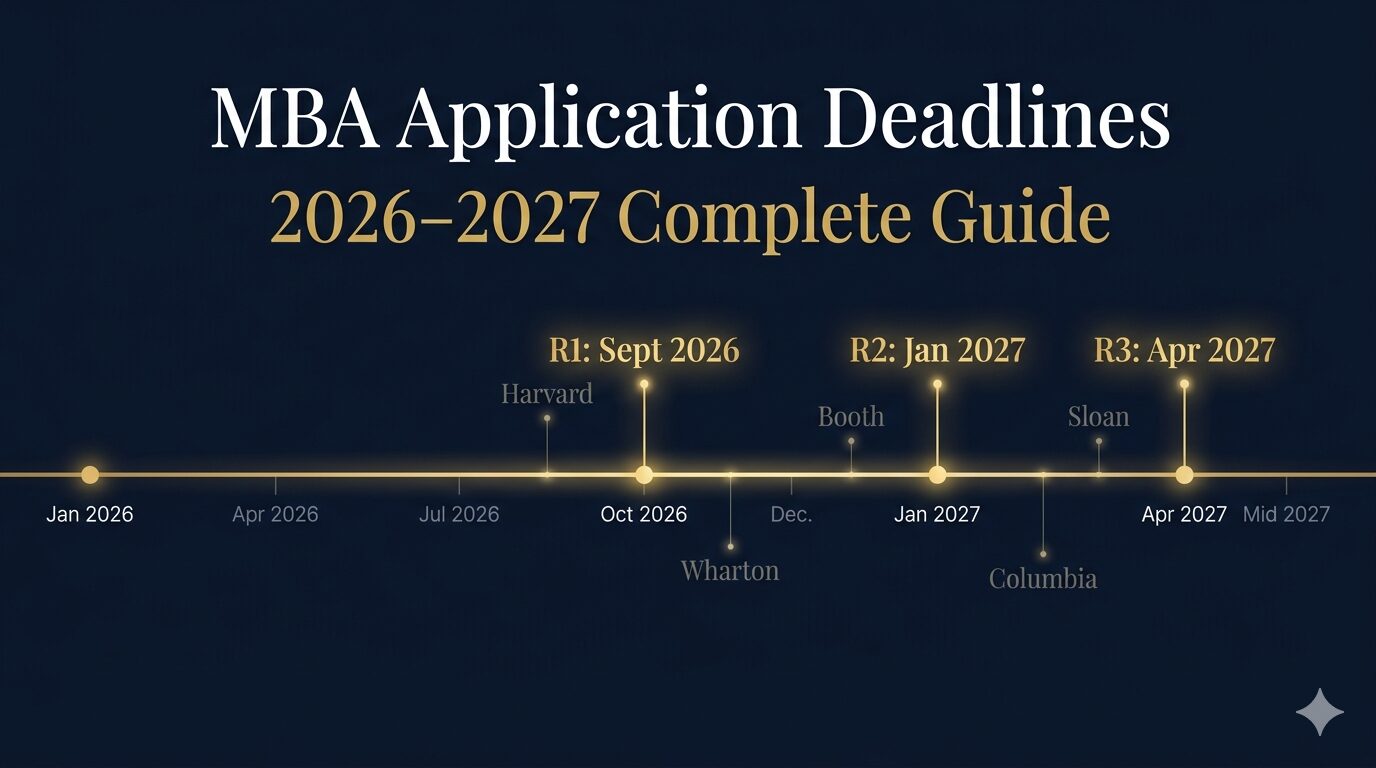
MBA admissions consulting is a multi-hundred-million dollar industry built on a simple premise: getting into Harvard, Wharton, or Booth is so valuable and so competitive that paying a professional to help you navigate the process is a rational investment. In 2026, with M7 acceptance rates below 12% and the application pool more sophisticated than ever, that premise has real substance. But the industry is also full of consultants who overpromise, underdeliver, and charge premium prices for work that any sufficiently self-aware candidate could do independently with the right framework. This article gives you the honest picture.
The goal of admissions consulting is not to manufacture a candidate who impresses an admissions committee. It is to help a genuinely strong candidate tell their story in a way that communicates their actual strengths with maximum clarity and impact. The distinction matters — and it is why the consultant you choose and how you use them is as important as whether you hire one at all.
M7 MBA programs have never been more competitive than they are in 2026. Harvard Business School receives over 10,000 applications annually for approximately 930 seats — an acceptance rate below 10%. Wharton, Booth, and Kellogg are similarly oversubscribed. The applicant pool has become dramatically more sophisticated: average GMAT scores have risen, the percentage of applicants with strong professional experience has increased, and the essay and interview preparation quality of the typical M7 applicant is far higher than it was a decade ago. The committee is not just evaluating credentials — they are evaluating narrative, self-awareness, and cultural fit.
This increased competition has directly fueled the growth of MBA admissions consulting. When acceptance rates were higher and the applicant pool less polished, a strong resume and coherent essays were often sufficient. In 2026, the marginal improvement from expert storytelling and positioning advice can genuinely be the difference between admission and rejection for borderline candidates — and for many strong candidates who do not know how to communicate their value compellingly on paper. The industry has grown because the problem it addresses is real.
Understanding exactly what consultants do — and do not do — is essential for evaluating whether you need one. At their best, MBA admissions consultants perform four high-value functions: school selection and positioning (which programs match your profile and goals, and how to sequence applications across rounds), essay strategy and editing (developing your narrative, identifying the most compelling story angles, and refining drafts to eliminate weaknesses while amplifying strengths), interview preparation (mock interviews, feedback on delivery and content, and coaching on how to handle difficult questions), and overall application project management (keeping you on track across multiple simultaneous applications with different deadlines and requirements).
What consultants do not do — and should never do — is write your essays for you. The top admissions consulting firms are explicit about this: they can provide structural feedback, suggest different framings, and help you identify when an essay is not communicating what you intend. But the content, voice, and specific examples must be authentically yours. Admissions committees at HBS and Wharton read thousands of applications per year and are extremely sensitive to essays that sound coached, generic, or disconnected from the applicant's evident personality and communication style. The consultant's job is to make your authentic voice clearer, not to replace it.
| Service | Typical Price Range |
|---|---|
| Essay Review (per school) | $300–$1,500 |
| Interview Coaching | $500–$2,000 |
| Full School Package (1 school) | $4,000–$10,000 |
| Elite Premium Packages (3+ schools) | $12,000–$18,000+ |
The cost range is enormous because the market is genuinely segmented. At the lower end, you have independent consultants with solid track records who work with a limited number of clients per year and charge reasonable rates for genuine engagement. At the high end, you have boutique firms that market access to former admissions officers and charge $15,000-$20,000 for comprehensive multi-school packages. The price does not always correlate with outcome quality — some of the most effective consultants charge mid-range rates and work with highly selective client lists, while some premium-priced firms deliver inconsistent results.
The most important variable is not the firm's brand or price point — it is the specific consultant you work with and whether their background, communication style, and approach match your profile and needs. Former HBS admissions officers understand what the HBS committee is looking for, but they may not be the best fit for an international applicant targeting a quantitative career at Booth. Doing due diligence on the specific consultant assigned to your case, not just the firm's overall reputation, is essential before committing to a premium package.
MBA consulting delivers the clearest ROI for nontraditional candidates who face an inherent positioning challenge. If your background — military officer, physician, artist, government official — does not map obviously to the standard MBA applicant profile, an experienced consultant can help you translate your experience into a narrative that resonates with admissions committees who are looking for leadership potential and intellectual curiosity, not just finance or consulting credentials. Without professional guidance, nontraditional applicants frequently undersell the most compelling aspects of their experience by framing it incorrectly.
Consulting is also highly valuable for reapplicants and for candidates targeting multiple M7 programs simultaneously across multiple rounds. Reapplicants face the specific challenge of explaining what has changed since their previous application — a nuanced narrative task where professional guidance often makes the difference between another rejection and an admission. Multi-school applicants managing 4-6 simultaneous applications with overlapping deadlines benefit enormously from the project management and quality-control functions that experienced consultants provide.
International applicants, particularly those for whom English is a second language, benefit significantly from essay editing assistance that ensures their authentic voice is not obscured by language barriers. The goal is not to make international applicant essays sound American — admissions committees value authentic international perspectives. The goal is to ensure that compelling stories are communicated with the clarity and precision that English-language essays require.
For traditional applicants with strong profiles — management consultant or investment banker with 4-6 years of experience, strong GMAT score, clear career narrative, and excellent communication skills — the marginal value of expensive admissions consulting is genuinely limited. If you can write clearly, reflect on your experience authentically, and articulate a compelling career goal, you can build a competitive M7 application without paying $10,000+ for professional help. Many candidates in this profile hire consultants primarily for peace of mind rather than because the consulting materially improves their application.
Consulting is also not worth it if the underlying application is weak in ways that consulting cannot fix. A GMAT score of 680 applying to HBS, or a professional record that includes unexplained gaps and weak leadership examples, cannot be rescued by better essay writing. Consultants are storytelling experts, not credential-manufacturing services. If your core profile does not meet the baseline threshold for your target programs, money spent on consulting would be better invested in retaking the GMAT, getting promoted, or taking on stretch assignments that generate better leadership examples.
The most common and most costly mistake MBA applicants make — with or without a consultant — is applying to the wrong schools. This sounds obvious, but the data is clear: most rejected applicants had profiles that were genuinely strong enough for the next tier of schools they did not apply to, while being marginal for the HBS-only or Wharton-only strategy they pursued. A diversified school list that matches your actual profile, including realistic targets alongside reaches, produces better outcomes than a prestige-concentrated list driven by ego rather than evidence.
The second most common mistake is treating the essay as a resume summary rather than a narrative about growth, self-awareness, and future direction. Admissions committees already have your resume. The essay exists to tell them what the resume cannot: why you want this specifically, what you have learned from your failures, how you operate in teams, and why an MBA at this particular institution is the right next step for you. Applicants who do not understand this distinction write essays that are technically competent but emotionally inert — and emotionally inert essays do not create the reader engagement that drives admissions decisions.
AI tools are changing the MBA application process in ways that are simultaneously helpful and potentially counterproductive. On the positive side, AI writing assistants can help applicants clarify structure, improve sentence-level prose, and identify logical gaps in their essays. For candidates who struggle with written communication in English, AI editing tools can meaningfully improve essay quality without distorting authentic voice. The democratization of high-quality editing assistance reduces the advantage that wealthier applicants once had over candidates who could not afford professional proofreaders.
The counterproductive dimension is that AI-generated essays are increasingly detectable and distinctly unappealing to experienced admissions readers. HBS and Wharton admissions officers have been explicit that they can identify AI-assisted essays by their characteristic smoothness, generic phrasing, and absence of the specific personal details that make individual stories compelling. An essay that is technically perfect but emotionally generic is a net negative in the admissions process. The practical implication is that AI tools should be used for editing and structural feedback, not for generating content — exactly the same function that a good human consultant provides.
| Firm | Known For |
|---|---|
| Fortuna Admissions | Former admissions officers from HBS, Wharton, INSEAD |
| Stacy Blackman Consulting | M7 expertise, essay strategy, executive applicants |
| mbaMission | Essay strategy, broad school coverage, structured process |
| ApplicantLab | Lower-cost DIY platform with structured guidance |
| Menlo Coaching | Personalized coaching, international applicants |
Each of these firms has genuine strengths, but the right choice depends heavily on your specific profile and budget. Fortuna is particularly strong for applicants targeting European programs and INSEAD in addition to US M7 programs, given its roster of former admissions officers from international programs. Stacy Blackman is particularly well-regarded for executive MBA applicants and re-applicants who need sophisticated positioning strategy. mbaMission and Menlo Coaching offer strong value at mid-range price points with track records at top programs. ApplicantLab is the most cost-effective option for self-directed applicants who want structured guidance without full-service engagement.
Rather than deciding between "consultant" and "no consultant," think about which components of the application process you genuinely need help with. Most candidates benefit from at least informal feedback on their essays from someone who has read successful M7 applications — a current student, an alum, or a mentor who has been through the process recently. This informal review is not a substitute for a professional consultant but can provide meaningful quality improvement at zero cost.
Formal consulting makes most sense for the essay strategy and school selection components, which are the highest-leverage activities in the application process. Interview preparation is something you can largely self-manage if you practice systematically with a partner — but for candidates who are particularly anxious about interviews or who have consistently underperformed in high-stakes conversations, a few sessions with an experienced interview coach can be genuinely valuable. The project management function is only necessary for candidates applying to many schools simultaneously with overlapping timelines.
The practical recommendation: before committing to a $10,000+ consulting package, do a thorough assessment of where your specific weaknesses lie. If your essays are genuinely strong and your school list is appropriate, you may need only limited help. If you are a nontraditional candidate with a complex story, or a reapplicant who needs to explain a previous rejection, or an international applicant managing language barriers, full-service consulting is a rational investment in a process where the stakes are genuinely high.
For years, management consulting was one of the safest bets for MBA graduates. If you got into McKinsey & Company, Boston Consulting Group, or Bain & Company after business school, you were set up for elite exits, rapid salary growth, and a resume credential that opened almost every door in corporate America. That image took a hit between 2023 and 2025. The honest 2026 answer is more nuanced than either extreme: consulting is not disappearing, but the version of consulting that existed in 2018 is no longer the same business today.
The MBB dream is not dead — but it has changed fundamentally. The candidates who succeed in consulting in 2026 bring technical depth, sector expertise, and AI fluency alongside traditional problem-solving skills.
For years, management consulting was one of the safest bets for MBA graduates. If you got into McKinsey & Company, Boston Consulting Group, or Bain & Company after business school, you were set up for elite exits, rapid salary growth, and a resume credential that opened almost every door in corporate America.
That image took a hit between 2023 and 2025. Consulting firms that spent aggressively during the post-pandemic boom suddenly faced slowing client demand, delayed transformation projects, and pressure to justify massive payrolls. McKinsey reportedly cut thousands of jobs globally during restructuring efforts, while other major firms quietly slowed hiring, delayed MBA start dates, and reduced utilization targets. Even firms that avoided public layoffs began trimming recruiting pipelines behind the scenes.
For MBA students, the timing created real anxiety. Many candidates entered business school expecting a traditional consulting recruiting cycle, only to find fewer interview slots, tighter case standards, and more competition from experienced hires. At several top MBA programs, students who previously would have landed multiple MBB interviews were suddenly competing for a much smaller number of offers.
At the same time, artificial intelligence changed the conversation around consulting itself. Tasks once handled by armies of junior analysts — market research, slide drafting, benchmarking, and data synthesis — can now be partially automated. That has raised an uncomfortable question for MBA candidates in 2026: is consulting still worth pursuing, or is the classic MBB dream starting to crack? The answer is more nuanced than either extreme. Consulting is not disappearing. But the version of consulting that existed in 2018 is no longer the same business in 2026.
The consulting slowdown did not happen overnight. It was largely the result of overexpansion during the COVID recovery cycle. Between 2021 and early 2023, strategy firms hired aggressively. Digital transformation spending exploded, interest rates were still relatively low, and companies were racing to redesign operations after the pandemic. Consulting firms assumed that demand would continue growing at the same pace for years.
It did not. As inflation rose and the Federal Reserve increased interest rates, many corporate clients started cutting discretionary spending. Large-scale transformation projects were delayed or canceled entirely. Companies became more skeptical about paying millions of dollars for strategy decks without measurable operational outcomes.
McKinsey & Company was one of the most visible examples. Reports throughout 2023 and 2024 indicated significant reductions in support staff and consulting headcount across several regions. While exact figures varied by office and business line, the firm clearly shifted into a more cautious operating mode after years of expansion. Boston Consulting Group and Bain & Company handled the slowdown somewhat differently. Instead of massive public layoffs, many teams saw slower promotion cycles, reduced MBA intake, and more selective staffing decisions. Some consultants remained "on the beach" for longer periods due to weaker project flow.
It is important to separate layoffs from hiring slowdowns. Consulting firms did not stop recruiting MBAs entirely. What changed was the ratio between applicants and available spots. Consulting is cyclical. Hiring contractions have happened before — after the dot-com crash, after the 2008 financial crisis, and during the early COVID period. The industry tends to shrink temporarily and then rebuild around new business priorities.
No, the consulting industry is not dying. The global consulting market is still worth well over $300 billion, and demand for specialized advisory services remains enormous across healthcare, technology, private equity, cybersecurity, and operations. Large corporations still need outside expertise, especially when entering unfamiliar markets or managing complex transformations.
What is changing is the type of consulting work clients are willing to pay for. In the past, strategy consulting firms generated massive revenue from long-duration corporate transformation projects. Today, executives want faster execution, clearer ROI, and deeper technical expertise. A 150-slide strategy presentation alone is no longer enough to justify consulting fees. That shift explains why firms are investing heavily in AI, digital infrastructure, cloud transformation, and sustainability practices. Clients increasingly expect consultants to combine business strategy with technical implementation capabilities.
The "up or out" model also remains intact. Consulting firms still operate under intense performance pressure. But despite the brutal reputation, consulting still offers one thing few industries can match: career acceleration. A successful post-MBA consultant can move into private equity operations, venture capital, corporate leadership, startup strategy, or executive roles within just a few years. That optionality remains one of the strongest reasons ambitious MBA graduates continue targeting consulting despite the recent instability.
The biggest mistake MBA candidates make in 2026 is assuming consulting firms still recruit the same profile they wanted a decade ago. They do not. Today's consulting firms want candidates who combine traditional problem-solving skills with real technical or industry expertise. Being good at frameworks alone is no longer enough.
McKinsey & Company, Boston Consulting Group, and Bain & Company are aggressively expanding in areas tied to AI transformation. Companies across industries are scrambling to integrate generative AI into operations, customer service, analytics, and decision-making. Consulting firms see this as a multi-billion-dollar opportunity. Healthcare and life sciences also remain major growth areas. Aging populations, biotech investment, healthcare digitization, and regulatory complexity continue driving consulting demand. MBA graduates with backgrounds in medicine, pharmaceuticals, biotech, or healthcare operations are particularly attractive right now.
Sustainability and ESG consulting have also become major practice areas, although growth has been uneven depending on political and regulatory conditions. Private equity advisory work remains one of the strongest consulting segments. PE firms continue hiring consultants to improve portfolio company operations, reduce costs, and accelerate growth post-acquisition. Implementation consulting has become increasingly important too — clients no longer want firms that simply diagnose problems. In practice, this means MBA graduates with engineering, software, analytics, healthcare, or operational backgrounds now hold a significant advantage over generalist candidates.
Consulting remains one of the largest post-MBA career paths at elite business schools, but placement numbers have become slightly more conservative than they were during peak hiring years. Here is what consulting placement roughly looks like across several top MBA programs:
| MBA Program | % Into Consulting | Top Firms |
|---|---|---|
| Harvard HBS | ~22% | McKinsey, BCG, Bain |
| Wharton | ~18% | McKinsey, BCG, Deloitte |
| Kellogg | ~35% | McKinsey, BCG, Bain |
| Chicago Booth | ~20% | McKinsey, BCG, Oliver Wyman |
| MIT Sloan | ~25% | McKinsey, BCG, Bain |
| Columbia CBS | ~15% | McKinsey, Deloitte, Accenture |
Kellogg School of Management continues to stand out because of its unusually strong consulting pipeline. At schools like Harvard Business School and The Wharton School, consulting still represents a major outcome, but finance and tech compete aggressively for top candidates. The recruiting process itself has also become more difficult — firms are interviewing fewer students relative to total applicant volume. Candidates with highly relevant pre-MBA backgrounds tend to perform better in the current environment. The pipeline absolutely still exists. But the days when consulting felt like a guaranteed MBA outcome at top schools are gone.
One reason consulting remains attractive is simple: the compensation is still extremely strong. Post-MBA associates at MBB firms routinely earn total first-year compensation packages approaching $200,000 when signing bonuses and performance bonuses are included. Here is how consulting compares with other common MBA career paths:
| Career Path | Year 1 Comp (Base+Bonus) | 5-Year Trajectory |
|---|---|---|
| MBB Associate | $175,000–$200,000 | Partner track or PE exit |
| IB Associate | $200,000–$250,000 | PE, hedge fund, corp dev |
| Tech (FAANG) | $200,000–$280,000 | Senior IC or management |
| Corporate Strategy | $130,000–$160,000 | VP or Director track |
Investment banking often pays slightly more upfront, especially when bonuses are strong. Tech compensation can also exceed consulting packages when equity appreciation is included. But consulting offers something many other careers struggle to replicate: broad exit opportunities. A consultant from McKinsey & Company or Boston Consulting Group can realistically pivot into private equity operations, venture capital, corporate strategy, startup leadership, or Fortune 500 management roles within a relatively short period. However, the MBA cost equation is becoming more important. Tuition at elite MBA programs frequently exceeds $250,000 when including living expenses and opportunity cost. Consulting is still financially attractive — it is just no longer the automatic low-risk path many MBA applicants once assumed.
Artificial intelligence is already changing consulting work. Research tasks that once took junior consultants several days can now be completed in hours using AI tools. Slide drafting, data summarization, benchmarking, and basic financial analysis are increasingly automated across the industry. That does not mean consultants are disappearing. It does mean the staffing pyramid is changing.
Historically, consulting firms relied on large numbers of junior analysts and associates to perform repetitive analytical work beneath smaller groups of senior managers and partners. AI allows firms to reduce some of that junior workload while maintaining productivity. Firms like Accenture and Deloitte have invested billions into AI capabilities because clients are demanding guidance on implementation, governance, and operational integration.
For MBA graduates, this creates both risk and opportunity. The risk is that firms may need fewer entry-level hires overall. The opportunity is that consultants who understand how to use AI effectively are becoming extremely valuable. Firms want professionals who can combine strategic thinking with AI fluency, operational understanding, and client communication skills. In practical terms, future consultants will spend less time building PowerPoint slides manually and more time interpreting outputs, managing stakeholders, and designing implementation strategies. Human judgment is still incredibly important in consulting, but the technical baseline is rising fast.
The honest answer is: it depends on why you want consulting in the first place. Consulting still makes a lot of sense if you want maximum career flexibility. Few industries expose you to as many executives, industries, and business problems in such a short period of time. It also remains one of the fastest ways to accelerate into senior leadership roles. Many Fortune 500 executives, startup operators, and private equity leaders started in consulting because the training environment is intense and highly structured.
You are especially well-positioned if you bring technical expertise into the field. MBA graduates with engineering, healthcare, AI, manufacturing, cybersecurity, or operational backgrounds are increasingly attractive because firms need more than generic business generalists. Boutique consulting firms can also be excellent options in 2026. Specialized firms focused on AI implementation, healthcare operations, restructuring, or private equity support are growing rapidly and often provide better lifestyle balance than traditional MBB paths.
But consulting is not automatically the right answer anymore. If you only want consulting because of the prestige, you may be disappointed. The hours are still demanding, the travel can still be exhausting, and the pressure remains extremely high. Debt also matters. MBA graduates carrying large student loans may prioritize careers with more predictable compensation upside or better work-life balance. The key is understanding what you are actually optimizing for: prestige, optionality, money, learning, lifestyle, or long-term specialization.
One major trend in 2026 is that many MBA graduates still want strategy-oriented careers without traditional consulting lifestyles. That is why in-house strategy teams have become increasingly attractive. Companies like Google, Amazon, and large PE-backed firms now build sophisticated internal strategy groups that handle work previously outsourced to consulting firms. These roles often pay competitively while offering significantly less travel and more stable schedules.
Boutique AI and tech consulting firms are another fast-growing alternative. Many clients prefer specialized operators over generalist consultants, especially for implementation-heavy work involving automation, cloud infrastructure, or AI systems. Corporate development and M&A teams also attract many MBA graduates who previously targeted consulting. These roles provide strategic exposure while building stronger financial transaction experience.
VC-backed startups are another increasingly popular path. Growth-stage companies frequently hire MBA graduates into strategy and operations positions where they work directly with founders and leadership teams. In many cases, these alternatives provide faster ownership opportunities than large consulting firms. The broader point is that consulting is no longer the only elite post-MBA option for ambitious operators. The market has diversified substantially over the last decade.
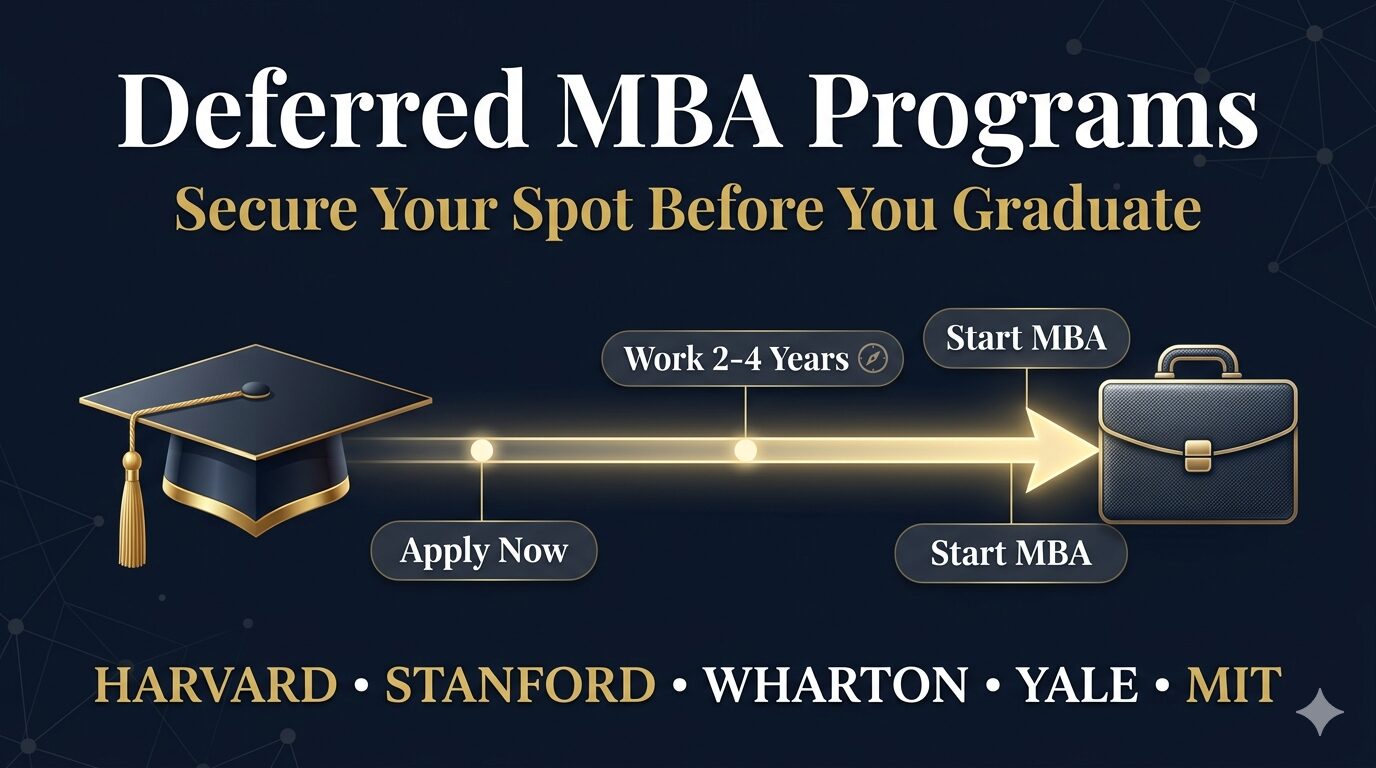
One of the biggest shifts in MBA admissions over the last few years has been the rise of deferred MBA programs. In 2026, more undergraduate students than ever are applying to elite business schools before they even start their full-time careers. The logic is simple: the traditional MBA admissions process has become brutally competitive. Deferred enrollment programs allow top undergraduates to secure admission now, work for a few years, and then return to campus later — giving students something increasingly rare in modern career planning: certainty.
Deferred MBA programs are not an easier path to elite business schools — they are often more competitive. Schools are making long-term bets on future potential, which raises the bar for every applicant.
One of the biggest shifts in MBA admissions over the last few years has been the rise of deferred MBA programs. In 2026, more undergraduate students than ever are applying to elite business schools before they even start their full-time careers. The logic is simple: the traditional MBA admissions process has become brutally competitive. At schools like Harvard Business School and Stanford Graduate School of Business, acceptance rates remain painfully low even for applicants with strong resumes, elite employers, and top GMAT scores. For ambitious college students, locking in a future MBA seat early removes a huge layer of uncertainty.
Deferred enrollment programs allow top undergraduates to secure admission now, work for a few years, and then return to campus later. In practice, it gives students something increasingly rare in modern career planning: certainty. That certainty matters more in 2026 than it did a decade ago. The job market for graduates has become more volatile, especially in consulting, tech, and finance. Students are watching layoffs happen at major firms while AI reshapes entire industries. Many high-performing undergrads now want a long-term safety net before entering the workforce.
There is also a prestige factor. Deferred MBA programs have become a signal that you were identified early as a high-potential candidate. Being admitted into programs like Harvard 2+2 or Stanford Deferred Enrollment immediately separates you from most of your peer group. The result is that deferred MBA admissions are now attracting some of the most competitive college students in the world — especially candidates interested in consulting, Wall Street, startups, entrepreneurship, and technology leadership.
A deferred MBA program allows undergraduate students or recent graduates to apply to business school before gaining traditional full-time work experience. Instead of starting the MBA immediately, admitted students defer enrollment for a required period — usually between two and five years — while they work professionally. After completing that work requirement, they return to campus and begin the MBA program.
Here is how the process usually works: you apply during your senior year of college or shortly after graduation; if admitted, your spot is reserved conditionally; you work full-time for several years; and then you return later to complete the MBA. Importantly, you do not pay tuition during the deferral period. You only begin paying once you officially start the MBA program.
The biggest advantage is obvious: you eliminate the uncertainty of future MBA admissions. Normally, professionals apply to MBA programs after several years of work experience, competing against thousands of applicants with impressive resumes from firms like Goldman Sachs, McKinsey & Company, or Google. Admissions outcomes can become unpredictable even for strong candidates. That said, these programs are not easier than traditional MBA admissions. In many cases, they are even more selective because schools are making long-term bets on your future potential rather than evaluating years of professional achievement.
Harvard Business School — 2+2 Program. Harvard Business School operates the most famous deferred MBA program in the world. Students apply during college or within one year of graduation, work for two to four years, and then return to Harvard for the MBA. The program remains extraordinarily competitive — estimated acceptance rates are around 6%, which is often lower than the already difficult standard HBS admissions rate. Harvard looks for more than academic excellence, focusing heavily on leadership, initiative, intellectual curiosity, and long-term impact potential. Harvard explicitly encourages applications from STEM and technical students, not just business majors.
Stanford GSB — Deferred Enrollment. Stanford Graduate School of Business may operate the single hardest deferred MBA program to enter. Stanford's deferred enrollment pathway is exceptionally selective because the school already has one of the lowest MBA acceptance rates in the world — estimates hover around 5% or even lower in some cycles. Unlike some programs that prioritize structured career progression, Stanford often favors applicants with unusual stories, entrepreneurial potential, or evidence of extraordinary impact. Stanford's strong connection to entrepreneurship and Silicon Valley makes it especially appealing for students interested in startups, AI, and venture capital.
Yale SOM — Silver Scholars Program. Yale School of Management offers one of the most unusual deferred MBA structures. Unlike traditional deferred programs, Silver Scholars allows students to begin the MBA immediately after undergrad. The structure works like this: Year 1 MBA coursework, Year 2 full-time internship or work experience, Year 3 final MBA coursework. The acceptance rate is estimated around 8%, making it highly competitive but slightly more accessible than Harvard or Stanford.
Wharton — Moelis Advance Access Program (M2A). The Wharton School launched the M2A program to compete directly with other elite deferred MBA offerings. Wharton remains especially dominant for students interested in investment banking, private equity, hedge funds, venture capital, and corporate finance. Many successful applicants have internship experience at firms like JPMorgan Chase, Morgan Stanley, or elite consulting firms. Estimated acceptance rates remain around 7%.
MIT Sloan — Deferred Enrollment. MIT Sloan School of Management operates one of the strongest deferred MBA programs for technical and analytical candidates, attracting a large percentage of applicants from engineering, computer science, mathematics, data science, artificial intelligence, and biotechnology. Candidates interested in AI, fintech, robotics, product management, and technical entrepreneurship often view Sloan as one of the best long-term MBA investments available. Estimated acceptance rates are near 8%.
Columbia Business School — Early Decision Program. Columbia's biggest advantage is obvious: New York City. For students targeting investment banking, private equity, asset management, or hedge funds, Columbia provides unmatched proximity to Wall Street recruiting and networking opportunities. Columbia's deferred-style admissions opportunities are generally slightly less selective than Harvard or Stanford, with estimated acceptance rates around 10%, though competition remains extremely intense.
| Program | School | Work Exp Required | Deferral Period | Acceptance Rate |
|---|---|---|---|---|
| HBS 2+2 | Harvard | 2-4 years | 2-4 years | ~6% |
| GSB Deferred | Stanford | 1-5 years | 1-5 years | ~5% |
| Silver Scholars | Yale SOM | None (internship) | Immediate | ~8% |
| M2A Program | Wharton | 2-5 years | 2-5 years | ~7% |
| Deferred Enrollment | MIT Sloan | 2-5 years | 2-5 years | ~8% |
| Early Decision | Columbia | 2-4 years | 2-4 years | ~10% |
Deferred MBA programs are not designed for average applicants. Schools are making long-term bets on future leadership potential, which means expectations are extremely high even before you begin your career. The strongest candidates usually have a GPA above 3.7, strong quantitative coursework, elite internships, demonstrated leadership, and clear long-term ambition.
Leadership matters enormously. Admissions committees want evidence that you already influence people around you. That could mean founding a startup, leading a student organization, captaining a sports team, managing a nonprofit initiative, or conducting meaningful research. Students from Ivy League schools and other target universities naturally dominate the applicant pool, but elite schools absolutely admit exceptional candidates from non-target universities as well. Deferred MBA programs also work best for students who already know they want high-level business leadership exposure in the future — candidates interested in consulting, finance, entrepreneurship, product leadership, or executive management tend to benefit the most.
The biggest challenge for deferred MBA applicants is simple: you have limited work experience. That means every other part of your profile becomes more important. First, timing matters — many strong applicants prepare during junior year rather than waiting until senior year. That gives you more time for GMAT or GRE preparation, leadership development, and internship recruiting.
Second, your "why MBA" must feel believable despite your age. Weak applicants write generic statements about "wanting leadership skills." Strong applicants connect their MBA goals directly to specific career ambitions and industry interests. Third, leadership is critical — schools care far more about initiative than titles alone. Starting something meaningful often matters more than joining prestigious organizations passively. Fourth, standardized test scores carry enormous weight for deferred applicants. Without years of work performance, admissions committees rely more heavily on quantitative indicators like GMAT and GRE scores.
Fifth, your essays need clarity. Schools want confidence that you understand where your career is heading, even if your plans evolve later. Finally, recommendations matter more than many students realize. Strong professors, research advisors, internship managers, or mentors can significantly strengthen your application if they can speak credibly about your leadership and intellectual potential.
There is no universally correct answer here. For some students, deferred MBA programs are incredible opportunities. For others, traditional MBA timing remains the better choice.
| Factor | Apply Deferred (Now) | Apply Normally (3-5 Years) |
|---|---|---|
| Certainty | High — secured seat | None — reapply later |
| Acceptance Rate | Lower (~6%) | Slightly higher (~12%) |
| Work Experience | Limited | Stronger professional profile |
| Application Prep | Less time | More preparation time |
| Best For | High-achieving students with clear goals | Most professionals |
Deferred admission works best if you are already an unusually strong candidate with clear long-term ambition. Traditional MBA admissions may be smarter if you need more time to build leadership experience, improve your profile, or clarify your career direction. There is also a psychological factor — having a guaranteed MBA seat allows some students to take bigger career risks early because they know they already secured elite graduate school admission.
The most common mistake applicants make is treating deferred MBA programs like "easier" MBA admissions. They are not. These programs attract some of the strongest undergraduates globally, including future consultants, bankers, engineers, founders, and researchers.
Another major mistake is weak career storytelling. Admissions committees do not expect perfect certainty, but they do expect direction. Generic goals like "becoming a business leader" usually fail. Applicants also underestimate interview preparation — schools like Harvard Business School and Stanford Graduate School of Business expect candidates to understand their programs deeply before interviews begin. Leadership gaps are another common weakness. Many applicants have excellent grades but very little evidence of initiative or influence outside academics. Finally, vague post-MBA plans hurt applicants significantly. Deferred MBA admissions are fundamentally about future potential. If your goals sound generic, schools struggle to envision your long-term trajectory.

Finance education is changing fast. The traditional path — textbooks, classroom lectures, and static case studies — is no longer enough for MBA students trying to compete in investment banking, private equity, consulting, venture capital, or corporate finance. In 2026, employers expect candidates to understand far more than accounting formulas and discounted cash flow models. Firms now care about financial storytelling, AI-assisted analysis, markets knowledge, technical modeling skills, and industry awareness.
Many MBA programs still teach broad business concepts, but students often need specialized resources to actually land elite finance jobs. The information gap between successful and unsuccessful candidates often comes down to preparation quality.
Whether you are interviewing with Goldman Sachs, Blackstone, or McKinsey & Company, the competition is significantly more technical than it was even five years ago. That is exactly why online finance resources have exploded in popularity. MBA students are increasingly building their own parallel education outside the classroom using websites, financial newsletters, interview prep platforms, modeling courses, and industry-specific guides.
The reality is simple: many MBA programs still teach broad business concepts, but students often need specialized resources to actually land elite finance jobs. A first-year MBA candidate preparing for investment banking recruiting may spend 20+ hours weekly on technical interview prep, additional time reading markets news, modeling practice outside class, networking preparation, and behavioral interview coaching. The same applies to consulting, equity research, corporate development, and private equity recruiting.
Not every finance website is useful for serious MBA candidates. Some platforms focus too heavily on theory. Others recycle generic career advice without explaining how recruiting actually works inside competitive industries like Wall Street or management consulting. The best MBA finance resources usually share a few key characteristics: practical career guidance, industry-specific technical content, recruiting insights, up-to-date salary and hiring trends, interview preparation materials, and real-world examples from finance firms.
For example, if you are targeting investment banking, you need more than definitions of EBITDA or enterprise value. You need to understand how technical interviews are structured, what analysts actually do daily, current compensation ranges, recruiting timelines, and which MBA programs dominate placement. The strongest finance resources in 2026 also integrate AI and technology discussions into traditional finance education — employers increasingly expect candidates to understand automation, financial analytics, and how AI affects dealmaking, valuation, and strategic decision-making.
Another major factor is readability. MBA students are busy. Most do not want 4,000-word academic essays filled with jargon. They want direct answers, real numbers, and actionable advice. That shift toward practical education is exactly why niche MBA-focused platforms continue growing rapidly.
Ten years ago, most MBA students relied heavily on school career centers, student clubs, and general business media for finance preparation. Today, students increasingly supplement those resources with specialized digital platforms. Websites focused specifically on MBA recruiting and finance careers are becoming popular because they address highly targeted questions such as: Is consulting still worth it after layoffs? Which MBA programs place best into private equity? How difficult is deferred MBA admission? What do hedge fund interviews actually look like? How much debt is reasonable for an MBA?
These are the kinds of questions students search for constantly but often struggle to answer through traditional university resources alone. MBA Finance Guide fits directly into this category by focusing on MBA-level finance education, career guidance, admissions insights, and recruiting analysis. Instead of covering general personal finance topics, the platform aligns closely with the interests of MBA applicants, business school students, early-career finance professionals, consulting candidates, and corporate strategy professionals.
This specialization matters because MBA recruiting itself has become more sophisticated. Students now compete globally for roles in investment banking, private equity, venture capital, management consulting, corporate finance, fintech, and asset management. The information gap between successful and unsuccessful candidates often comes down to preparation quality.
There is no single perfect finance platform. Most successful MBA students combine multiple resources depending on their career goals. Here are some of the most useful finance and MBA-related resources available in 2026:
| Resource | Best For | Strength |
|---|---|---|
| MBA Finance Guide | MBA careers and recruiting | MBA-focused finance insights |
| Wall Street Oasis | Investment banking prep | Interview prep and forums |
| Mergers & Inquisitions | IB recruiting | Technical finance training |
| Management Consulted | Consulting prep | Case interview resources |
| Breaking Into Wall Street | Financial modeling | Excel and valuation skills |
| Coursera | Flexible learning | University-backed online courses |
| Bloomberg | Markets knowledge | Real-time financial news |
| PitchBook | Private markets | PE and VC data |
Wall Street Oasis remains one of the most active communities for investment banking and private equity recruiting discussions. Management Consulted dominates the consulting prep space, especially for candidates targeting BCG or Bain & Company. MBA Finance Guide fills an important niche by combining MBA admissions guidance with practical finance career content in a more structured and accessible format.
One of the biggest problems with finance education online is fragmentation. Students often jump between Reddit threads, YouTube videos, outdated blog posts, and random PDFs trying to piece together information about MBA recruiting and finance careers. MBA Finance Guide stands out because it organizes finance-related content specifically around MBA student goals — MBA admissions strategy, deferred MBA programs, consulting recruiting, investment banking careers, finance salary analysis, MBA ROI discussions, and Wall Street recruiting trends.
The tone matters too. Many finance websites either sound overly academic or aggressively corporate. MBA students generally want direct, realistic guidance that reflects what recruiting actually looks like in 2026 — whether consulting is still stable after layoffs, whether AI threatens finance careers, which MBA programs still justify six-figure tuition, and which industries are growing fastest. Another strength is accessibility: finance content often becomes unreadable because writers assume everyone already understands technical terminology. That balance is extremely important for career switchers, international students, early-stage MBA applicants, and undergraduates exploring finance.
MBA recruiting trends are changing rapidly, especially as technology and AI reshape hiring priorities. Here are some of the most common post-MBA finance and strategy career paths in 2026:
| Career Path | Typical Post-MBA Compensation | Main Recruiters |
|---|---|---|
| Investment Banking | $200K–$250K | Goldman Sachs, JPMorgan |
| Consulting | $175K–$210K | McKinsey, BCG, Bain |
| Private Equity | $180K–$300K | Blackstone, KKR |
| Corporate Strategy | $140K–$180K | Amazon, Google |
| Product Finance | $160K–$220K | Microsoft, Meta |
| Venture Capital | Highly variable | VC funds and startups |
Investment banking remains one of the most popular MBA exits because compensation is still extremely strong. However, recruiting has become more selective, especially as firms reduce analyst and associate hiring during slower deal environments. Consulting remains attractive because of career optionality — even after industry layoffs, MBB firms continue offering strong exit opportunities. Meanwhile, fintech and AI-related finance roles are becoming increasingly important: MBA students with technical backgrounds now have a major advantage in recruiting.
Artificial intelligence is already reshaping how MBA students learn finance. Tasks that previously required hours of spreadsheet work can now be partially automated. AI tools help students summarize reports, analyze financial statements, generate market research drafts, and build forecasting models faster than before. That does not mean technical finance skills are becoming irrelevant — in fact, the opposite is happening.
As automation handles repetitive work, employers increasingly value candidates who can interpret financial insights, communicate strategy clearly, understand markets deeply, and make judgment calls under uncertainty. MBA students now need both technical literacy and strategic thinking. This is why modern finance education resources increasingly discuss AI in banking and consulting, financial automation, data analytics, and quantitative decision-making. Platforms that ignore these topics risk becoming outdated quickly. For students, the smartest approach is combining traditional finance fundamentals with modern analytical tools.
The best MBA students rarely rely on a single source of information. Instead, they build layered learning systems depending on career goals. A student targeting investment banking might combine technical modeling courses, markets news, networking prep, behavioral interview practice, and industry recruiting research. A consulting candidate might focus more heavily on case interview prep, strategy frameworks, industry analysis, AI transformation trends, and leadership communication.
A practical MBA finance learning stack in 2026 looks like this: daily markets reading, weekly modeling practice, networking outreach, interview preparation, career-focused MBA content, and AI and analytics education. Most successful MBA candidates spend months preparing for recruiting before interviews begin — that preparation usually happens outside formal classroom settings. Instead of wasting time searching endlessly across the internet, students can focus on curated, MBA-specific content aligned with actual recruiting outcomes.

For most professionals, changing careers without going back to school is difficult. Investment banks rarely hire engineers directly into associate roles. Consulting firms usually recruit through structured pipelines. Private equity remains heavily network-driven. And corporate finance leadership tracks often require credentials that signal both analytical skill and business judgment. That's why the MBA remains one of the most effective career reset buttons available in 2026. Over the past decade, top MBA programs have increasingly become transition platforms rather than simple advancement degrees. At schools like Harvard Business School, Wharton School, Chicago Booth, MIT Sloan, Columbia Business School, and Kellogg School of Management, a significant percentage of students enter from engineering, healthcare, military, government, or technology backgrounds and recruit into finance or consulting afterward.
"The biggest misconception about MBA recruiting is that firms only want candidates with finance backgrounds. In reality, top employers often prefer career changers because they bring industry expertise, maturity, and problem-solving skills that traditional finance candidates don't have."
In 2026, many MBA classrooms are filled with people trying to reposition themselves professionally. Engineers want access to leadership and higher compensation. Physicians are burned out from clinical practice. Software professionals want strategy exposure instead of pure execution work. Lawyers are looking for operational roles outside billable-hour structures. Business schools actively encourage these transitions because employers increasingly value diverse operating experience.
Investment banks like Goldman Sachs and JPMorgan Chase recruit engineers because they tend to handle technical modeling rigor well under pressure. Consulting firms such as McKinsey & Company, Boston Consulting Group, and Bain & Company value candidates with deep industry knowledge in healthcare, semiconductors, AI, energy, and enterprise software. Private equity firms have also widened recruiting pools. While mega-funds still prefer former bankers, operationally focused firms increasingly hire candidates with real domain expertise in healthcare systems, infrastructure, manufacturing, and technology.
| Career Path | Base Salary | Bonus Range | Total First-Year Compensation |
|---|---|---|---|
| Investment Banking Associate | $175K–$225K | $100K–$175K | $275K–$400K |
| MBB Consulting | $190K–$220K | $30K–$70K | $220K–$290K |
| Corporate Finance Leadership Programs | $140K–$180K | $20K–$50K | $160K–$230K |
| Private Equity Associate/Senior Associate | $225K–$300K | $150K–$400K+ | $400K–$700K+ |
| Corporate Strategy | $150K–$200K | $25K–$75K | $175K–$275K |
For many career changers, the MBA isn't just about prestige. It's a structured recruiting mechanism that provides access to employers who would otherwise never interview them.
Investment banking is the most reliable path for career changers because banks run formal associate recruiting programs specifically designed for MBA students. Firms expect many candidates to come from non-finance backgrounds. Consulting is similarly accessible. MBB firms routinely hire former engineers, doctors, military officers, and product managers because consulting work requires structured thinking more than prior finance knowledge.
Private equity is more complicated. Traditional buyout firms still strongly prefer candidates with pre-MBA investment banking experience. However, growth equity, healthcare investing, infrastructure, and operational investing have become more open to professionals with industry expertise. Corporate finance is often overlooked but can offer excellent compensation and work-life balance. Large companies recruit MBAs into finance leadership development programs where candidates rotate through FP&A, treasury, strategic finance, and operations.
| Career Path | Difficulty Level | Best Prior Backgrounds | MBA Recruiting Structure |
|---|---|---|---|
| Investment Banking | Moderate | Engineering, military, accounting | Highly structured |
| Consulting | Moderate | Tech, medicine, engineering | Highly structured |
| Corporate Finance | Easy | Almost all professional backgrounds | Structured |
| Private Equity | Difficult | Banking, consulting, healthcare operators | Semi-structured |
| Venture Capital | Difficult | Startup or product experience | Network-driven |
| Hedge Funds | Very difficult | Markets or investing background | Opportunistic |
One important reality: your pre-MBA background still matters after business school. A physician may have an easier path into healthcare private equity than industrials banking. A semiconductor engineer could recruit strongly for technology investment banking. The best career changers don't erase their previous careers. They reposition them.
Most applicants underestimate how compressed MBA recruiting timelines really are. For career changers targeting banking or consulting, recruiting effectively begins before classes even start. Pre-MBA preparation during the summer matters heavily. Candidates entering investment banking usually complete accounting courses, valuation training, and financial modeling prep before arriving on campus. Consulting candidates often begin casing practice months in advance.
The first semester becomes extremely intense because networking and recruiting overlap with academics immediately. For banking, informational interviews with alumni and recruiters often begin in September. Formal interviews can happen as early as January. Internship offers usually determine full-time outcomes because most firms convert interns directly into returning associates.
| MBA Timeline | What Career Changers Should Focus On |
|---|---|
| Pre-MBA Summer | Technical prep, resume repositioning, networking |
| Fall Semester Year 1 | Club involvement, recruiting events, interview prep |
| Winter Year 1 | Internship interviews |
| Summer Internship | Conversion to full-time offer |
| Year 2 | Electives, networking, specialized recruiting |
The internship is the critical turning point. If you successfully land a summer associate role at Goldman Sachs or a consulting internship at McKinsey & Company, the hardest part of the transition is already done. That's why MBA recruiting is less about your final GPA and more about preparation speed.
Engineering to investment banking is probably the most established MBA career transition path. Banks like hiring engineers because they're comfortable with quantitative work, tight deadlines, and analytical problem solving. Many engineering candidates also communicate complex ideas clearly, which matters during client interactions.
The biggest challenge isn't technical ability. It's storytelling. Many engineers explain their background in overly operational terms. Recruiters don't care that you optimized a manufacturing process by 17%. They care whether you can analyze businesses, communicate with executives, and handle high-pressure client situations.
Strong engineering-to-banking candidates usually position themselves around one of three narratives:
Sector alignment matters heavily. Oil and gas engineers often recruit into energy banking. Semiconductor engineers target technology groups. Aerospace engineers fit industrials coverage teams. A mechanical engineer from Boeing entering an MBA program at MIT Sloan could realistically recruit for industrials banking at JPMorgan Chase or technology banking at Goldman Sachs if their background supports the story.
Technical preparation is also non-negotiable. You need to understand accounting fundamentals, valuation methodologies, DCF models, comparable company analysis, M&A concepts, and financial statement interactions. Banks do not expect career changers to arrive as experts. But they do expect competence.
Technology professionals entering consulting often have an advantage that they underestimate. Consulting firms increasingly serve clients dealing with AI adoption, cloud migration, cybersecurity, enterprise software transformation, and digital operations. A software engineer or product manager can become highly valuable if they learn to frame their experience strategically instead of technically.
Weak positioning: "I built backend infrastructure systems."
Strong positioning: "I led cross-functional implementation projects supporting enterprise scalability."
Consulting recruiting focuses heavily on communication, leadership, and structured thinking. Former product managers often perform particularly well because they already work cross-functionally across engineering, operations, and leadership teams. Case interviews dominate the process. Candidates need to demonstrate structured problem-solving, clear communication, quantitative reasoning, executive presence, and comfort with ambiguity.
Top MBA consulting pipelines remain heavily concentrated at schools like Kellogg School of Management, Harvard Business School, and Wharton School. Firms such as Boston Consulting Group and Bain & Company continue to hire large numbers of technology-background MBAs because digital transformation consulting remains one of the fastest-growing segments in the industry.
Physicians and lawyers often underestimate how attractive their backgrounds can be in finance. Healthcare investing has expanded dramatically over the past decade. Private equity firms increasingly invest in physician practice management, biotech, healthcare IT, insurance platforms, and pharmaceutical services. As a result, firms value candidates who actually understand healthcare systems operationally.
A physician with an MBA from Columbia Business School or Harvard Business School may become highly competitive for healthcare-focused investing roles, particularly at middle-market funds. Similarly, lawyers often transition effectively into corporate strategy, M&A advisory, restructuring, compliance-driven finance roles, and corporate development.
However, these candidates face unique challenges. Doctors often lack financial modeling experience entirely. Lawyers may struggle with quantitative interview questions. Both groups must demonstrate genuine commitment to business rather than temporary dissatisfaction with their current careers.
Healthcare-focused firms like Blackstone and KKR increasingly value operators who understand healthcare delivery and regulation. A physician transitioning into strategic finance at a healthcare company may earn lower peak compensation than private equity but gain significantly better work-life balance while still maintaining strong long-term earnings potential.
Career changers often overcomplicate MBA essays. Admissions committees are not looking for perfect certainty. They want believable logic.
The biggest mistake applicants make is sounding artificial. Engineers suddenly claim lifelong passions for investment banking. Doctors abruptly discover "a deep love of finance." Admissions officers read thousands of applications and recognize manufactured stories immediately.
Strong career change essays usually follow a simpler structure:
Weak essay: "I want to make a global impact through finance leadership."
Strong essay: "After leading semiconductor manufacturing projects for four years, I became increasingly interested in how capital allocation decisions shaped long-term strategic priorities. I now want to transition into technology investment banking advising industrial automation clients."
Schools like Chicago Booth and MIT Sloan especially value analytical clarity and realistic career planning. You also need to explain employability — admissions officers care deeply about whether recruiters will hire you. The best essays make the transition feel inevitable rather than dramatic.
Not all MBA programs support career transitions equally well. Career changers should prioritize recruiting infrastructure over rankings alone.
| School | Strongest Career Pivot Areas | Key Recruiting Strengths |
|---|---|---|
| Harvard Business School | Consulting, PE, leadership roles | Massive alumni network |
| Wharton | Investment banking, PE | Strongest finance recruiting |
| Chicago Booth | Banking, hedge funds, corporate finance | Quantitative reputation |
| Columbia Business School | Investment banking | NYC proximity |
| MIT Sloan | Tech consulting, fintech | Strong engineering crossover |
| Kellogg | Consulting, strategy | Team leadership reputation |
Location still matters more than applicants often realize. Columbia Business School benefits enormously from direct access to New York banking recruiting. MIT Sloan tends to perform especially well for engineers and technology professionals. Healthcare professionals may also benefit from programs with strong healthcare ecosystems, including Wharton, Kellogg, Duke Fuqua, and Harvard. Schools with deep alumni representation at firms like Goldman Sachs, McKinsey & Company, Blackstone, and KKR create more interview opportunities for career changers who initially lack industry credibility.
The first major mistake is waiting too long to prepare. Many applicants assume the MBA itself will teach them everything they need for recruiting. That's incorrect. You should ideally start preparing six to twelve months before classes begin.
Second, candidates often misunderstand networking. Effective networking means gathering information, building familiarity, and demonstrating genuine interest in an industry — not asking strangers for jobs. Third, career changers frequently target overly broad goals. "I want to work in finance" is not a strategy. Better examples include: technology investment banking, healthcare private equity, corporate strategy for industrial companies, or management consulting focused on digital transformation.
Another common mistake is underestimating interview preparation. Consulting candidates often require 50–100 live case interview practices. Banking candidates may spend months preparing technical questions. Finally, many candidates fail to leverage their previous experience. Your old career is not dead weight — it's differentiation. A healthcare professional understands provider economics better than most MBA classmates. An engineer may understand manufacturing operations better than many bankers.
The MBA is not about becoming someone entirely different. It's about repositioning your existing expertise into industries with higher leverage, broader responsibility, and stronger long-term compensation potential.

Every year, thousands of applicants look at average GMAT scores and GPA ranges and assume MBA admissions are mostly numerical. That's only partially true. At elite MBA programs like Harvard Business School, Wharton School, Stanford Graduate School of Business, Chicago Booth, Columbia Business School, and MIT Sloan, admissions committees evaluate applicants holistically — but "holistic" does not mean random.
Strong candidates consistently show five things: intellectual horsepower, career momentum, leadership potential, self-awareness, and clear post-MBA goals. In 2026, MBA admissions are also more competitive than many applicants realize. Application volumes increased significantly after layoffs in tech and finance during 2023–2025, pushing more professionals toward graduate business education. That means schools now reject many candidates who would have been admitted five years ago.
Most MBA applicants overestimate the importance of raw stats and underestimate the importance of trajectory. Top schools are not building classrooms full of perfect resumes — they're building future leadership networks.
Admissions officers build a narrative impression almost immediately. A reader usually starts with resume, employer quality, career progression, academic indicators, and demographic context. Before they even finish the essays, they already have an initial judgment: Is this person ambitious? Are they credible? Do they stand out? Would recruiters want them? Would classmates learn from them?
That early impression influences how the rest of the file is interpreted. A mediocre essay from a high-impact military officer may be forgiven. A generic essay from a private equity associate probably will not. A low GPA from an engineer can be contextualized. A low GPA from a business major raises more concern.
Admissions committees also evaluate risk. MBA programs care deeply about employment outcomes because rankings and recruiter relationships depend on them. Schools want candidates who can secure strong internships and full-time offers — which is why elite programs heavily favor applicants with strong communication skills, clear career goals, demonstrated leadership, and recruitable backgrounds.
Another misconception is that schools only care about prestige. Prestige helps, but trajectory matters more. A candidate promoted rapidly at a mid-sized industrial company may outperform a stagnant analyst at a famous bank. Admissions readers constantly ask: "Is this person already becoming exceptional?"
MBA programs rarely publish minimum GPA requirements because they evaluate applicants contextually. But unofficial floors absolutely exist. At M7 schools, most admitted students fall between 3.4 and 3.8 GPA equivalents. Context matters enormously: an electrical engineering major with a 3.3 from a top technical university may be viewed more favorably than a communications major with a 3.7 from a less rigorous institution.
Admissions committees evaluate major difficulty, institutional rigor, grade trends, quantitative coursework, and professional evidence of analytical ability.
| School | Competitive GPA Range | Comments |
|---|---|---|
| Harvard Business School | 3.6–3.8 | Leadership can offset lower GPA |
| Stanford GSB | 3.7–3.9 | Most selective overall |
| Wharton | 3.5–3.8 | Strong quant profile preferred |
| Chicago Booth | 3.4–3.8 | Analytical rigor matters heavily |
| Kellogg | 3.5–3.8 | Team leadership valued |
| Columbia Business School | 3.5–3.8 | Finance-heavy applicant pool |
| MIT Sloan | 3.5–3.9 | Technical and quantitative strength valued |
A GPA below 3.2 becomes materially harder at top schools unless compensated by exceptional GMAT/GRE, elite work experience, military background, strong leadership achievements, or quant-heavy professional roles. Strong mitigation strategies include CFA exams, quantitative coursework, clear academic explanations, and demonstrated analytical success at work.
Test scores function primarily as threshold indicators. Once you're inside a competitive range, incremental gains matter less than applicants think. The practical difference between a 740 and 760 GMAT is far smaller than the difference between average and exceptional leadership experience. Still, elite programs remain highly score-sensitive.
| School | Competitive GMAT Range | Notes |
|---|---|---|
| Stanford GSB | 730–780 | Extremely score-sensitive |
| Harvard Business School | 730–770 | Balanced evaluation |
| Wharton | 730–770 | Quantitative rigor emphasized |
| Chicago Booth | 720–770 | Strong quant applicants |
| Columbia Business School | 720–760 | Finance-heavy competition |
| Kellogg | 720–760 | Leadership-focused culture |
| MIT Sloan | 730–770 | Analytical profile valued |
GRE acceptance has expanded significantly — schools increasingly treat GRE and GMAT equivalently. Applicants from quantitative backgrounds face higher expectations: a software engineer with a 315 GRE may face more scrutiny than a nonprofit applicant with the same score. Test waivers at elite programs are generally best used only when you already have exceptional quantitative credentials, advanced technical degrees, or work experience that strongly demonstrates analytical capability.
Admissions committees also evaluate demographic context. Indian male engineers face tougher statistical competition. Private equity applicants compete against extremely polished peers. Military applicants are assessed differently. Healthcare candidates often receive more contextual flexibility.
Admissions committees do not simply rank employers by prestige and admit accordingly. They evaluate progression, responsibility, impact, selectivity, leadership, and distinctiveness. A candidate at Goldman Sachs who spent three years without meaningful ownership may look weaker than an operations manager leading 80 employees at a manufacturing company.
Strong indicators include early promotions, managing teams, revenue ownership, client responsibility, strategic exposure, and high-stakes projects. Admissions committees also value asymmetric achievement: an engineer who launched a business line, an army officer leading combat logistics, a product manager driving AI deployment.
| Strong Profile | Weak Profile |
|---|---|
| Promoted twice in four years | Same title for five years |
| Led cross-functional initiatives | Individual contributor only |
| Demonstrated measurable impact | Generic responsibilities |
| Clear upward trajectory | Flat progression |
| Strategic exposure | Operational execution only |
Employer prestige still matters because schools understand recruiting selectivity. Candidates from firms like McKinsey & Company, Goldman Sachs, and Blackstone enter with credibility. But prestige without impact is weaker than many applicants assume.
MBA programs are fundamentally selecting future executives, investors, entrepreneurs, and decision-makers. That means schools care less about whether you were technically brilliant and more about whether people trust you to lead. Leadership appears in many forms: managing teams, influencing without authority, building organizations, handling crises, driving difficult decisions, creating measurable outcomes.
The strongest applicants show repeated patterns of leadership over time — military officers leading operations under pressure, product managers coordinating engineering teams, healthcare administrators redesigning clinical workflows, startup operators scaling teams rapidly. Schools especially value "earned leadership": gaining influence through competence and initiative rather than being handed authority through hierarchy.
Leadership outside work also matters if it shows genuine ownership. Weak: attending volunteer events occasionally or passive nonprofit membership. Strong: founding a mentorship initiative, leading fundraising strategy, building scalable community programs, managing volunteers and budgets. Leadership is also where essays and recommendations become critical because resumes alone rarely capture interpersonal influence effectively.
Most MBA essays fail for one reason: they sound interchangeable. Admissions officers read thousands of essays filled with vague ambitions about "making impact," "driving innovation," and "leading global organizations." Strong essays sound specific, reflective, and grounded in lived experience. The best essays answer three questions: Why you? Why now? Why this MBA?
Weak applicants describe accomplishments. Strong applicants explain decisions. Weak: "I worked on strategic initiatives at my company." Strong: "After leading an automation project that reduced manufacturing downtime by 18%, I became increasingly interested in how executive capital allocation decisions shaped operational priorities." The second version demonstrates ownership, reflection, strategic thinking, and career evolution.
Admissions readers also evaluate maturity — over-polished essays often become emotionally flat and forgettable. Schools like Stanford GSB especially reward introspection and self-awareness. Programs like Chicago Booth and MIT Sloan value intellectual clarity and analytical communication. Another major factor is goal realism: admissions committees constantly evaluate whether recruiters will buy your story. If the answer is no, your essays become much weaker regardless of writing quality.
Recommendations are not supposed to repeat your resume — their purpose is validation. Admissions committees use them to verify leadership potential, interpersonal effectiveness, coachability, professional reputation, and comparative performance. Weak recommendations are generic and inflated: "She is hardworking." "He is a great team player." "One of our best analysts." These statements mean almost nothing without evidence.
Strong recommendations include specific examples, comparative context, leadership observations, development trajectory, and honest constructive feedback. Good recommenders know your work deeply — a detailed recommendation from a VP who worked with you daily is stronger than a vague letter from a CEO who barely remembers your projects. Chasing prestigious titles instead of substantive advocacy is one of the most common application mistakes.
Recommendations become especially important for career changers because schools want external confirmation that transition goals are realistic. For applicants to Wharton or Harvard Business School, strong recommendations often become the differentiator among candidates with similar stats. One underappreciated point: recommendations should sound human. Authenticity matters more than perfection.
Most applicants either dramatically overestimate or underestimate their competitiveness. Elite MBA admits rarely have perfect profiles across every category. Most have 1–2 major strengths, 1 moderate weakness, and strong overall coherence.
| Category | Score 1 | Score 3 | Score 5 |
|---|---|---|---|
| GPA | Below 3.0 with no mitigation | Around school average | Exceptional academic record |
| GMAT/GRE | Below competitive range | Within target range | Elite percentile score |
| Work Experience | Limited impact or progression | Solid progression | Exceptional leadership and trajectory |
| Leadership | Minimal examples | Some team/project leadership | Repeated high-impact leadership |
| Essays | Generic and vague | Clear but conventional | Memorable, reflective, highly credible |
| Recommendations | Generic praise | Positive and specific | Deep advocacy with examples |
| Extracurriculars | Minimal involvement | Consistent participation | Significant leadership impact |
| Total Score | Assessment |
|---|---|
| 30–35 | Highly competitive for M7 |
| 24–29 | Competitive with strong execution |
| 18–23 | Reach candidate at top programs |
| Below 18 | Significant weaknesses to address |
MBA admissions are not fully predictable. Applicants with lower stats sometimes outperform stronger numerical candidates because they present more compelling stories, leadership patterns, or career trajectories. The strongest profiles feel coherent — admissions officers should finish reading your file and clearly understand what motivates you, why you've succeeded, where you're headed, and why an MBA makes sense now. That clarity matters far more than perfection.
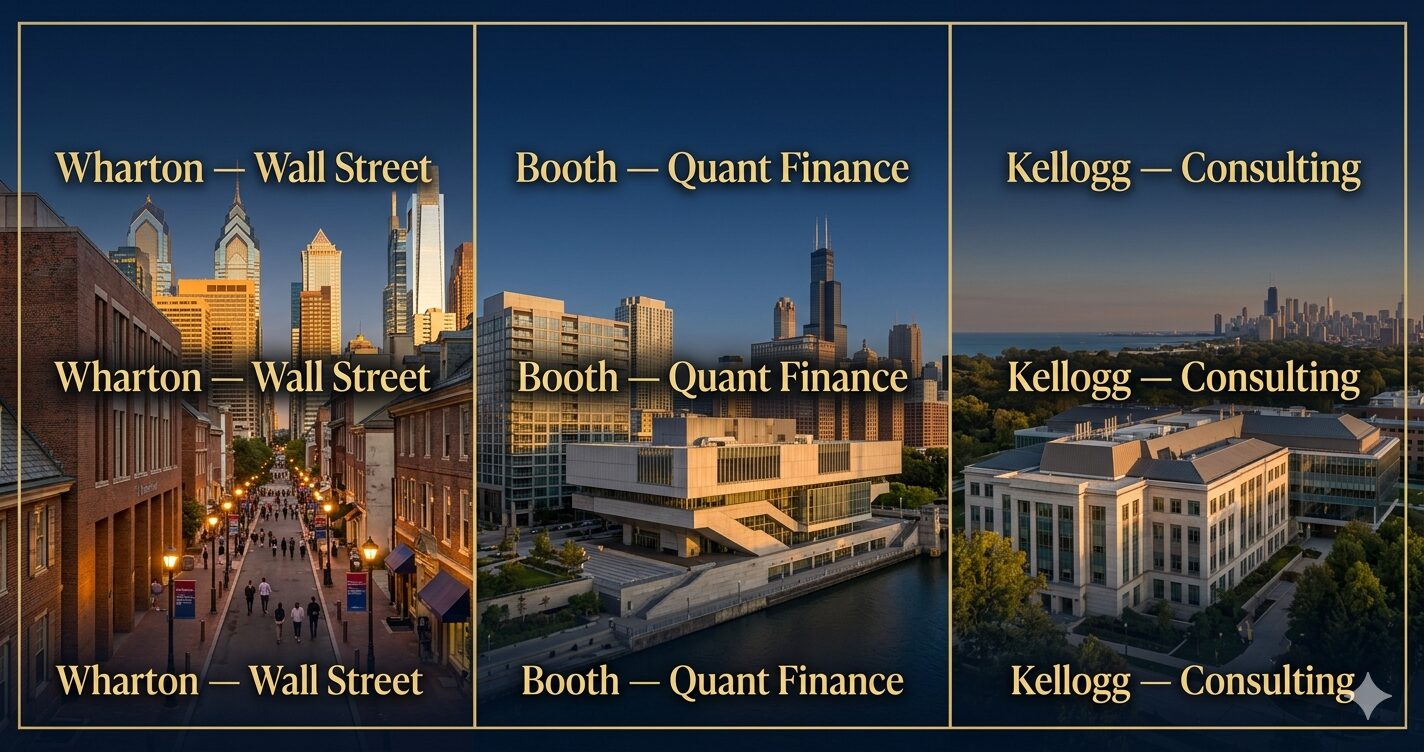
"At the M7 level, all three schools can get you interviews at Goldman Sachs, McKinsey, or Blackstone. The real difference is not whether doors open — it's which doors open more easily, how competitive your classmates are for the same jobs, and whether the school's culture actually fits the way you work."
For MBA applicants targeting finance, three schools consistently dominate the conversation outside of Harvard and Stanford: Wharton School, Chicago Booth, and Kellogg School of Management. All three sit inside the M7. All three place graduates into elite investment banks, consulting firms, private equity funds, and corporate leadership programs. And all three regularly send students to Goldman Sachs, JPMorgan Chase, McKinsey & Company, Boston Consulting Group, Bain & Company, Blackstone, and KKR.
But applicants often misunderstand how different these programs actually are. Wharton is fundamentally a finance-first ecosystem with unmatched Wall Street scale. Booth is intensely analytical and deeply respected in quantitative finance circles. Kellogg dominates consulting culture and collaborative leadership development. Those distinctions affect recruiting outcomes, internship access, peer competition, alumni behavior, classroom style, and long-term network value. This guide compares all three directly — not from a rankings perspective, but from the perspective that actually matters: which school gives you the highest probability of reaching your target career outcome?
Among elite MBA programs, Wharton, Booth, and Kellogg occupy a unique position because they combine large class sizes, deep recruiter relationships, strong alumni density, consistent finance placement, and broad career flexibility. Unlike smaller programs, these schools feed multiple industries simultaneously at scale. That matters because MBA recruiting is partly statistical — larger pipelines create stronger recruiter familiarity and more alumni pull.
Wharton sends massive numbers into investment banking and private equity. Booth maintains one of the strongest reputations in analytical finance and asset management. Kellogg consistently dominates consulting placement while still maintaining strong finance access. Applicants often assume rankings differences between these schools matter heavily. In practice, recruiter perception among top employers is extremely close. Nobody at Goldman Sachs thinks Wharton is elite but Booth isn't. Nobody at McKinsey & Company treats Kellogg as materially weaker than Wharton. The differences emerge in specialization and culture.
These schools also attract different applicant personalities. Wharton tends to attract highly ambitious finance-oriented candidates comfortable with competitive environments. Booth often attracts analytically driven applicants who prefer intellectual independence over heavily social cultures. Kellogg draws more collaborative and leadership-oriented candidates, especially those interested in consulting or team-heavy leadership roles. The best fit depends less on rankings and more on your personality, target industry, learning style, tolerance for competition, and long-term network priorities.
If your primary goal is high finance, Wharton School remains the strongest pure finance MBA in the world. That reputation is not marketing hype — it's structural. Wharton's scale in finance recruiting is difficult to replicate because of massive alumni representation on Wall Street, long-standing recruiter pipelines, a large finance-focused student population, extensive finance curriculum depth, and geographic proximity to New York.
Wharton consistently sends large numbers of graduates into investment banking, private equity, hedge funds, asset management, venture capital, and growth equity. The school's alumni network inside firms like Goldman Sachs, JPMorgan Chase, Blackstone, and KKR is enormous. That density matters because MBA recruiting is relationship-driven even when formalized. Wharton also benefits from self-selection: students entering the program often already have finance backgrounds, which strengthens recruiter confidence and internship conversion rates.
But that creates a tradeoff — competition can become extremely intense. At Wharton, you are surrounded by former bankers, PE associates, hedge fund analysts, consultants, and startup operators with elite resumes. For some students, that environment is energizing. For others, it becomes exhausting. Academically, Wharton remains broad rather than purely quantitative, with popular finance strengths including PE/VC coursework, real estate finance, distressed investing, capital markets, entrepreneurship through acquisition, and fintech.
| Best For | Less Ideal For |
|---|---|
| Investment banking | Applicants wanting low-pressure culture |
| Private equity | Students avoiding finance competition |
| Hedge funds | Highly non-quant candidates |
| High-finance networking | Applicants seeking small cohorts |
Chicago Booth occupies a very different niche from Wharton despite similar rankings. Booth's reputation is built around intellectual rigor and analytical credibility. Among finance professionals, Booth carries unusually strong respect in investment management, quantitative finance, hedge funds, asset pricing, and economics-heavy finance roles. This reputation comes partly from the school's historical connection to the Chicago economics tradition.
Booth students are often highly analytical, independent, and intellectually self-directed. The culture is less polished socially than Kellogg and less aggressively prestige-oriented than Wharton. Booth's flexibility is another major advantage: unlike many MBA programs with lockstep structures, Booth allows students substantial control over course sequencing, academic intensity, and specialization depth. Students targeting finance can build extremely technical academic paths. Booth performs exceptionally well in asset management, research-heavy investing, quant-oriented finance, corporate finance, and restructuring.
Chicago's financial ecosystem supports strong recruiting into Goldman Sachs, JPMorgan Chase, elite hedge funds, proprietary trading firms, and investment management firms. The city remains heavily connected to trading, derivatives, market-making, industrial finance, and Midwestern corporate leadership. One underrated advantage of Booth is reduced social pressure — students often describe the environment as intellectually intense but less performative. However, that culture can also feel less cohesive socially compared to Kellogg.
| Best For | Less Ideal For |
|---|---|
| Quantitative finance | Applicants wanting highly social culture |
| Hedge funds | Candidates uncomfortable with academic rigor |
| Investment management | Students seeking structured environments |
| Corporate finance | Heavy leadership-development focus |
Kellogg School of Management is frequently misunderstood by finance applicants. Many candidates incorrectly assume Kellogg is "only" a consulting school. That's inaccurate. Kellogg absolutely dominates consulting placement, but it also maintains strong finance recruiting pipelines — especially in investment banking, corporate finance, strategy roles, fintech, and growth-oriented investing.
The school's defining characteristic is collaborative leadership culture. Kellogg places enormous emphasis on teamwork, communication, interpersonal effectiveness, and leadership development. That culture aligns extremely well with consulting recruiting. As a result, firms like McKinsey & Company, Boston Consulting Group, and Bain & Company recruit heavily from Kellogg every year. The school consistently produces some of the strongest MBB placement numbers in the MBA market.
Kellogg's finance outcomes are solid but less finance-dominated culturally than Wharton or Booth. At Kellogg, you are less likely to feel like every conversation revolves around private equity recruiting or hedge fund compensation. The school also tends to attract candidates with stronger interpersonal orientation: consultants, marketers, operators, product managers, and military officers. Kellogg's Evanston location supports consulting recruiting and Midwestern corporate leadership but lacks the immediate Wall Street immersion of New York programs.
| Best For | Less Ideal For |
|---|---|
| Consulting | Pure hedge fund recruiting |
| Leadership development | Hyper-competitive finance culture |
| Team-oriented candidates | Deep quant specialization |
| Corporate strategy | Applicants wanting NYC proximity |
All three schools provide elite finance education, but they approach it differently. Wharton offers the broadest dedicated finance ecosystem overall — you can specialize deeply across nearly every finance vertical including PE, VC, real estate, credit, restructuring, and entrepreneurship finance. Booth provides the strongest technical rigor; students interested in modeling, pricing, economics, and quantitative analysis often prefer Booth's intellectual environment. Kellogg's curriculum is comparatively leadership-oriented — finance students still receive excellent technical preparation, but the broader emphasis remains on management, teams, communication, and organizational leadership.
| Category | Wharton | Booth | Kellogg |
|---|---|---|---|
| IB Placement | Extremely strong | Very strong | Strong |
| Consulting Placement | Strong | Very strong | Elite |
| Median Salary | ~$190K | ~$185K | ~$185K |
| Median GMAT | ~733 | ~729 | ~731 |
| Tuition & Fees | ~$175K+ | ~$170K+ | ~$170K+ |
| Class Size | Large (~875) | Large (~620) | Large (~560) |
| Location Advantage | NYC access | Chicago finance ecosystem | Chicago consulting ecosystem |
Another distinction is grading and classroom culture. Booth students often describe classes as highly analytical and debate-driven. Wharton classes can feel professionally competitive and recruiter-focused. Kellogg classes tend to emphasize collaboration and group dynamics more heavily. These differences shape daily MBA life more than applicants expect.
Recruiting outcomes at elite MBA programs are not equal across all industries.
Wharton remains the strongest overall banking feeder because of alumni scale, NYC proximity, recruiter volume, and finance concentration. Booth remains extremely strong, especially for restructuring, industrials, asset management, and trading-oriented finance. Kellogg places well into banking but sends a smaller percentage of the class there overall.
Private equity recruiting remains heavily network-based. Wharton's PE alumni network is probably unmatched outside Harvard. Booth also performs strongly in hedge funds, investment management, and buy-side finance. Kellogg has solid PE outcomes but is less dominant in mega-fund recruiting.
Kellogg's consulting culture and alumni density make it one of the strongest MBB pipelines globally. Both Booth and Wharton also place heavily into McKinsey & Company, Boston Consulting Group, and Bain & Company — but Kellogg's collaborative reputation aligns particularly well with consulting recruiting.
Booth performs strongly because of analytical credibility. Kellogg performs strongly because of leadership orientation and corporate relationships. Wharton graduates often self-select away from corporate finance toward higher-paying finance roles.
Applicants consistently underestimate how important culture becomes during the MBA experience. Two years is a long time. The social environment affects friendships, recruiting stress, networking comfort, and emotional sustainability.
Wharton's culture is ambitious and highly career-focused. Students often describe the environment as energetic, competitive, high-achieving, and finance-heavy. For some people, that creates extraordinary motivation and networking access. For others, it becomes emotionally draining. Booth's culture is more intellectually individualistic — students tend to care less about status signaling and more about analytical competence. The atmosphere is often described as thoughtful, low-ego, academically serious, and independent.
Kellogg has the strongest reputation for social cohesion. Students often describe collaborative recruiting, strong peer support, active social life, and highly team-oriented culture. This distinction matters especially during recruiting: consulting recruiting at Kellogg often feels highly collaborative, while banking recruiting at Wharton can feel more competitive internally because many classmates pursue similar goals.
Alumni behavior also differs. Wharton's alumni network is massive and influential. Booth's network is deeply respected in finance circles, particularly among analytical investors. Kellogg's alumni network tends to be unusually responsive and relationship-oriented. None of these cultures are objectively better — they fit different personalities.
All three programs are extremely expensive in 2026. Estimated total MBA cost including tuition, housing, travel, and opportunity cost often exceeds $250K–$350K+. That makes ROI analysis essential.
| School | Estimated Total Cost | Typical Post-MBA Median Compensation |
|---|---|---|
| Wharton | $300K+ | $190K+ |
| Booth | $285K+ | $185K+ |
| Kellogg | $285K+ | $185K+ |
Wharton often produces the highest upside outcomes because of stronger PE placement, banking concentration, and buy-side access. Booth performs exceptionally well for investment management, hedge funds, and analytical finance. Kellogg tends to produce slightly broader distributions because more students enter consulting and corporate leadership.
Scholarships vary heavily based on demographics, industry background, competing offers, test scores, and diversity priorities. Booth is often viewed as somewhat more merit-scholarship aggressive than Wharton. Kellogg also uses scholarships strategically to compete for consulting-oriented candidates. Applicants leaving PE, hedge funds, or investment banking face much higher forgone income than applicants from engineering or nonprofit backgrounds, which changes the economics substantially.
There is no universally "best" school among these three. The best school depends on your career target, personality, learning style, and recruiting priorities.
You are highly focused on investment banking or private equity, you want maximum Wall Street alumni density, you thrive in ambitious competitive environments, you care about broad finance optionality, and you want the strongest overall finance brand. Wharton is the safest high-finance bet.
You are deeply analytical, you care about quantitative rigor, you are interested in hedge funds or investment management, you prefer intellectually independent cultures, and you value flexibility over structured leadership programming. Booth is often the strongest fit for finance purists.
You are targeting consulting, you value collaborative culture, you want strong leadership development, you prefer team-oriented environments, and you want broad corporate strategy flexibility. Kellogg is often the best long-term leadership development environment.
At this level, fit matters more than rankings noise. All three schools can get you interviews at Goldman Sachs, JPMorgan Chase, McKinsey & Company, and Blackstone. But your experience, network strength, and recruiting success often improve dramatically when the culture actually matches your personality. That's the difference applicants discover too late.

MBA employment reports are designed to market schools, not help applicants compare risk. The important question is not whether graduates eventually get jobs — it's who gets the best jobs, how fast they get them, and how many students quietly miss the outcomes advertised on the brochure.
MBA employment reports look impressive on the surface. Schools regularly advertise placement rates above 90%, median salaries above $175,000, and recruiter relationships with firms like Goldman Sachs, McKinsey & Company, Google, and Blackstone.
But raw placement numbers can be misleading. A school reporting "95% employed within three months" does not necessarily mean:
In 2026, MBA applicants are increasingly focused on return on investment. Tuition at top US MBA programs now regularly exceeds $250,000 all-in once living expenses and opportunity cost are included. That changes the calculation dramatically. Applicants no longer just ask "Can this school get me a job?" They ask: "Can this school get me the specific career outcome I'm paying for?"
This distinction matters because placement strength varies heavily by industry, geography, alumni density, economic cycles, international hiring conditions, and employer pipelines. This guide breaks down what MBA placement data actually means, which schools dominate specific industries, and how applicants should interpret employment reports realistically instead of emotionally.
Most employment reports emphasize headline metrics: employment rate, median salary, signing bonus, and top employers. These numbers are useful, but incomplete. The biggest issue is that schools report aggregate outcomes rather than distribution quality.
For example, a school may report a median salary of $190,000 while quietly placing only a small percentage into elite investment banking or consulting firms. Similarly, employment reports often blur distinctions between:
Timing also matters. Schools typically measure outcomes three months after graduation. That can obscure candidates who struggled initially but found jobs later. Economic conditions matter even more. Between 2021 and early 2023, MBA hiring was exceptionally strong. By 2024 and 2025, consulting firms slowed hiring while technology recruiting weakened substantially. Finance remained relatively resilient, but placement became more uneven across schools.
Applicants should also understand how schools classify outcomes. "Consulting" may include Tier-2 firms, implementation consulting, or boutique strategy firms. "Finance" may include corporate finance roles, not just investment banking or private equity. "Technology" can include operations or sales roles, not necessarily product management. Employment reports are marketing documents first and analytical comparisons second. That's why applicants need to focus on deeper metrics.
Applicants evaluating MBA placement outcomes should focus on five core indicators.
A school may rank highly overall while underperforming in your target field. Columbia Business School is exceptionally strong for investment banking, Kellogg School of Management consistently dominates consulting, and MIT Sloan performs strongly in technology and analytics. General rankings often hide these distinctions.
Fast recruiting pipelines reduce career risk. Schools with deeply established recruiting ecosystems tend to generate earlier internship and full-time offers. That matters significantly during weaker hiring cycles.
You should look at repeat recruiters rather than one-off placements. A school sending dozens of graduates annually to Goldman Sachs, Morgan Stanley, McKinsey & Company, Boston Consulting Group, and Bain & Company is fundamentally different from a school occasionally placing one or two students there.
Location strongly affects recruiting density. New York programs naturally dominate Wall Street recruiting. Chicago schools maintain strong Midwestern corporate pipelines. Bay Area schools benefit from technology ecosystems.
This is the least transparent but increasingly important metric. Some schools maintain stronger employer sponsorship ecosystems than others. International students often face materially different recruiting outcomes, especially in consulting and tech. Applicants should evaluate placement reports with skepticism but not cynicism. The numbers matter — you just need to interpret them properly.
Finance placement remains one of the clearest differentiators among top MBA programs. While many schools place graduates into finance broadly defined, only a smaller group consistently feeds elite investment banking, private equity, and buy-side recruiting at scale.
| School | IB Placement % | Consulting % | Tech % | Median Salary | Avg. Time to Offer |
|---|---|---|---|---|---|
| Wharton | 38% | 24% | 14% | $190K | 2–3 months |
| Columbia | 36% | 21% | 13% | $190K | 2–3 months |
| Chicago Booth | 34% | 26% | 15% | $185K | 2–4 months |
| Harvard | 22% | 28% | 20% | $190K | 2–4 months |
| Kellogg | 18% | 37% | 18% | $185K | 2–4 months |
| MIT Sloan | 16% | 27% | 26% | $185K | 2–5 months |
| NYU Stern | 32% | 19% | 16% | $180K | 2–4 months |
| Georgetown McDonough | 21% | 24% | 12% | $165K | 3–5 months |
These figures are based on publicly available employment reports combined with observed recruiting trends from 2025 and early 2026. Finance recruiting remains highly concentrated geographically. Wharton School, Columbia Business School, and New York University Stern School of Business maintain especially strong finance pipelines because of direct New York access.
Even traditionally finance-heavy schools now send larger percentages into corporate strategy, technology, AI infrastructure, fintech, and operations leadership. The modern MBA market is much less banking-dominated than it was fifteen years ago.
Investment banking remains one of the most structured MBA recruiting industries. Banks hire associates through highly organized internship pipelines, making MBA programs critically important entry points. The schools dominating Wall Street recruiting in 2026 — Wharton School, Columbia Business School, Chicago Booth, and New York University Stern School of Business — consistently place graduates into Goldman Sachs, Morgan Stanley, and JPMorgan Chase.
Wall Street recruiting remains heavily relationship-driven despite formal processes. That's why alumni density matters so much. At schools like Columbia and Wharton, students interact directly with alumni bankers throughout the recruiting cycle. Those relationships improve interview access significantly.
A school placing 35% into investment banking may have strong self-selection toward finance, recruit heavily from former bankers, offer stronger technical preparation, or maintain long-standing alumni dominance. This is why applicants should evaluate not just placement percentages but also candidate backgrounds. For career changers, banking placement strength matters even more because structured recruiting reduces transition risk.
Banks increasingly prefer converting summer associates rather than hiring externally. Schools with stronger internship conversion pipelines provide more stability during uncertain hiring cycles. Typical 2026 investment banking associate compensation: base salary $175K–$225K, bonus $100K–$175K, with total compensation reaching $275K–$400K+.
Consulting placement remains one of the clearest indicators of overall MBA recruiting strength. Unlike banking, consulting firms recruit from broader backgrounds: engineers, military officers, physicians, product managers, nonprofit leaders, and corporate operators. This makes consulting especially attractive for career changers.
The strongest consulting pipelines in 2026 remain concentrated at Kellogg School of Management, Harvard Business School, Chicago Booth, and MIT Sloan. MBB firms — McKinsey & Company, Boston Consulting Group, and Bain & Company — still dominate elite consulting recruiting.
However, hiring slowed materially during 2024 and parts of 2025 because of reduced corporate strategy spending and over-hiring during earlier years. That slowdown revealed an important difference: top-tier MBA programs maintained recruiting resilience better than lower-ranked programs. Kellogg continued placing heavily into consulting despite slower hiring, while mid-tier programs saw significantly weaker MBB conversion rates.
Consulting compensation remains strong: base salary $190K–$220K, signing bonus $30K–$40K, and performance bonus $20K–$40K. One emerging trend is specialization — technology strategy, AI implementation, healthcare transformation, and operations consulting are growing rapidly, favoring candidates with prior domain expertise rather than pure generalists.
The biggest structural shift in MBA employment over the past decade has been the growth of technology and corporate strategy roles. Historically, banking and consulting dominated MBA recruiting. Today, many students deliberately avoid both industries.
Even after technology hiring slowdowns during 2023–2025, companies such as Google and Amazon remain major MBA employers. Corporate strategy has also expanded substantially across healthcare, manufacturing, fintech, AI infrastructure, energy, and enterprise software. This trend benefits candidates seeking better work-life balance, lower burnout risk, long-term operational leadership, and geographic flexibility.
Schools like MIT Sloan and Harvard Business School perform particularly well in these hybrid leadership pathways. Compensation in corporate strategy remains lower than investment banking but still highly competitive: base salary $150K–$210K, bonus/equity $25K–$100K+, with total compensation reaching $180K–$300K+. Equity upside becomes especially important at technology companies and growth-stage firms.
Unlike banking, corporate strategy recruiting often occurs throughout the year rather than through narrow internship windows. That flexibility can help students pivot industries during the MBA rather than committing immediately.
Salary data remains one of the most visible MBA outcome metrics, but median salary does not reflect equity compensation, carry potential, long-term upside, geographic cost differences, or international compensation adjustments. Still, salary comparisons provide useful directional insight.
| School | Median Base Salary | Typical Signing Bonus | High-End Outcomes |
|---|---|---|---|
| Harvard | $190K | $35K | PE/HF roles exceed $400K |
| Wharton | $190K | $35K | Strongest finance upside |
| Columbia | $190K | $30K | Heavy banking concentration |
| Booth | $185K | $30K | Strong finance + consulting |
| Kellogg | $185K | $30K | Consulting-heavy distribution |
| MIT Sloan | $185K | $30K | Strong tech/equity upside |
| NYU Stern | $180K | $25K | Strong Wall Street access |
| Georgetown McDonough | $165K | $20K | DC corporate/government mix |
Salary dispersion at top MBA programs is massive. A graduate entering private equity, hedge funds, or elite investment banking may earn dramatically more than classmates entering corporate leadership programs, nonprofit management, or public sector strategy. Median figures compress these differences heavily. Applicants should focus more on target industry placement, employer access, alumni networks, and long-term trajectory rather than salary numbers alone.
Geography shapes MBA outcomes more than rankings discussions usually acknowledge.
New York remains the dominant center for investment banking, private equity, hedge funds, corporate law, and financial services consulting. Schools with strongest NYC access — Columbia Business School, New York University Stern School of Business, and Wharton School — benefit from frequent networking events, semester-time interviews, dense alumni presence, and easier informational meetings.
Chicago remains exceptionally strong for corporate finance, investment management, consulting, and industrials banking. Chicago Booth and Kellogg School of Management benefit heavily from deep Midwestern corporate relationships. Chicago also tends to provide slightly lower living costs than New York or San Francisco, which matters during MBA programs.
The Bay Area dominates technology leadership, product management, venture capital, AI infrastructure, and startup ecosystems. MIT Sloan and West Coast schools maintain stronger access to these industries. However, technology recruiting became more volatile after 2023 layoffs. Applicants should understand that tech placement can fluctuate more dramatically than banking or consulting. Location does not determine your career outcome entirely, but proximity still matters because recruiting remains relationship-driven.
Most applicants use rankings incorrectly. General MBA rankings matter less than industry fit, recruiting strength, geographic access, alumni density, and career-switching support.
If your goal is investment banking, placement percentages into Wall Street firms matter more than overall academic reputation. If your goal is consulting, MBB pipelines matter more than broad employment rates. Applicants should also think probabilistically. The real question is not "Can someone from this school get my target job?" The correct question is: "How consistently does this school place candidates like me into that role?" That distinction matters enormously for career changers, international students, and nontraditional applicants.
During weaker hiring cycles, elite schools maintain recruiter relationships better, strong alumni networks matter more, and internship conversion rates become critical. This is why placement consistency matters more than isolated high-end outcomes. Every school occasionally places graduates at elite firms like Blackstone. The important question is how repeatable those outcomes actually are.
Ultimately, the best MBA program is not necessarily the highest-ranked one. It's the school that maximizes your probability of achieving your specific career goal with acceptable financial risk.

Every May and June, top business schools begin publishing application deadlines for the next admissions cycle — and every year, thousands of strong candidates miss their best shot simply because they started planning too late. For applicants targeting Fall 2027 enrollment, the 2026-2027 cycle deadlines are now rolling out, with Round 1 dates for most M7 and other elite programs falling between early September and mid-October 2026.
This guide compiles what has been confirmed so far, the typical deadline pattern each school has followed in recent cycles, and — more importantly — how to actually use these dates to build a realistic application timeline. We update this page as schools confirm their official 2026-2027 dates.
Round 1 isn't just "the first deadline." At most top programs it's a structurally different applicant pool, a different scholarship pool, and a different admit rate than Round 2 or Round 3. Treating all rounds as interchangeable is one of the most expensive mistakes applicants make.
Application volume at elite MBA programs has stayed elevated since the 2023-2025 layoff wave pushed more finance, consulting, and tech professionals toward graduate business education. That means more qualified candidates competing for a roughly fixed number of seats — and it means the advantages of applying earlier in the cycle, when class composition and scholarship budgets are most open, matter more than they did five years ago.
Schools also increasingly evaluate Round 1 and Round 2 applicants somewhat differently in practice, even when they publicly describe a single holistic standard. Interview invitations move faster in Round 1, waitlist movement is more predictable, and many merit scholarship dollars get allocated before Round 2 decisions are even released.
Most M7 and top-15 programs run three or four rounds per cycle, typically clustered around September-October (R1), December-January (R2), and March-April (R3, often for international or reapplicants only at the most selective schools). The mechanics differ meaningfully between rounds.
| Factor | Round 1 | Round 2 | Round 3 |
|---|---|---|---|
| Applicant pool size | Smaller, often stronger self-selected pool | Largest pool of the cycle | Smallest, most competitive for remaining seats |
| Scholarship availability | Most open | Partially allocated | Often very limited |
| Visa/relocation runway | Most comfortable for international students | Workable | Tight, especially for visa processing |
| Effective admit rate | Typically the most favorable | Moderate | Lowest — competing for what's left |
| Best for | Applicants with a ready GMAT/GRE score and polished essays | Most applicants — the default round | Reapplicants or candidates with a strong, specific reason to wait |
The common myth that "Round 2 is the real Round 1 because more people apply then" is only partly true. Pool size is larger in Round 2, but so is the number of available seats already filled by Round 1 admits — which is exactly why effective admit rates tend to compress in later rounds. None of this means Round 2 candidates can't get in; the majority of any admitted class enrolls from Round 2. It means Round 1 carries a structural advantage for candidates who are genuinely ready.
Schools confirm exact 2026-2027 dates on a rolling basis between May and August 2026, and a portion of the list below was still pending official confirmation at the time of writing. Where a school has not yet published its exact date, we list the typical historical window based on the school's pattern over the past several cycles. Always verify the exact date on the school's official admissions page before building your timeline around it.
| School | Round 1 (Fall 2027 entry) | Round 2 |
|---|---|---|
| Columbia Business School | September 9, 2026 (confirmed) | Early January 2027 (typical) |
| Harvard Business School | Early-to-mid September 2026 (typical) | Early January 2027 (typical) |
| Stanford GSB | Late September 2026 (typical) | Early January 2027 (typical) |
| Wharton School | Mid-September 2026 (typical) | Early January 2027 (typical) |
| Chicago Booth | Late September 2026 (typical) | Early January 2027 (typical) |
| Kellogg School of Management | Mid-September 2026 (typical) | Early January 2027 (typical) |
| MIT Sloan | Late September 2026 (typical) | Early January 2027 (typical) |
| NYU Stern | Mid-October 2026 (typical) | Early January 2027 (typical) |
| Yale SOM | Mid-September 2026 (typical) | Early January 2027 (typical) |
| Duke Fuqua | Mid-September 2026 (typical) | Early January 2027 (typical) |
| UVA Darden | Mid-September 2026 (typical) | Early January 2027 (typical) |
| UC Berkeley Haas | Late September 2026 (typical) | Early January 2027 (typical) |
| U Washington Foster | October 1, 2026 (confirmed) | Early January 2027 (typical) |
Two patterns are worth noting. First, Round 1 deadlines cluster tightly within about a five-week window (early September to mid-October) — meaning candidates applying to three or four schools in Round 1 are usually managing overlapping essay sets simultaneously, not sequential ones. Second, nearly every school's Round 2 deadline lands in the first two weeks of January, immediately after the holidays, which is precisely why so many applicants underestimate how much essay and recommendation work needs to happen before Thanksgiving.
The single biggest planning error applicants make is treating the deadline as the start of the work rather than the end of it. A realistic Round 1 timeline, working backward from an early-to-mid September deadline, looks roughly like this:
Candidates who start essay drafts in August for a September deadline are almost always writing under avoidable pressure. The schools can tell.
Apply Round 1 if your GMAT/GRE score is already where you want it, your essays can get genuine revision time (not just proofreading), and your recommenders have the bandwidth to write thoughtful letters before September. Apply Round 2 if you need until November or December to hit your target test score, or if a Round 1 deadline would force you to submit a rushed, generic application. Round 2 is the default round for the majority of a typical admitted class and carries no stigma.
Consider waiting a full additional year if your profile has a structural gap — a GPA or test score well outside your target schools' range, limited leadership evidence, or a career story that genuinely needs another 12 months to develop — rather than submitting a weaker application on a tighter timeline. An extra year that meaningfully strengthens your profile usually outperforms rushing into the current cycle.

For two decades, the investment banking analyst role has run on a predictable formula: hire a large class of bright generalists, have them build models and decks until 3am, and let the highest performers survive into associate roles. In 2026, that formula is breaking — not because deal volume is collapsing, but because generative AI tools are absorbing a growing share of the work that used to define the first two years of the job.
This isn't a hypothetical future. Banks are already restructuring deal teams around it, and the analyst experience entering in 2026 looks materially different from the one that existed even three years ago.
AI hasn't eliminated the analyst seat. It has eliminated the version of the analyst seat where your value was simply being willing to build the same model faster than the next person.
Deal volumes recovered meaningfully through 2025 and into 2026 as interest rates stabilized and CEO confidence improved, and hiring at most major banks picked up in response. Sector demand has been particularly strong in technology, financial institutions, healthcare, private capital advisory, secondaries, restructuring, and energy and infrastructure. So the headline story is not "banks are cutting analysts" — it's that banks are increasingly hiring fewer analysts per deal while expecting more output per head, with automation absorbing the repetitive modeling and document work that traditionally consumed junior banker hours.
That distinction matters enormously for anyone evaluating whether to pursue this career. The job hasn't become less valuable — it has become less forgiving of analysts who can only execute mechanical tasks and can't yet add judgment on top of them.
Generative AI and purpose-built financial automation tools have gotten genuinely good at a specific category of work — the category that used to anchor most of an analyst's first six months on the job.
These were, historically, exactly the tasks that justified hiring a large analyst class — and exactly the tasks that are now compressing the number of junior staff needed per deal team.
The tasks AI handles well are precisely the tasks that were never the actual differentiator between a good banker and a mediocre one. What still requires a human, and what increasingly defines the value of a junior banker in 2026, includes:
The MBA and pre-MBA finance education that builds these skills hasn't become less relevant in the AI era — if anything, the gap between analysts who only execute and analysts who can also exercise judgment has widened.
The practical effect inside banks has been a quiet compression of deal team size at the most junior level, paired with a higher technical bar for the analysts who are hired. Competition for entry-level seats has intensified rather than eased — Goldman Sachs reportedly received over 250,000 applications for roughly 2,900 summer internship slots in the most recent cycle, putting the acceptance rate at just above 1%.
| Then (pre-AI deal teams) | Now (2026 deal teams) |
|---|---|
| 2-3 analysts per live deal | 1-2 analysts per live deal, AI-assisted |
| Value measured by hours and output volume | Value measured by judgment, accuracy, and speed of review |
| Modeling skill alone was differentiating | Modeling + AI-tool fluency + judgment is the baseline |
| Large analyst classes hired broadly | Smaller, more selective analyst classes |
Compensation has not compressed alongside headcount — if anything the opposite. Base salaries for entry-level roles have risen, with many firms now starting analysts between $110,000 and $125,000 before bonus, and total first-year compensation frequently exceeding $190,000 once year-end incentives are included. At elite boutiques such as Evercore, Centerview, and Moelis, total comp for top-ranked analysts can exceed $250,000. Hiring strength is concentrated at the associate and VP levels even more than at the analyst level, reinforcing that banks want fewer, stronger junior staff who can be promoted quickly.
Recruiters are explicitly screening for AI-tool fluency alongside the traditional technical screen. Candidates who can demonstrate they've used AI tools to accelerate modeling or research — while still being able to explain and defend every number by hand — stand out from candidates who either can't model independently or who treat AI output as a black box.
The technical interview bar itself has not softened. If anything, interviewers increasingly probe whether a candidate understands why a model produces a given output, not just whether they can produce one — because that's exactly the skill AI can't yet replace, and exactly the skill banks are now optimizing their hiring for.

"What are my actual odds of getting an investment banking offer?" is one of the most common questions we get from undergraduates and MBA candidates — and it's also one of the hardest to answer precisely, because banks do not publish official acceptance-rate statistics the way universities do. What follows is the most accurate picture we can compile from reported application volumes, hiring class sizes, and recruiting-cycle data points that have surfaced publicly, alongside the context needed to interpret them correctly.
A single acceptance-rate number tells you almost nothing about your own odds. The same recruiting cycle that rejects 99% of applicants overall converts a meaningfully higher share of candidates who do the process right.
Unlike business schools, banks rarely disclose exact application and offer counts. The figures that circulate publicly come from a mix of leaked internal data, journalist reporting, and bank statements made in specific contexts (often around a flagship internship program). They should be read as directional estimates, not audited statistics. That said, the consistent picture across every reporting cycle is the same: top-tier investment banking recruiting is now harder to break into than admission to most elite universities and graduate programs.
Knowing the real order of magnitude matters because it resets expectations. Many candidates underestimate how much volume they're competing against, then misread early rejections as a signal about their own qualifications rather than as a predictable function of an extremely oversubscribed process.
The most cited public data point comes from Goldman Sachs, which has reported receiving roughly 250,000 applications for its summer internship program against approximately 2,900 available slots in recent cycles — an acceptance rate just above 1%. Other bulge bracket banks (JPMorgan, Morgan Stanley, Bank of America, Citi) do not publish comparably precise figures, but recruiting professionals and campus career offices consistently describe application volumes and hiring-class sizes in a similar range, with reported overall acceptance rates across major banks' entry-level programs typically estimated between 1% and 4% depending on the specific division, region, and how narrowly "applicant" is defined.
| Firm tier | Estimated acceptance rate | Note |
|---|---|---|
| Goldman Sachs (summer internship) | ~1.16% (reported) | ~250,000 applicants vs ~2,900 slots |
| Other bulge brackets (JPM, MS, BofA, Citi) | ~1-4% (estimated) | No official published figures; estimated from reported volumes |
| Elite boutiques (Evercore, Centerview, Moelis, Lazard) | <1% (estimated) | Far smaller analyst classes per cycle |
| Middle-market and regional banks | 5-15% (estimated) | Smaller applicant pools, less centralized recruiting |
These figures should be treated as a directional range rather than precise benchmarks — exact percentages shift year to year with deal volume, headcount planning, and how aggressively a given bank markets its program to undergraduates.
It's a common misconception that boutiques are "easier" than bulge brackets because they're less famous to the general public. In practice, the opposite is usually true. Firms like Evercore, Centerview Partners, Moelis, Lazard, and Perella Weinberg run analyst classes that are a fraction of the size of a typical bulge bracket's — often 15 to 40 analysts globally, compared to several hundred at a large bank — while still drawing applications from many of the same highly credentialed candidates. The result is an acceptance rate that is frequently lower than the bulge brackets, even though the applicant pool is smaller in absolute terms, because the number of seats shrinks even faster.
Target-school recruiting pipelines remain real and measurable: banks allocate a disproportionate share of first-round interviews to a defined list of "core" or "target" schools where they run structured on-campus recruiting, info sessions, and dedicated recruiter relationships. Candidates from those schools statistically see meaningfully higher response and interview rates simply because the volume of resumes a recruiter reviews per target-school candidate is far lower than the volume reviewed from the open applicant pool.
That said, target-school status changes the size of the funnel you enter, not the ceiling on outcomes. Non-target candidates with a strong network, a finance-relevant internship already on the resume, and a technical interview that's genuinely sharp regularly convert offers — they simply have to work harder to get the first conversation, often through networking and direct outreach rather than the structured on-campus pipeline.
The headline acceptance-rate statistics describe the hardest part of the funnel: getting the internship offer in the first place. The number that should actually shape your strategy once you're in the door is the internship-to-full-time conversion rate — and it is dramatically more favorable. Most bulge brackets and boutiques convert the large majority of their summer analyst class into full-time offers, with conversion rates commonly reported in the 80-95% range in strong deal-volume years, falling somewhat lower in slower years when banks tighten headcount.
This is the single most underappreciated fact in IB recruiting: the brutal odds are concentrated almost entirely at the point of landing the internship. Once you have the seat, your odds of converting to a full-time offer are far better than the initial acceptance rate suggests — provided you perform reasonably well and don't damage the relationship during the summer.

You cleared the hardest part of investment banking recruiting — a sub-2% acceptance rate, multiple rounds of technical interviews, and a superday. Now you have ten weeks to turn that internship into the offer that makes it worth it. Most summer analysts who don't convert don't fail because they couldn't do the work. They fail because they misread what the bank was actually evaluating.
The internship isn't a longer interview. It's a preview of what you'd be like to work with at 1am on a live deal. Banks are hiring for that version of you, not the polished version from your superday.
Most bulge bracket and elite boutique banks convert 80–95% of their summer analyst class in strong years. That sounds reassuring — and it should be, partially. But the distribution of outcomes within that range matters more than the average. At banks with a 90% conversion rate, the 10% who don't convert are rarely the weakest performers on paper. They're usually the ones who made one or two avoidable, relationship-damaging mistakes during the summer that no one told them about until mid-August.
The other reality: in slower deal years or years when a bank over-hired relative to its pipeline, that conversion rate can fall to 70% or below — meaning roughly one in three summer analysts doesn't get an offer despite performing adequately. Understanding which year you're in matters for calibrating how hard you need to compete internally.
The first two weeks set your reputation before you've had enough time to build one intentionally. Banks are watching for a specific set of signals during this window:
The bar is not perfection. It's "trustworthy enough that a senior banker would hand this to a client without checking every cell." That's a meaningful distinction. Perfection is unachievable under investment banking timelines; trustworthiness is learnable.
In practice, this means:
You need at least one strong internal advocate by the end of the summer — ideally two or three across different seniority levels. That advocate doesn't have to be a Managing Director. In many banks, Associates and VPs carry more weight in internship conversion decisions than MDs, because they worked directly with the interns and can speak to specific deliverables.
The way to build that relationship is not through surface-level interaction. It's through making someone's life measurably easier during a stressful stretch and letting them notice it without making a point of it. Concretely:
Most avoidable conversion failures trace back to one of a handful of patterns:
The last week of a summer analyst program disproportionately affects the final conversion decision, because it's the most recent data point in the evaluator's memory. A few things that matter specifically at this stage:

If you started your investment banking analyst program in June or July 2026, private equity on-cycle recruiting is not a distant concern. Headhunters begin identifying and reaching out to first-year analysts as early as July and August — often before you've closed your first live deal. How prepared you are when that first email lands in your inbox will have an outsized effect on where you end up.
On-cycle PE recruiting moves faster than almost any other hiring process in finance. The window from first headhunter call to signed offer at a top fund can be under a week. Being prepared before the call matters more than performing well during it.
On-cycle PE recruiting refers to the structured, compressed process through which the largest and most prestigious private equity funds — primarily upper-middle-market and large-cap buyout shops — hire investment banking analysts for associate roles that typically start 12 to 18 months later. It's called "on-cycle" because it runs on a predictable annual schedule coordinated across funds and headhunters, as opposed to off-cycle recruiting, which is ad hoc and year-round.
The timeline has crept earlier in recent years as funds compete to lock up the best analysts before rival firms can. The 2026 cycle is expected to begin formal process in September-October, but headhunter outreach — the critical first step — starts in July-August. Missing the headhunter window doesn't disqualify you from on-cycle, but it makes the process significantly harder because you lose the ability to be introduced to funds proactively by a recruiter who's advocating for you.
| Period | What's happening |
|---|---|
| July – August 2026 | Headhunters build candidate lists; first informal outreach to first-year analysts begins |
| August – September 2026 | Headhunter coffee chats and candidate vetting; prep now if you haven't started |
| September – October 2026 | Formal first-round interviews begin; process kicks off with little warning |
| October – November 2026 | Superdays compress into 24-72 hour windows; offers extended with short decision deadlines |
| November – December 2026 | On-cycle dust settles; remaining seats fill via off-cycle or targeted outreach |
One important caveat: on-cycle timing has become less predictable year to year. The 2025 cycle kicked off earlier than most analysts expected; some reports suggest the 2026 cycle may start later. The practical implication is simple — be ready in July regardless of when you think the process will start, because catching analysts off-guard is effectively a feature of the timing, not a bug.
The major headhunting firms that place analysts into PE roles — including Oxbridge Group, Dynamics Search Partners, CPI, Amity Search, and a handful of others — operate as the gatekeepers to the on-cycle process. Most top funds won't accept direct applications from analysts; they hire exclusively through headhunters during on-cycle. Getting on a headhunter's list early is therefore not optional if you want access to the best opportunities.
How to get on their radar:
Investment banking recruiting and PE recruiting evaluate different things, even though the candidate pool largely overlaps. IB hiring is heavily credential-driven — GPA, school, group, deal experience. PE hiring adds a layer that IB doesn't: investment judgment.
PE interviewers want to know whether you can identify what makes a business a good investment, not just whether you can build a model. The questions they ask are designed to surface this:
The analysts who struggle in PE interviews are usually the ones who can answer every technical question but have no genuine opinion about what makes a business valuable. Reading deal case studies, industry primers, and developing actual views on specific sectors before the process starts is what separates candidates who get offers from candidates who get first rounds.
The technical bar for PE interviews is meaningfully higher than for IB interviews. You will be expected to build a paper LBO or a full LBO model under time pressure, often in a 3-hour or 6-hour case study format. The model itself is only half the test — the investment recommendation and the sensitivity analysis you draw from it are equally important.
What to master before the process starts:
On-cycle is not the right path for every analyst, and knowing when to wait for off-cycle is a legitimate strategic choice rather than a concession.
On-cycle makes sense if:
Off-cycle may be the better path if:
The worst outcome is going through on-cycle underprepared because you felt pressure to participate, not converting, and then entering off-cycle with a weaker profile and less time to prepare. If you're not ready, waiting is not failure — it's strategy.

An MBA in finance is attracting renewed attention in 2026, but the reason is not simply that Wall Street salaries remain high. The more important story is that deal activity has accelerated, employers are raising their expectations for technology skills, and business schools are reporting strong finance placement even in a selective labor market. For you, that creates opportunity — but only if you understand which roles are growing and what recruiters now expect.
The timing matters. In June 2026, GMAC released its latest Corporate Recruiters Survey, based on responses from more than 620 recruiters and staffing-firm hiring managers. The report found that data analysis, AI-tool proficiency, and broader technology skills gained the most importance over the previous year, while communication, adaptability, and strategic thinking remained central to hiring decisions.
At the same time, finance is not moving in one direction. The broader U.S. labor market added only 57,000 jobs in June — while finance-related dealmaking reached record levels in the first half of the year. That combination means MBA finance candidates may see attractive compensation and active recruiting in selected areas, but not an easy market where every applicant receives multiple offers.
The clearest reason is the return of large transactions. Global M&A reached approximately $2.8 trillion during the first half of 2026, up 48% from the same period a year earlier. The number of announced deals fell to a six-year low, but 47 transactions valued above $10 billion represented almost half of total deal value. In other words, banks are working on fewer transactions overall, yet the transactions that do move forward are often larger and more complex.
The U.S. market has been especially active. PwC reported that U.S. M&A value reached $1.2 trillion in the first five months of 2026 — nearly twice the $603 billion recorded during the comparable period in 2025, even though deal volume declined 4%. For MBA candidates, this supports demand for associates who can build valuation models, coordinate due diligence, understand financing structures, and communicate recommendations to senior bankers and clients.
However, a stronger deal market does not automatically produce broad-based hiring. Banks have become more selective, and some have reduced MBA associate pipelines in recent years. Recruiters are reporting particular demand at the associate and VP levels in technology, healthcare, financial institutions, restructuring, private-capital advisory, energy, and infrastructure. That makes industry knowledge more valuable than a general claim that you are "interested in finance."
Investment banking remains one of the most direct MBA-to-finance career paths. JPMorgan Chase, Wells Fargo, Bank of America, Goldman Sachs, Morgan Stanley, and other banks continue to use summer associate programs as the primary route into full-time post-MBA positions.
The current transaction cycle gives those roles more strategic exposure. Goldman Sachs advised on more than $1 trillion of announced M&A during the first half of 2026, while Jefferies reported record quarterly investment-banking revenue of $1.21 billion, up 57.5% from the prior year. These figures do not guarantee that banks will expand every MBA class, but they show that advisory and underwriting businesses are generating enough activity to justify continued investment in talent.
Your preparation must go beyond memorizing technical interview questions. You should be able to explain how higher financing costs affect valuation, why a company might choose debt instead of equity, how accretion and dilution work, and what risks could prevent a transaction from closing. Recruiters also expect you to discuss recent deals with a clear point of view rather than simply repeating headline values.
Corporate finance offers a different value proposition. Instead of advising multiple clients, you work inside one company on budgeting, forecasting, capital allocation, treasury, investor relations, or strategic finance. The compensation is often lower than in investment banking, but the work places you closer to internal operating and investment decisions. Wharton's Class of 2025 reported a median base salary of $159,500 for corporate finance roles, compared with $175,000 for investment banking.
Investment management, private equity, and venture capital remain attractive but more difficult to enter without relevant pre-MBA experience. Wharton reported a $175,000 median salary for investment management and $200,000 for private equity among its Class of 2025 graduates. Those numbers are compelling, but hiring is less standardized than banking recruiting and often depends on prior investing experience, alumni introductions, and evidence that you can form an original investment thesis.
Fintech and finance-transformation roles are becoming more relevant because employers increasingly want professionals who can connect financial judgment with data and technology. You do not need to become a software engineer, but you should understand how automation changes forecasting, risk assessment, customer economics, compliance, and transaction workflows. GMAC's 2026 findings make that expectation explicit: AI-tool skills now rank among the most important future capabilities across most employer sectors.
The latest business-school employment reports show that $175,000 has become a common median base salary for finance and investment-banking roles at several leading U.S. MBA programs. Reported median signing bonuses range from approximately $30,000 to $50,000. Base salary is still the most practical number for comparing programs because bonus eligibility and reporting practices vary.
| MBA Program | Finance placement | Median finance base salary | Bonus data |
|---|---|---|---|
| Wharton (Class of 2025) | 38.2% in financial services | $175,000 | IB median sign-on: $50,000 |
| Cornell Johnson (Class of 2025) | 43% in finance & IB | $175,000 | Avg sign-on (all): $39,795 |
| Michigan Ross (Class of 2025) | 19.5% in financial services | $175,000 | Financial services sign-on: $50,000 |
| Duke Fuqua (Class of 2025) | 20.9% in financial services | $175,000 | 10.6% in investment banking |
The table also shows why you should look beyond rankings. Cornell placed 43% of its reported graduates into finance and investment-banking functions, while Wharton placed 38.2% into the broader financial-services industry. Michigan Ross and Duke Fuqua posted smaller finance shares, but both reported the same $175,000 median. The right program depends on your target function, preferred employers, geography, scholarship package, and prior experience — not only the headline salary.
You should also separate salary from return on investment. A $175,000 base salary can look impressive, but your real outcome depends on tuition, living expenses, foregone income, taxes, debt service, and how long you remain in the role. A candidate who receives a substantial scholarship and enters corporate finance may achieve a stronger risk-adjusted return than a candidate who borrows the full cost of attendance and leaves investment banking after one year.
AI is changing the work performed by junior finance professionals, but it has not removed the need for financial judgment. Tools can accelerate comparable-company analysis, document review, market research, presentation drafting, and parts of financial modeling. The value of an MBA graduate increasingly comes from checking assumptions, identifying errors, interpreting outputs, and explaining what the analysis means for a decision.
GMAC's June 2026 survey found that technology, AI, and data-analysis capabilities had increased the most in importance since the previous year. At the same time, employers continued to prioritize communication, adaptability, strategic thinking, and problem-solving. The practical lesson: technical fluency and human judgment are complements. A candidate who can automate a sensitivity table but cannot defend the assumptions will not stand out.
Your MBA coursework should therefore combine valuation, accounting, corporate finance, and capital markets with analytics. Useful practical skills include advanced Excel, financial-model auditing, SQL, data visualization, and responsible use of generative AI. You should also understand confidentiality and model-risk concerns, especially when working with client information, unpublished financial results, or personally identifiable data.
Start with the latest employment report and identify how many graduates entered your target function. A school may have a strong overall median salary but limited placement in investment banking, asset management, or corporate finance. You should also examine which employers hired multiple graduates, whether recruiting is concentrated in New York, and how many offers came through school-facilitated channels.
Placement timing matters as well. Cornell reported that 85% of job-seeking Class of 2025 graduates received offers within three months, while Michigan Ross reported 86% within three months and 92% within six months. A program that reports six-month outcomes may appear stronger than one using a three-month standard — always compare on the same time window.
Before recruiting begins, you should be comfortable building a three-statement model, performing DCF and comparable-company valuations, and explaining how working capital affects cash flow. You should also know how to use AI tools to speed up research or test scenarios without allowing the tool to make unverified assumptions.
Create evidence of your skills. A concise investment memo, a merger model, an earnings analysis, or a corporate-finance dashboard gives recruiters something concrete to discuss. GMAC's 2026 employer research confirms that technical tools are gaining importance, but your work product still needs clear reasoning and communication.
MBA finance recruiting moves quickly, particularly for investment banking. You should begin learning about firms, coverage groups, and alumni before formal interviews. Strong networking is not a request for a job; it is a process of understanding how teams operate, what transactions they handle, and which candidate profiles succeed.
Use each conversation to improve your positioning. After several calls, you should be able to explain why you prefer healthcare banking over technology banking, why corporate development fits your operating background, or why investment management matches your research experience. Specificity makes your story credible and helps contacts remember you.
An MBA in finance can still deliver a strong return when it helps you make a career transition that would be difficult without structured recruiting. This is especially true for professionals moving from the military, engineering, operations, public service, or accounting into investment banking, corporate finance, or investment management. The degree gives you access to internships, alumni, career services, and employers that may not recruit experienced candidates through ordinary job postings.
The case is weaker when you already have access to your target role, must borrow the full cost of an expensive program, or are choosing an MBA mainly because finance salaries look high. The market remains selective, and the June 2026 U.S. employment data — only 57,000 jobs added — confirms that overall hiring is not accelerating uniformly. You should model a downside case that includes a delayed job search, lower-than-expected bonus, and a role outside your first-choice function.
For 2026 applicants, the strongest strategy is to treat the MBA as a platform rather than a credential. Choose a school with demonstrated placement in your target field, build technical and AI-related capabilities before recruiting, and calculate ROI using realistic compensation and debt assumptions. The current finance market offers meaningful opportunities, but it rewards candidates who arrive prepared.