Wharton vs Booth vs Kellogg in 2026: Which MBA Is Best for Finance?
- 1. Why These Three Schools Define the M7 Finance Debate
- 2. Wharton: The Wall Street Feeder School
- 3. Booth: The Quantitative Finance Powerhouse
- 4. Kellogg: The Consulting and Leadership MBA
- 5. Head-to-Head: Curriculum and Finance Specialization
- 6. Recruiting Access: Which School Opens Which Doors
- 7. Class Culture and Network: The Differences That Matter
- 8. Cost, Scholarships, and ROI Comparison
- 9. Who Should Choose Wharton, Booth, or Kellogg?
"At the M7 level, all three schools can get you interviews at Goldman Sachs, McKinsey, or Blackstone. The real difference is not whether doors open — it's which doors open more easily, how competitive your classmates are for the same jobs, and whether the school's culture actually fits the way you work."
For MBA applicants targeting finance, three schools consistently dominate the conversation outside of Harvard and Stanford: Wharton School, Chicago Booth, and Kellogg School of Management. All three sit inside the M7. All three place graduates into elite investment banks, consulting firms, private equity funds, and corporate leadership programs. And all three regularly send students to Goldman Sachs, JPMorgan Chase, McKinsey & Company, Boston Consulting Group, Bain & Company, Blackstone, and KKR.
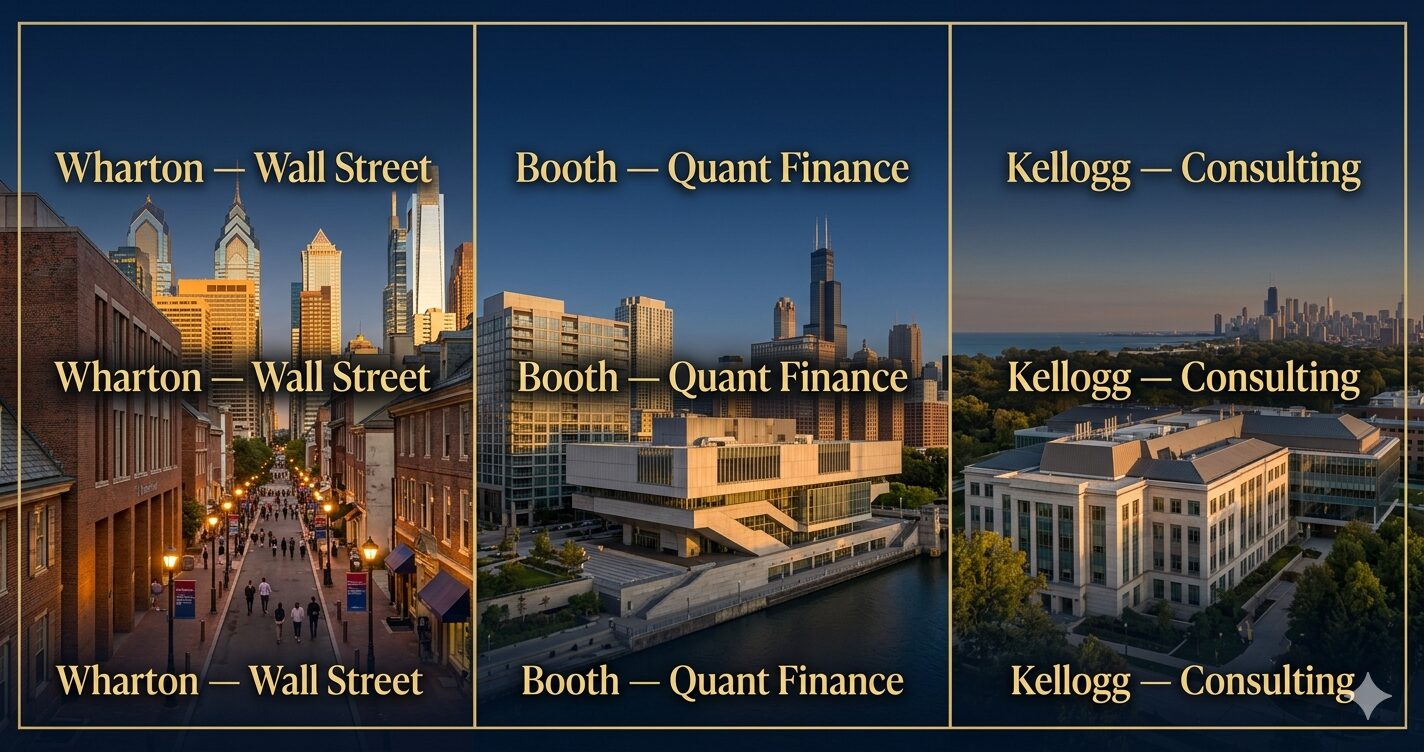
But applicants often misunderstand how different these programs actually are. Wharton is fundamentally a finance-first ecosystem with unmatched Wall Street scale. Booth is intensely analytical and deeply respected in quantitative finance circles. Kellogg dominates consulting culture and collaborative leadership development. Those distinctions affect recruiting outcomes, internship access, peer competition, alumni behavior, classroom style, and long-term network value. This guide compares all three directly — not from a rankings perspective, but from the perspective that actually matters: which school gives you the highest probability of reaching your target career outcome?
1. Why These Three Schools Define the M7 Finance Debate
Among elite MBA programs, Wharton, Booth, and Kellogg occupy a unique position because they combine large class sizes, deep recruiter relationships, strong alumni density, consistent finance placement, and broad career flexibility. Unlike smaller programs, these schools feed multiple industries simultaneously at scale. That matters because MBA recruiting is partly statistical — larger pipelines create stronger recruiter familiarity and more alumni pull.
Wharton sends massive numbers into investment banking and private equity. Booth maintains one of the strongest reputations in analytical finance and asset management. Kellogg consistently dominates consulting placement while still maintaining strong finance access. Applicants often assume rankings differences between these schools matter heavily. In practice, recruiter perception among top employers is extremely close. Nobody at Goldman Sachs thinks Wharton is elite but Booth isn't. Nobody at McKinsey & Company treats Kellogg as materially weaker than Wharton. The differences emerge in specialization and culture.
These schools also attract different applicant personalities. Wharton tends to attract highly ambitious finance-oriented candidates comfortable with competitive environments. Booth often attracts analytically driven applicants who prefer intellectual independence over heavily social cultures. Kellogg draws more collaborative and leadership-oriented candidates, especially those interested in consulting or team-heavy leadership roles. The best fit depends less on rankings and more on your personality, target industry, learning style, tolerance for competition, and long-term network priorities.
2. Wharton: The Wall Street Feeder School
If your primary goal is high finance, Wharton School remains the strongest pure finance MBA in the world. That reputation is not marketing hype — it's structural. Wharton's scale in finance recruiting is difficult to replicate because of massive alumni representation on Wall Street, long-standing recruiter pipelines, a large finance-focused student population, extensive finance curriculum depth, and geographic proximity to New York.
Wharton consistently sends large numbers of graduates into investment banking, private equity, hedge funds, asset management, venture capital, and growth equity. The school's alumni network inside firms like Goldman Sachs, JPMorgan Chase, Blackstone, and KKR is enormous. That density matters because MBA recruiting is relationship-driven even when formalized. Wharton also benefits from self-selection: students entering the program often already have finance backgrounds, which strengthens recruiter confidence and internship conversion rates.
But that creates a tradeoff — competition can become extremely intense. At Wharton, you are surrounded by former bankers, PE associates, hedge fund analysts, consultants, and startup operators with elite resumes. For some students, that environment is energizing. For others, it becomes exhausting. Academically, Wharton remains broad rather than purely quantitative, with popular finance strengths including PE/VC coursework, real estate finance, distressed investing, capital markets, entrepreneurship through acquisition, and fintech.
| Best For | Less Ideal For |
|---|---|
| Investment banking | Applicants wanting low-pressure culture |
| Private equity | Students avoiding finance competition |
| Hedge funds | Highly non-quant candidates |
| High-finance networking | Applicants seeking small cohorts |
3. Booth: The Quantitative Finance Powerhouse
Chicago Booth occupies a very different niche from Wharton despite similar rankings. Booth's reputation is built around intellectual rigor and analytical credibility. Among finance professionals, Booth carries unusually strong respect in investment management, quantitative finance, hedge funds, asset pricing, and economics-heavy finance roles. This reputation comes partly from the school's historical connection to the Chicago economics tradition.
Booth students are often highly analytical, independent, and intellectually self-directed. The culture is less polished socially than Kellogg and less aggressively prestige-oriented than Wharton. Booth's flexibility is another major advantage: unlike many MBA programs with lockstep structures, Booth allows students substantial control over course sequencing, academic intensity, and specialization depth. Students targeting finance can build extremely technical academic paths. Booth performs exceptionally well in asset management, research-heavy investing, quant-oriented finance, corporate finance, and restructuring.
Chicago's financial ecosystem supports strong recruiting into Goldman Sachs, JPMorgan Chase, elite hedge funds, proprietary trading firms, and investment management firms. The city remains heavily connected to trading, derivatives, market-making, industrial finance, and Midwestern corporate leadership. One underrated advantage of Booth is reduced social pressure — students often describe the environment as intellectually intense but less performative. However, that culture can also feel less cohesive socially compared to Kellogg.
| Best For | Less Ideal For |
|---|---|
| Quantitative finance | Applicants wanting highly social culture |
| Hedge funds | Candidates uncomfortable with academic rigor |
| Investment management | Students seeking structured environments |
| Corporate finance | Heavy leadership-development focus |
4. Kellogg: The Consulting and Leadership MBA
Kellogg School of Management is frequently misunderstood by finance applicants. Many candidates incorrectly assume Kellogg is "only" a consulting school. That's inaccurate. Kellogg absolutely dominates consulting placement, but it also maintains strong finance recruiting pipelines — especially in investment banking, corporate finance, strategy roles, fintech, and growth-oriented investing.
The school's defining characteristic is collaborative leadership culture. Kellogg places enormous emphasis on teamwork, communication, interpersonal effectiveness, and leadership development. That culture aligns extremely well with consulting recruiting. As a result, firms like McKinsey & Company, Boston Consulting Group, and Bain & Company recruit heavily from Kellogg every year. The school consistently produces some of the strongest MBB placement numbers in the MBA market.
Kellogg's finance outcomes are solid but less finance-dominated culturally than Wharton or Booth. At Kellogg, you are less likely to feel like every conversation revolves around private equity recruiting or hedge fund compensation. The school also tends to attract candidates with stronger interpersonal orientation: consultants, marketers, operators, product managers, and military officers. Kellogg's Evanston location supports consulting recruiting and Midwestern corporate leadership but lacks the immediate Wall Street immersion of New York programs.
| Best For | Less Ideal For |
|---|---|
| Consulting | Pure hedge fund recruiting |
| Leadership development | Hyper-competitive finance culture |
| Team-oriented candidates | Deep quant specialization |
| Corporate strategy | Applicants wanting NYC proximity |
5. Head-to-Head: Curriculum and Finance Specialization
All three schools provide elite finance education, but they approach it differently. Wharton offers the broadest dedicated finance ecosystem overall — you can specialize deeply across nearly every finance vertical including PE, VC, real estate, credit, restructuring, and entrepreneurship finance. Booth provides the strongest technical rigor; students interested in modeling, pricing, economics, and quantitative analysis often prefer Booth's intellectual environment. Kellogg's curriculum is comparatively leadership-oriented — finance students still receive excellent technical preparation, but the broader emphasis remains on management, teams, communication, and organizational leadership.
| Category | Wharton | Booth | Kellogg |
|---|---|---|---|
| IB Placement | Extremely strong | Very strong | Strong |
| Consulting Placement | Strong | Very strong | Elite |
| Median Salary | ~$190K | ~$185K | ~$185K |
| Median GMAT | ~733 | ~729 | ~731 |
| Tuition & Fees | ~$175K+ | ~$170K+ | ~$170K+ |
| Class Size | Large (~875) | Large (~620) | Large (~560) |
| Location Advantage | NYC access | Chicago finance ecosystem | Chicago consulting ecosystem |
Another distinction is grading and classroom culture. Booth students often describe classes as highly analytical and debate-driven. Wharton classes can feel professionally competitive and recruiter-focused. Kellogg classes tend to emphasize collaboration and group dynamics more heavily. These differences shape daily MBA life more than applicants expect.
6. Recruiting Access: Which School Opens Which Doors
Recruiting outcomes at elite MBA programs are not equal across all industries.
Investment Banking
Wharton remains the strongest overall banking feeder because of alumni scale, NYC proximity, recruiter volume, and finance concentration. Booth remains extremely strong, especially for restructuring, industrials, asset management, and trading-oriented finance. Kellogg places well into banking but sends a smaller percentage of the class there overall.
Private Equity
Private equity recruiting remains heavily network-based. Wharton's PE alumni network is probably unmatched outside Harvard. Booth also performs strongly in hedge funds, investment management, and buy-side finance. Kellogg has solid PE outcomes but is less dominant in mega-fund recruiting.
Consulting
Kellogg's consulting culture and alumni density make it one of the strongest MBB pipelines globally. Both Booth and Wharton also place heavily into McKinsey & Company, Boston Consulting Group, and Bain & Company — but Kellogg's collaborative reputation aligns particularly well with consulting recruiting.
Corporate Finance and Strategy
Booth performs strongly because of analytical credibility. Kellogg performs strongly because of leadership orientation and corporate relationships. Wharton graduates often self-select away from corporate finance toward higher-paying finance roles.
7. Class Culture and Network: The Differences That Matter
Applicants consistently underestimate how important culture becomes during the MBA experience. Two years is a long time. The social environment affects friendships, recruiting stress, networking comfort, and emotional sustainability.
Wharton's culture is ambitious and highly career-focused. Students often describe the environment as energetic, competitive, high-achieving, and finance-heavy. For some people, that creates extraordinary motivation and networking access. For others, it becomes emotionally draining. Booth's culture is more intellectually individualistic — students tend to care less about status signaling and more about analytical competence. The atmosphere is often described as thoughtful, low-ego, academically serious, and independent.
Kellogg has the strongest reputation for social cohesion. Students often describe collaborative recruiting, strong peer support, active social life, and highly team-oriented culture. This distinction matters especially during recruiting: consulting recruiting at Kellogg often feels highly collaborative, while banking recruiting at Wharton can feel more competitive internally because many classmates pursue similar goals.
Alumni behavior also differs. Wharton's alumni network is massive and influential. Booth's network is deeply respected in finance circles, particularly among analytical investors. Kellogg's alumni network tends to be unusually responsive and relationship-oriented. None of these cultures are objectively better — they fit different personalities.
8. Cost, Scholarships, and ROI Comparison
All three programs are extremely expensive in 2026. Estimated total MBA cost including tuition, housing, travel, and opportunity cost often exceeds $250K–$350K+. That makes ROI analysis essential.
| School | Estimated Total Cost | Typical Post-MBA Median Compensation |
|---|---|---|
| Wharton | $300K+ | $190K+ |
| Booth | $285K+ | $185K+ |
| Kellogg | $285K+ | $185K+ |
Wharton often produces the highest upside outcomes because of stronger PE placement, banking concentration, and buy-side access. Booth performs exceptionally well for investment management, hedge funds, and analytical finance. Kellogg tends to produce slightly broader distributions because more students enter consulting and corporate leadership.
Scholarships vary heavily based on demographics, industry background, competing offers, test scores, and diversity priorities. Booth is often viewed as somewhat more merit-scholarship aggressive than Wharton. Kellogg also uses scholarships strategically to compete for consulting-oriented candidates. Applicants leaving PE, hedge funds, or investment banking face much higher forgone income than applicants from engineering or nonprofit backgrounds, which changes the economics substantially.
9. Who Should Choose Wharton, Booth, or Kellogg?
There is no universally "best" school among these three. The best school depends on your career target, personality, learning style, and recruiting priorities.
Choose Wharton if…
You are highly focused on investment banking or private equity, you want maximum Wall Street alumni density, you thrive in ambitious competitive environments, you care about broad finance optionality, and you want the strongest overall finance brand. Wharton is the safest high-finance bet.
Choose Booth if…
You are deeply analytical, you care about quantitative rigor, you are interested in hedge funds or investment management, you prefer intellectually independent cultures, and you value flexibility over structured leadership programming. Booth is often the strongest fit for finance purists.
Choose Kellogg if…
You are targeting consulting, you value collaborative culture, you want strong leadership development, you prefer team-oriented environments, and you want broad corporate strategy flexibility. Kellogg is often the best long-term leadership development environment.
At this level, fit matters more than rankings noise. All three schools can get you interviews at Goldman Sachs, JPMorgan Chase, McKinsey & Company, and Blackstone. But your experience, network strength, and recruiting success often improve dramatically when the culture actually matches your personality. That's the difference applicants discover too late.
- Wharton remains the strongest overall MBA program for investment banking and private equity recruiting
- Booth offers the deepest analytical finance reputation and strongest fit for quantitative finance candidates
- Kellogg dominates consulting placement and collaborative leadership development
- NYC proximity gives Wharton a major Wall Street networking advantage, while Chicago supports strong finance and consulting ecosystems
- The best MBA choice depends less on rankings and more on your target industry, personality, and preferred recruiting culture