MBA Job Placement Rates in 2026: Which Programs Actually Get You Hired
- 1. Why MBA Placement Data Is Often Misleading
- 2. The Metrics That Actually Matter
- 3. Top MBA Programs Ranked by Finance Placement Rate 2026
- 4. Investment Banking Placement: Which Schools Dominate Wall Street
- 5. Consulting Placement: McKinsey, BCG, Bain — Who Places Most
- 6. Tech and Corporate Strategy: The Growing Alternative
- 7. Median Salaries 3 Months After Graduation by School
- 8. Regional Differences: NYC vs. Chicago vs. Bay Area
- 9. How to Use Placement Data When Choosing Your MBA Program
MBA employment reports are designed to market schools, not help applicants compare risk. The important question is not whether graduates eventually get jobs — it's who gets the best jobs, how fast they get them, and how many students quietly miss the outcomes advertised on the brochure.
MBA employment reports look impressive on the surface. Schools regularly advertise placement rates above 90%, median salaries above $175,000, and recruiter relationships with firms like Goldman Sachs, McKinsey & Company, Google, and Blackstone.
But raw placement numbers can be misleading. A school reporting "95% employed within three months" does not necessarily mean:
- Graduates landed their target industries
- International students had equal outcomes
- Compensation was evenly distributed
- Students secured offers quickly
- Recruiting markets remained strong across all sectors
In 2026, MBA applicants are increasingly focused on return on investment. Tuition at top US MBA programs now regularly exceeds $250,000 all-in once living expenses and opportunity cost are included. That changes the calculation dramatically. Applicants no longer just ask "Can this school get me a job?" They ask: "Can this school get me the specific career outcome I'm paying for?"
This distinction matters because placement strength varies heavily by industry, geography, alumni density, economic cycles, international hiring conditions, and employer pipelines. This guide breaks down what MBA placement data actually means, which schools dominate specific industries, and how applicants should interpret employment reports realistically instead of emotionally.
1. Why MBA Placement Data Is Often Misleading (and How to Read It)
Most employment reports emphasize headline metrics: employment rate, median salary, signing bonus, and top employers. These numbers are useful, but incomplete. The biggest issue is that schools report aggregate outcomes rather than distribution quality.
For example, a school may report a median salary of $190,000 while quietly placing only a small percentage into elite investment banking or consulting firms. Similarly, employment reports often blur distinctions between:
- Internships vs full-time offers
- Domestic vs international placement
- Sponsored vs non-sponsored students
- Elite firms vs mid-market employers
Timing also matters. Schools typically measure outcomes three months after graduation. That can obscure candidates who struggled initially but found jobs later. Economic conditions matter even more. Between 2021 and early 2023, MBA hiring was exceptionally strong. By 2024 and 2025, consulting firms slowed hiring while technology recruiting weakened substantially. Finance remained relatively resilient, but placement became more uneven across schools.
Applicants should also understand how schools classify outcomes. "Consulting" may include Tier-2 firms, implementation consulting, or boutique strategy firms. "Finance" may include corporate finance roles, not just investment banking or private equity. "Technology" can include operations or sales roles, not necessarily product management. Employment reports are marketing documents first and analytical comparisons second. That's why applicants need to focus on deeper metrics.
2. The Metrics That Actually Matter: What to Look For
Applicants evaluating MBA placement outcomes should focus on five core indicators.
1. Industry-Specific Placement Strength
A school may rank highly overall while underperforming in your target field. Columbia Business School is exceptionally strong for investment banking, Kellogg School of Management consistently dominates consulting, and MIT Sloan performs strongly in technology and analytics. General rankings often hide these distinctions.
2. Time to Offer
Fast recruiting pipelines reduce career risk. Schools with deeply established recruiting ecosystems tend to generate earlier internship and full-time offers. That matters significantly during weaker hiring cycles.
3. Employer Concentration
You should look at repeat recruiters rather than one-off placements. A school sending dozens of graduates annually to Goldman Sachs, Morgan Stanley, McKinsey & Company, Boston Consulting Group, and Bain & Company is fundamentally different from a school occasionally placing one or two students there.
4. Geographic Access
Location strongly affects recruiting density. New York programs naturally dominate Wall Street recruiting. Chicago schools maintain strong Midwestern corporate pipelines. Bay Area schools benefit from technology ecosystems.
5. International Student Outcomes
This is the least transparent but increasingly important metric. Some schools maintain stronger employer sponsorship ecosystems than others. International students often face materially different recruiting outcomes, especially in consulting and tech. Applicants should evaluate placement reports with skepticism but not cynicism. The numbers matter — you just need to interpret them properly.
3. Top MBA Programs Ranked by Finance Placement Rate 2026
Finance placement remains one of the clearest differentiators among top MBA programs. While many schools place graduates into finance broadly defined, only a smaller group consistently feeds elite investment banking, private equity, and buy-side recruiting at scale.
| School | IB Placement % | Consulting % | Tech % | Median Salary | Avg. Time to Offer |
|---|---|---|---|---|---|
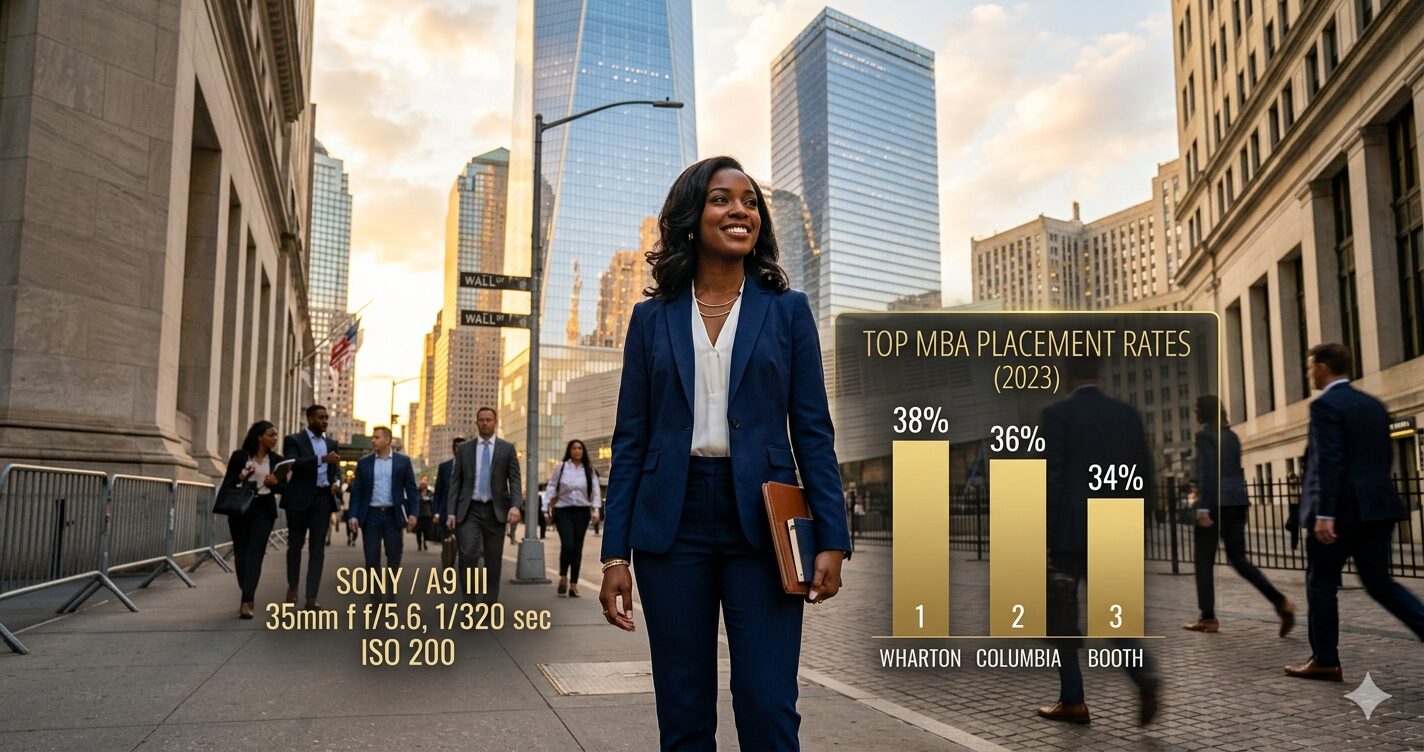
| Wharton | 38% | 24% | 14% | $190K | 2–3 months |
| Columbia | 36% | 21% | 13% | $190K | 2–3 months |
| Chicago Booth | 34% | 26% | 15% | $185K | 2–4 months |
| Harvard | 22% | 28% | 20% | $190K | 2–4 months |
| Kellogg | 18% | 37% | 18% | $185K | 2–4 months |
| MIT Sloan | 16% | 27% | 26% | $185K | 2–5 months |
| NYU Stern | 32% | 19% | 16% | $180K | 2–4 months |
| Georgetown McDonough | 21% | 24% | 12% | $165K | 3–5 months |
These figures are based on publicly available employment reports combined with observed recruiting trends from 2025 and early 2026. Finance recruiting remains highly concentrated geographically. Wharton School, Columbia Business School, and New York University Stern School of Business maintain especially strong finance pipelines because of direct New York access.
Even traditionally finance-heavy schools now send larger percentages into corporate strategy, technology, AI infrastructure, fintech, and operations leadership. The modern MBA market is much less banking-dominated than it was fifteen years ago.
4. Investment Banking Placement: Which Schools Dominate Wall Street
Investment banking remains one of the most structured MBA recruiting industries. Banks hire associates through highly organized internship pipelines, making MBA programs critically important entry points. The schools dominating Wall Street recruiting in 2026 — Wharton School, Columbia Business School, Chicago Booth, and New York University Stern School of Business — consistently place graduates into Goldman Sachs, Morgan Stanley, and JPMorgan Chase.
Wall Street recruiting remains heavily relationship-driven despite formal processes. That's why alumni density matters so much. At schools like Columbia and Wharton, students interact directly with alumni bankers throughout the recruiting cycle. Those relationships improve interview access significantly.
A school placing 35% into investment banking may have strong self-selection toward finance, recruit heavily from former bankers, offer stronger technical preparation, or maintain long-standing alumni dominance. This is why applicants should evaluate not just placement percentages but also candidate backgrounds. For career changers, banking placement strength matters even more because structured recruiting reduces transition risk.
Banks increasingly prefer converting summer associates rather than hiring externally. Schools with stronger internship conversion pipelines provide more stability during uncertain hiring cycles. Typical 2026 investment banking associate compensation: base salary $175K–$225K, bonus $100K–$175K, with total compensation reaching $275K–$400K+.
5. Consulting Placement: McKinsey, BCG, Bain — Who Places Most
Consulting placement remains one of the clearest indicators of overall MBA recruiting strength. Unlike banking, consulting firms recruit from broader backgrounds: engineers, military officers, physicians, product managers, nonprofit leaders, and corporate operators. This makes consulting especially attractive for career changers.
The strongest consulting pipelines in 2026 remain concentrated at Kellogg School of Management, Harvard Business School, Chicago Booth, and MIT Sloan. MBB firms — McKinsey & Company, Boston Consulting Group, and Bain & Company — still dominate elite consulting recruiting.
However, hiring slowed materially during 2024 and parts of 2025 because of reduced corporate strategy spending and over-hiring during earlier years. That slowdown revealed an important difference: top-tier MBA programs maintained recruiting resilience better than lower-ranked programs. Kellogg continued placing heavily into consulting despite slower hiring, while mid-tier programs saw significantly weaker MBB conversion rates.
Consulting compensation remains strong: base salary $190K–$220K, signing bonus $30K–$40K, and performance bonus $20K–$40K. One emerging trend is specialization — technology strategy, AI implementation, healthcare transformation, and operations consulting are growing rapidly, favoring candidates with prior domain expertise rather than pure generalists.
6. Tech and Corporate Strategy: The Growing Alternative
The biggest structural shift in MBA employment over the past decade has been the growth of technology and corporate strategy roles. Historically, banking and consulting dominated MBA recruiting. Today, many students deliberately avoid both industries.
Even after technology hiring slowdowns during 2023–2025, companies such as Google and Amazon remain major MBA employers. Corporate strategy has also expanded substantially across healthcare, manufacturing, fintech, AI infrastructure, energy, and enterprise software. This trend benefits candidates seeking better work-life balance, lower burnout risk, long-term operational leadership, and geographic flexibility.
Schools like MIT Sloan and Harvard Business School perform particularly well in these hybrid leadership pathways. Compensation in corporate strategy remains lower than investment banking but still highly competitive: base salary $150K–$210K, bonus/equity $25K–$100K+, with total compensation reaching $180K–$300K+. Equity upside becomes especially important at technology companies and growth-stage firms.
Unlike banking, corporate strategy recruiting often occurs throughout the year rather than through narrow internship windows. That flexibility can help students pivot industries during the MBA rather than committing immediately.
7. Median Salaries 3 Months After Graduation by School
Salary data remains one of the most visible MBA outcome metrics, but median salary does not reflect equity compensation, carry potential, long-term upside, geographic cost differences, or international compensation adjustments. Still, salary comparisons provide useful directional insight.
| School | Median Base Salary | Typical Signing Bonus | High-End Outcomes |
|---|---|---|---|
| Harvard | $190K | $35K | PE/HF roles exceed $400K |
| Wharton | $190K | $35K | Strongest finance upside |
| Columbia | $190K | $30K | Heavy banking concentration |
| Booth | $185K | $30K | Strong finance + consulting |
| Kellogg | $185K | $30K | Consulting-heavy distribution |
| MIT Sloan | $185K | $30K | Strong tech/equity upside |
| NYU Stern | $180K | $25K | Strong Wall Street access |
| Georgetown McDonough | $165K | $20K | DC corporate/government mix |
Salary dispersion at top MBA programs is massive. A graduate entering private equity, hedge funds, or elite investment banking may earn dramatically more than classmates entering corporate leadership programs, nonprofit management, or public sector strategy. Median figures compress these differences heavily. Applicants should focus more on target industry placement, employer access, alumni networks, and long-term trajectory rather than salary numbers alone.
8. Regional Differences: NYC vs. Chicago vs. Bay Area Outcomes
Geography shapes MBA outcomes more than rankings discussions usually acknowledge.
New York Ecosystem
New York remains the dominant center for investment banking, private equity, hedge funds, corporate law, and financial services consulting. Schools with strongest NYC access — Columbia Business School, New York University Stern School of Business, and Wharton School — benefit from frequent networking events, semester-time interviews, dense alumni presence, and easier informational meetings.
Chicago Ecosystem
Chicago remains exceptionally strong for corporate finance, investment management, consulting, and industrials banking. Chicago Booth and Kellogg School of Management benefit heavily from deep Midwestern corporate relationships. Chicago also tends to provide slightly lower living costs than New York or San Francisco, which matters during MBA programs.
Bay Area Ecosystem
The Bay Area dominates technology leadership, product management, venture capital, AI infrastructure, and startup ecosystems. MIT Sloan and West Coast schools maintain stronger access to these industries. However, technology recruiting became more volatile after 2023 layoffs. Applicants should understand that tech placement can fluctuate more dramatically than banking or consulting. Location does not determine your career outcome entirely, but proximity still matters because recruiting remains relationship-driven.
9. How to Use Placement Data When Choosing Your MBA Program
Most applicants use rankings incorrectly. General MBA rankings matter less than industry fit, recruiting strength, geographic access, alumni density, and career-switching support.
If your goal is investment banking, placement percentages into Wall Street firms matter more than overall academic reputation. If your goal is consulting, MBB pipelines matter more than broad employment rates. Applicants should also think probabilistically. The real question is not "Can someone from this school get my target job?" The correct question is: "How consistently does this school place candidates like me into that role?" That distinction matters enormously for career changers, international students, and nontraditional applicants.
During weaker hiring cycles, elite schools maintain recruiter relationships better, strong alumni networks matter more, and internship conversion rates become critical. This is why placement consistency matters more than isolated high-end outcomes. Every school occasionally places graduates at elite firms like Blackstone. The important question is how repeatable those outcomes actually are.
Ultimately, the best MBA program is not necessarily the highest-ranked one. It's the school that maximizes your probability of achieving your specific career goal with acceptable financial risk.
- MBA employment reports often hide important differences in industry quality, geographic access, and recruiting consistency
- Wharton, Columbia, Booth, and NYU Stern remain among the strongest schools for investment banking placement
- Kellogg, Harvard, Booth, and MIT Sloan continue to dominate consulting pipelines into McKinsey, BCG, and Bain
- Technology and corporate strategy roles are growing alternatives to traditional banking and consulting pathways
- Applicants should evaluate MBA programs based on target industry placement strength and alumni pipelines rather than rankings alone