Is an MBA Still Worth It in the Age of AI? (2026 Honest Answer)
- 1. The Question Everyone Is Asking Right Now
- 2. What AI Is Actually Replacing in Finance
- 3. What AI Cannot Replace (Yet)
- 4. The MBA Network Advantage Has Never Been More Valuable
- 5. MBA ROI in 2026: The Real Numbers
- 6. When an MBA Is Worth It in 2026
- 7. When an MBA Is NOT Worth It in 2026
- 8. The Verdict: MBA + AI Skills = The Strongest Profile of 2026
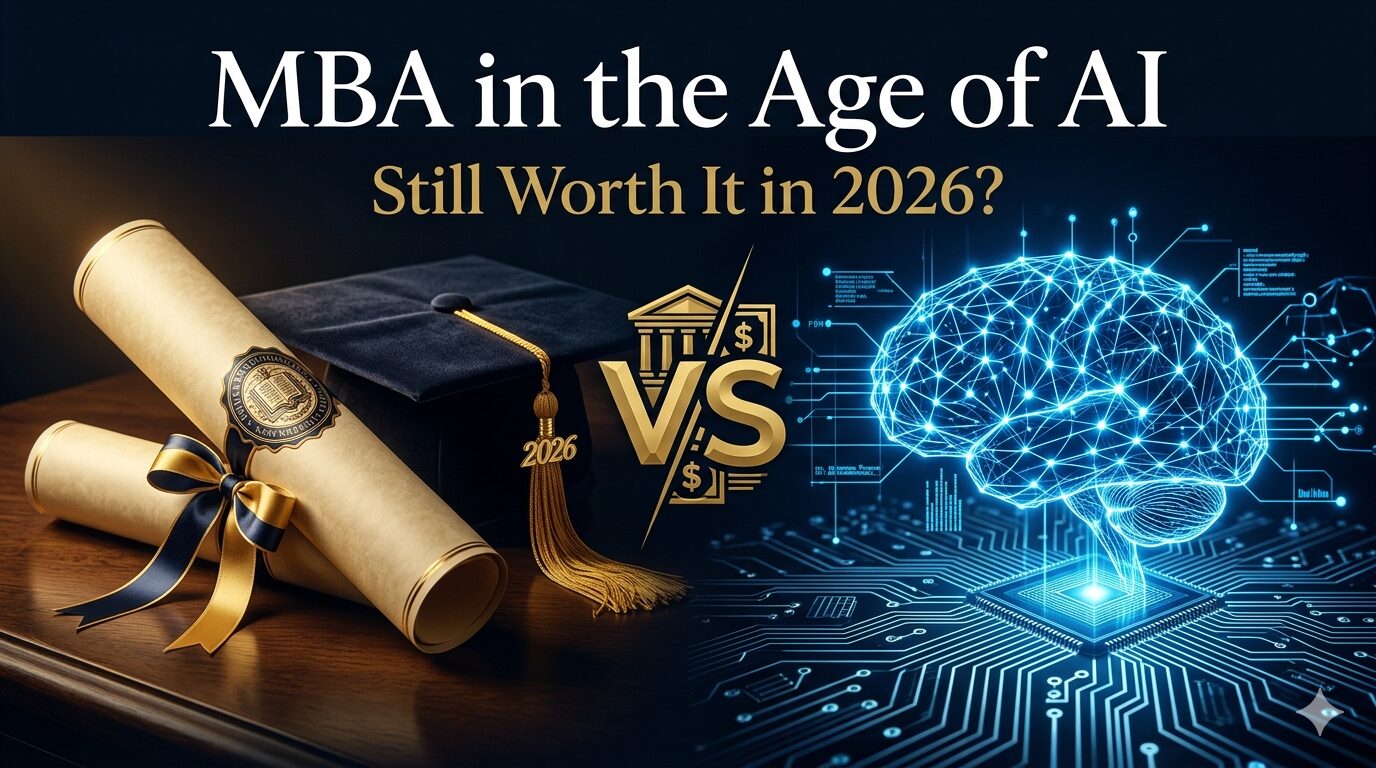
The rise of AI has triggered a genuine crisis of confidence among prospective MBA students. If ChatGPT can write a memo, build a financial model, and summarize an earnings call in seconds, what exactly are $200,000 and two years of your life buying you? It is a legitimate question — and one that deserves a direct, data-grounded answer rather than reassuring platitudes from business school admissions offices. The honest 2026 answer is nuanced: AI is meaningfully changing what finance professionals do, but the career credentials, network access, and leadership development that a top MBA provides have become more valuable, not less, in an AI-accelerated world.
AI is reshaping finance workflows — but the humans directing those workflows still need judgment, relationships, and institutional credibility. That is exactly what a top MBA is designed to build.
1. The Question Everyone Is Asking Right Now
In 2026, every prospective MBA student is confronting the same uncomfortable question: does a $200,000+ degree still make sense when AI tools can perform many of the analytical tasks that used to require years of expensive education? The anxiety is real, but it is also somewhat misdirected. AI is automating tasks — specific, repeatable, data-processing tasks. It is not automating careers, judgment, relationships, or organizational credibility. Understanding the difference is critical to making a rational decision about graduate business education.
The MBA's value proposition has always rested on three pillars: skills, network, and credential. AI is affecting the first pillar at the margins — certain technical tasks are becoming easier. But the credential and network pillars are completely unaffected by AI adoption, and if anything, they are becoming more valuable as the supply of AI-proficient workers grows and employers increasingly differentiate based on leadership capacity and institutional trust rather than technical execution alone.
The right question is not whether AI replaces the MBA. The right question is whether an MBA still provides a sufficient return on a $200k+ investment for your specific career goals. For investment banking, private equity, consulting, and corporate leadership tracks, the answer in 2026 remains yes — with important caveats about program selection and career fit.
2. What AI Is Actually Replacing in Finance
AI is genuinely automating a meaningful portion of the work that junior finance professionals once performed manually. Document review, data extraction from financial statements, first-draft financial model construction, earnings call transcription and summarization, covenant compliance checking in credit agreements — these tasks are being partially or fully automated across investment banks, PE firms, and asset managers. Junior analysts at bulge-bracket banks are reporting that AI tools now handle work that previously consumed 30-40% of their working hours.
This is real and consequential. But it is important to recognize what this automation actually means for MBA value: it means that the lower-level analytical grunt work that used to justify hiring large analyst classes is shrinking. Firms need fewer people doing data entry and first-pass modeling. They need more people who can interpret, contextualize, advise, and lead — which is precisely the skill set that MBA programs are designed to develop. The automation of junior-level tasks does not make the MBA irrelevant; it makes the judgment and leadership development that MBAs provide more valuable at the margin.
3. What AI Cannot Replace (Yet)
There are entire categories of high-value finance work that AI cannot perform in 2026 and is unlikely to perform well for many years. Client relationship management requires trust, emotional intelligence, and institutional credibility that no language model can credibly replicate. Deal negotiation involves real-time reading of human psychology, power dynamics, and organizational politics. Investment thesis development at the highest level requires the synthesis of qualitative judgment with quantitative analysis in ways that remain fundamentally human. Managing teams through uncertainty, communicating complex ideas to boards, structuring novel deal terms — these are all deeply human activities.
Leadership, in particular, is an area where AI has essentially no footprint. PE portfolio company CEOs, investment committee chairs, and managing directors at major banks are not being replaced by AI — they are using AI to make their existing teams more productive. The people in those senior roles came through MBA programs, not because the MBA taught them Python, but because it taught them how to operate credibly in high-stakes institutional environments. That skill is completely orthogonal to what AI does.
4. The MBA Network Advantage Has Never Been More Valuable
The MBA alumni network argument has always been made by business schools, and it has always been somewhat overstated in marketing materials. But in 2026, the network component of a top MBA is genuinely undervalued by prospective students. As AI compresses the technical skill differentials between candidates — if everyone can build a DCF in minutes using AI tools, the technical moat shrinks — what differentiates candidates increasingly comes down to relationships, referrals, and institutional trust.
Harvard, Wharton, and Booth graduates are not getting hired at Goldman Sachs and Blackstone because they learned financial modeling in business school. They are getting hired because alumni already inside those firms vouch for them, because recruiters have 30-year relationships with those schools, and because the credential signals a specific level of institutional selectivity that firms use as a proxy for candidate quality. AI does nothing to undermine this dynamic — if anything, it intensifies it, because the credential becomes a more important signal when technical skills are increasingly commoditized.
The practical implication is that the MBA network compounds over a career in ways that are difficult to quantify at the time of enrollment but become unmistakably clear by year ten. Board seats, LP relationships, senior hiring decisions, and strategic partnership introductions disproportionately flow through MBA alumni networks. That advantage is completely unaffected by the rise of AI language models.
5. MBA ROI in 2026: The Real Numbers
| Program | Total Cost | Avg Post-MBA Salary | Break-Even |
|---|---|---|---|
| Harvard HBS | $230,000 | $175,000 | 3–4 years |
| Wharton | $225,000 | $172,000 | 3–4 years |
| Chicago Booth | $215,000 | $165,000 | 3–4 years |
| Kellogg | $210,000 | $158,000 | 4–5 years |
| Yale SOM | $200,000 | $150,000 | 4–5 years |
These numbers tell a clear story for candidates targeting finance, consulting, and leadership tracks: the break-even is 3-5 years, and the 10-year net present value of the investment is substantially positive for most M7 graduates who pursue the right career paths. The salary premium from a top MBA over a non-MBA career trajectory at the same starting point typically runs $50,000-$100,000 per year in finance — a premium that compounds significantly over a 20-year career. For a full program-by-program comparison, see our guide on Harvard MBA vs. Wharton MBA for Finance careers. The ROI math has not fundamentally changed in 2026.
6. When an MBA Is Worth It in 2026
An MBA is clearly worth it in 2026 for several specific profiles. Career switchers moving into investment banking, private equity, or management consulting from unrelated fields almost always need an MBA from a target school — there is no other credible pathway into these careers at the post-analyst level without the institutional credential. Candidates targeting senior leadership roles in corporate finance, strategy, or general management benefit enormously from the MBA's combination of credential signaling and network development. International candidates looking to break into the US finance market use M7 MBAs as the primary mechanism for obtaining recruiting access that would otherwise be completely unavailable to them.
The strongest 2026 candidates are those who combine MBA credentials with genuine AI competency — not the ability to use ChatGPT, but the ability to integrate AI tools into financial workflows, evaluate AI-generated analysis critically, and build processes that leverage AI while retaining human judgment at decision points. Programs like Wharton, Booth, and MIT Sloan are actively incorporating AI education into their curricula, which increases the value of attending specifically those programs for candidates who want both credentials.
7. When an MBA Is NOT Worth It in 2026
The MBA is not worth it for everyone. Candidates who already have strong recruiting access to their target role — software engineers at top tech companies, for example, or finance professionals already in PE or hedge funds — often find that the opportunity cost of two years out of the workforce, plus $200k in tuition and foregone income, does not justify the credential. The MBA is a tool for gaining access and making career transitions; if you do not need either, the financial case weakens considerably.
Candidates targeting roles where the MBA credential is not a meaningful differentiator should also think carefully. Technical roles in quantitative finance, systematic trading, and data science increasingly value advanced degrees in mathematics, statistics, or computer science over business education. And entrepreneurs who are already building companies rarely benefit from the two-year interruption that a full-time MBA requires, particularly when alternative credentials and accelerator networks are available without the full program cost.
8. The Verdict: MBA + AI Skills = The Strongest Profile of 2026
The honest 2026 verdict is this: a top MBA remains one of the highest-ROI educational investments available for candidates targeting finance, consulting, and leadership careers — but only from programs with genuine recruiting power and alumni network depth. AI has not changed this calculation in any fundamental way. What it has changed is the adjacent skill set that the strongest candidates bring alongside their MBA credential. The MBA graduate who also understands how to deploy AI tools in financial workflows, evaluate AI-generated analysis, and lead AI-augmented teams is meaningfully more valuable than the MBA graduate who treats AI as a threat rather than a tool.
The MBA application cycle for 2027 entry will be competitive regardless of what AI does to individual tasks. If you are targeting Goldman Sachs, Blackstone, McKinsey, or a top corporate leadership role, the credential from a top-8 program is still the most reliable path to that outcome. The question is not whether to get an MBA in the age of AI — it is whether your target program has the recruiting relationships, alumni network, and curriculum quality to justify the investment. For Harvard, Wharton, Booth, Kellogg, and their M7 peers, the answer remains yes.
- AI is automating finance tasks, but not replacing high-level careers
- Human skills like leadership and negotiation remain extremely valuable
- Top MBA programs still provide powerful recruiting access and alumni networks
- MBA ROI remains strong for IB, consulting, PE, and leadership careers
- The strongest 2026 candidates combine MBA credentials with AI skills