MBA vs Master in Finance 2026: Which Degree Gets You to Wall Street Faster?
- 1. Two Paths, One Destination — Which Is Right for You?
- 2. What Is a Master in Finance (MFin)?
- 3. What Is an MBA?
- 4. Head-to-Head Comparison
- 5. Investment Banking: Which Degree Wins?
- 6. For Quantitative Finance and Trading
- 7. The Cost-Benefit Reality in 2026
- 8. Which Should You Choose? A Decision Framework
- 9. Top Programs for Each Path in 2026
Two graduate degrees dominate the conversation for candidates targeting Wall Street: the MBA and the Master in Finance. They serve overlapping but distinct audiences, and choosing the wrong one for your profile and career goals can cost you years of time and six figures in avoidable tuition. The decision is more nuanced in 2026 than it has ever been — because the MBA is evolving to compete more directly with specialized finance degrees, while top MFin programs are expanding their recruiting relationships to reach employers that once recruited exclusively from MBA programs.
The MBA and the MFin are not interchangeable. One is designed for career changers and future leaders. The other is designed for technically minded recent graduates who want deep finance specialization fast. Your choice should start with honest self-assessment about where you are, not where you want to end up.
1. Two Paths, One Destination — Which Is Right for You?
Both the MBA and the Master in Finance can lead to careers at investment banks, PE firms, asset managers, and hedge funds. But they get there via completely different mechanisms, serve different candidate profiles, and create different types of institutional capital. The MBA is a generalist leadership credential that happens to open specific finance doors through its recruiting network. The MFin is a specialized technical degree that provides deep quantitative finance training and increasingly strong placement at specific finance employers — particularly in technical and quantitative roles.
The most common mistake candidates make is treating this as a prestige comparison — asking which degree is "better" — rather than a fit question: which degree is right for my specific experience level, financial situation, and target career path? A recent college graduate targeting a quant trading role at Jane Street is almost certainly better served by a Princeton MFin than a Harvard MBA. A career-changer with five years in consulting who wants to move into PE is almost certainly better served by a Wharton MBA. The degree that matches your situation produces a dramatically better return than the nominally more prestigious degree that does not.
2. What Is a Master in Finance (MFin)?
The Master in Finance is a specialized graduate degree focused on advanced financial theory, quantitative methods, and technical finance skills. Top programs include Princeton's Bendheim Center MFin, MIT Sloan's Master of Finance, London Business School's Master in Finance, and HEC Paris's Master in Finance. These programs typically run 10-16 months and admit students with limited professional experience — often directly from undergraduate programs or with one to three years of work experience. The curriculum is heavily quantitative: derivatives pricing, fixed income analysis, portfolio theory, financial econometrics, and risk management are core components.
The MFin is not a watered-down MBA. At programs like Princeton and MIT, it is a rigorous, mathematically demanding degree that prepares students for roles that require genuine quantitative depth. Graduates enter investment banking sales and trading, quantitative research, risk management, and increasingly asset management roles where analytical sophistication is the primary differentiator. The credential is well understood by sophisticated financial employers and is treated with significant respect in quantitative and trading-oriented hiring contexts.
3. What Is an MBA?
The MBA is a two-year general management degree with broad applicability across industries and functions. Unlike the MFin, it is explicitly designed for candidates with meaningful professional experience — typically 3-7 years — who want to either change careers or dramatically accelerate their trajectory in their existing field. The MBA curriculum covers finance, marketing, operations, leadership, strategy, and organizational behavior. At M7 programs, the finance elective catalog is genuinely deep, but the foundation is breadth and leadership development rather than technical finance specialization.
The MBA's primary mechanism for creating career outcomes is its recruiting ecosystem, not its curriculum. The on-campus recruiting relationships that Harvard, Wharton, Booth, and Kellogg maintain with Goldman Sachs, McKinsey, Blackstone, and their peers are the core product being purchased. A Wharton MBA graduate entering investment banking is not competing on technical superiority over MFin graduates — they are entering through a recruiting channel that is specifically reserved for MBA students from target programs, with different interview formats, offer timelines, and expectations.
4. Head-to-Head Comparison
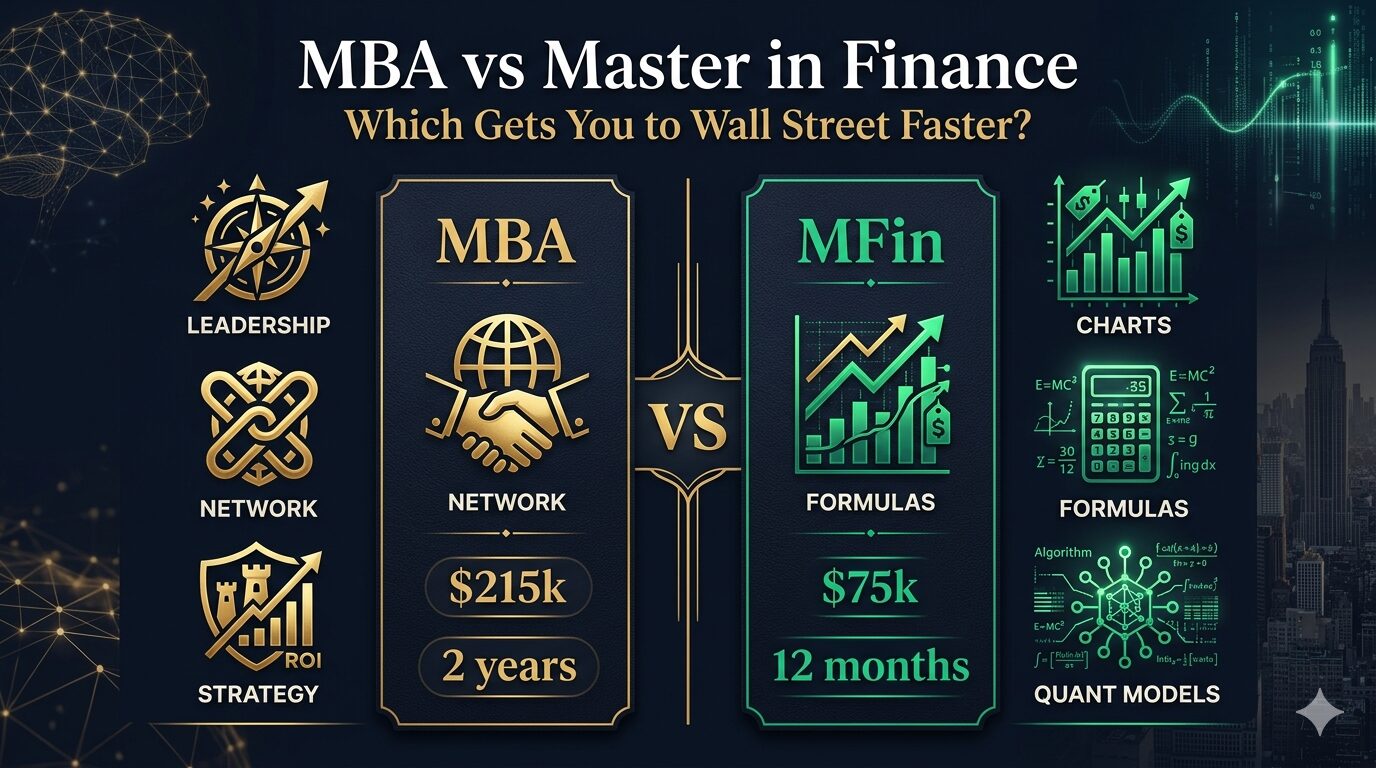
| Factor | MBA | Master in Finance |
|---|---|---|
| Duration | 2 years | 10–12 months |
| Total Cost | $200k–$230k | $60k–$90k |
| Work Exp Required | 3–7 years | 0–3 years |
| Curriculum Focus | Broad / Leadership | Technical / Quant |
| Network Size | Very large | Smaller, specialized |
| IB Recruiting Access | Strong at M7 | Moderate |
| PE / VC Access | Strong | Limited |
| Best For | Career switchers | Recent graduates |
| ROI Timeline | 3–5 years | 1–2 years |
The cost differential is the most striking data point for most candidates: a top MFin costs roughly one-quarter to one-third of a top MBA. For candidates who do not need the MBA's career-switching mechanism, network breadth, or institutional credential, the financial case for the MFin is very strong. The ROI timeline reflects this — MFin graduates typically recover their investment in 1-2 years because the degree is shorter, cheaper, and they enter the workforce sooner. MBA graduates break even in 3-5 years despite higher post-degree salaries because the investment is so much larger.
5. Investment Banking: Which Degree Wins?
For traditional investment banking — mergers and acquisitions, capital markets, leveraged finance — the MBA from an M7 program is the dominant pathway at the associate level. Bulge-bracket banks maintain formal on-campus recruiting programs at Harvard, Wharton, Booth, Kellogg, Columbia, and MIT Sloan that produce a substantial fraction of their associate-class hiring. MFin graduates can enter investment banking, but typically at the analyst level rather than the associate level, and with more limited access to the most prestigious banking franchises through campus recruiting alone.
The distinction matters because associate versus analyst is not just a title difference — it is a different career trajectory, different compensation level, and different set of exit opportunities. MBA associates at Goldman Sachs earn substantially more than MFin analysts in their first year, and the exit opportunity set into PE and hedge funds is stronger from the associate level. For candidates who specifically want investment banking at the senior associate level from day one, the M7 MBA remains the clearer path in 2026.
6. For Quantitative Finance and Trading
The MFin's advantage is clearest in quantitative finance and systematic trading. Firms like Citadel, Two Sigma, DE Shaw, Jane Street, and Bridgewater are not primarily recruiting MBA graduates for their quantitative research and trading desks — they are recruiting candidates with deep mathematical and statistical foundations who can build and validate models. Princeton MFin graduates, MIT MFin graduates, and candidates from top European programs like LBS and HEC Paris compete directly with PhD candidates from top mathematics and statistics programs for these roles.
An MBA, even from Harvard or Wharton, does not create a comparable technical credential for quantitative roles. MBA finance courses build financial intuition and analytical frameworks, but they do not develop the stochastic calculus, time series econometrics, and statistical modeling depth that quant roles require. Candidates who know they want to work in systematic strategies, quant research, or derivatives structuring should strongly consider the MFin over the MBA — it is a better credential for that specific outcome and costs dramatically less to obtain.
7. The Cost-Benefit Reality in 2026
The financial math is straightforward but often underweighted by applicants caught up in prestige comparisons. A Harvard MBA costs approximately $230,000 in tuition and fees plus $60,000-$80,000 in living expenses and foregone income — bringing the total economic cost close to $500,000 over the two-year program. A Princeton MFin costs roughly $70,000 in tuition, takes one year, and involves minimal foregone income for candidates who enroll directly from undergraduate or with only a year or two of work experience. The difference in total economic cost is staggering.
For this difference to be justified by the MBA, the credential needs to produce meaningfully higher lifetime earnings than the MFin — and for many career paths, it does. But the calculation is only favorable for the MBA when it opens doors that are genuinely closed without it: the M7 recruiting channel into PE, the network compounding that produces board seats and LP relationships, and the career-switching mechanism for candidates who cannot otherwise access their target role. When none of these apply, the MFin's financial efficiency is compelling.
8. Which Should You Choose? A Decision Framework
Choose the MFin if: you are within 0-3 years of undergraduate graduation, you are targeting technical finance roles in trading or quant research, you cannot or do not want to spend $200k+ on a degree, you are confident in your career direction and do not need a two-year exploratory period, or your target employers actively recruit from top MFin programs. The MFin is also the right choice if your undergraduate institution was not a target school and you want to establish a new institutional affiliation quickly and cost-efficiently.
Choose the MBA if: you are making a significant career switch into a field that requires institutional credentialing, you have 4-7 years of experience and want to dramatically compress your timeline to senior roles, your primary goal is the alumni network and recruiting access rather than curriculum content, you are targeting PE, VC, or consulting at the post-MBA associate level, or you want a broader leadership credential that remains relevant across multiple career pivots over a 30-year career. The MBA's flexibility across career paths is a genuine advantage that the MFin cannot provide.
9. Top Programs for Each Path in 2026
For the MBA, the M7 programs — Harvard, Wharton, Booth, Kellogg, MIT Sloan, Columbia, and Stanford GSB — remain the clear tier-one choice for finance careers. See our in-depth look at the Wharton MBA curriculum and our Harvard vs. Wharton comparison to understand what differentiates the top two finance-focused programs. Below the M7, Tuck, Haas, Stern, Darden, and Yale SOM offer strong finance recruiting, particularly for regional or sector-specific roles. The prestige hierarchy within the MBA world is well understood by employers and matters enormously for the most competitive roles at the most selective firms.
For the MFin, the leading programs in 2026 include Princeton Bendheim, MIT Sloan MFin, LBS Master in Finance, HEC Paris Master in Finance, Vanderbilt Owen MS Finance, and Brandeis IBS. In the US context, Princeton and MIT are the clear tier-one programs with the strongest employer relationships in quantitative finance. European MFin programs are particularly well-regarded for candidates targeting European financial centers — London, Paris, and Frankfurt — and for international students who want to return to their home markets with a globally recognized technical credential.
- MBA and MFin target very different career stages and goals
- MFin programs are shorter, cheaper, and more technical
- MBA provides stronger access to IB, PE, consulting, and leadership roles
- Quant finance and trading often favor MFin candidates
- Best choice depends on experience, finances, and long-term goals